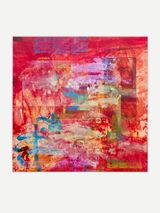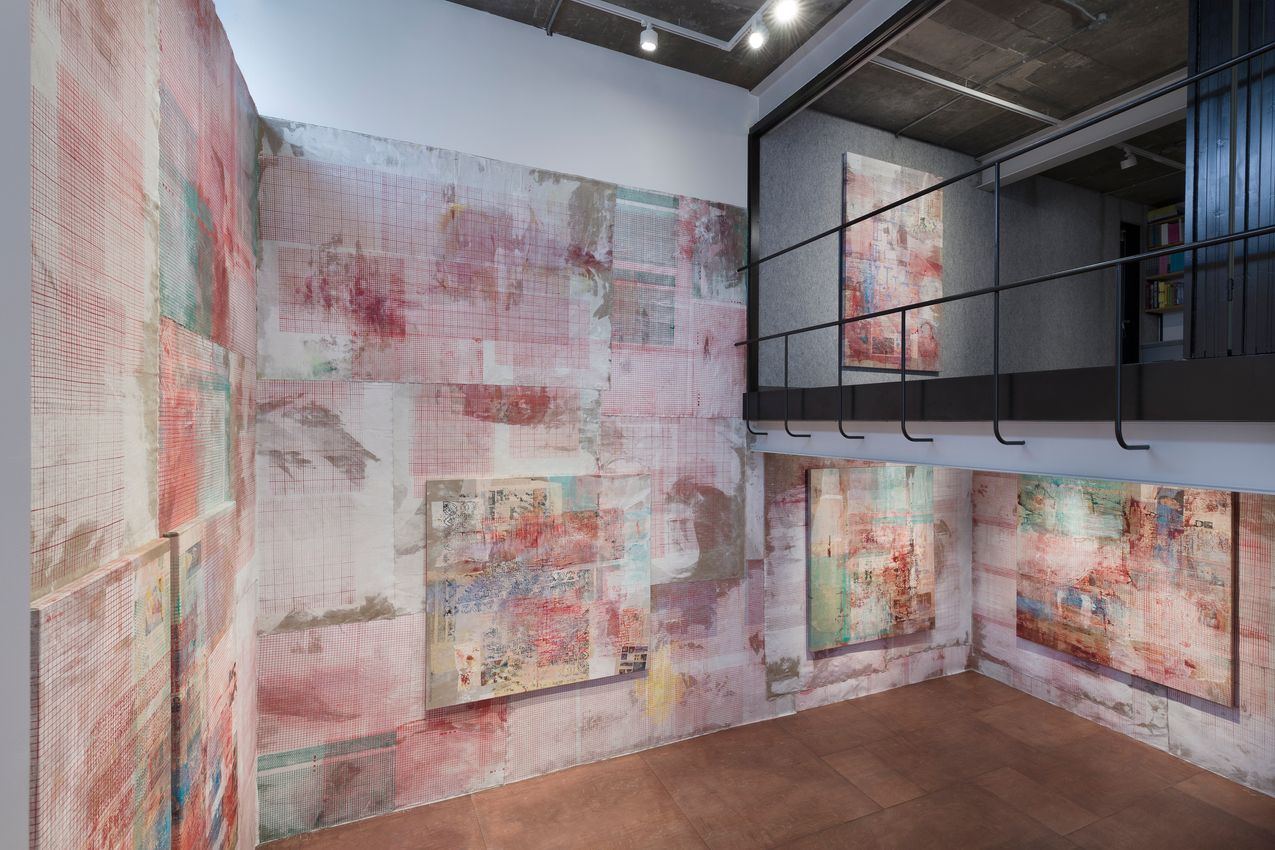
Lehmann Maupin Seoul is pleased to present Protective Inscriptions, an exhibition of new work by London-based artist Mandy El-Sayegh, whose practice reflects the fractured nature of communication, knowledge, and identity. Adapting elements of psychoanalysis within a formal aesthetic, El-Sayegh investigates the body as a site of cultural rupture, linguistic entropy, and mutated meaning. ‘I’m interested in this idea of lost time and the impossibility of finding a moment of origin,’ states El-Sayegh, ‘My work builds fragmented histories into absurdist bodies and forms.’ The artist’s first solo exhibition in Seoul, Protective Inscriptions will feature an immersive installation, combining painting and soundscape to activate a formless language of flesh and vibration.
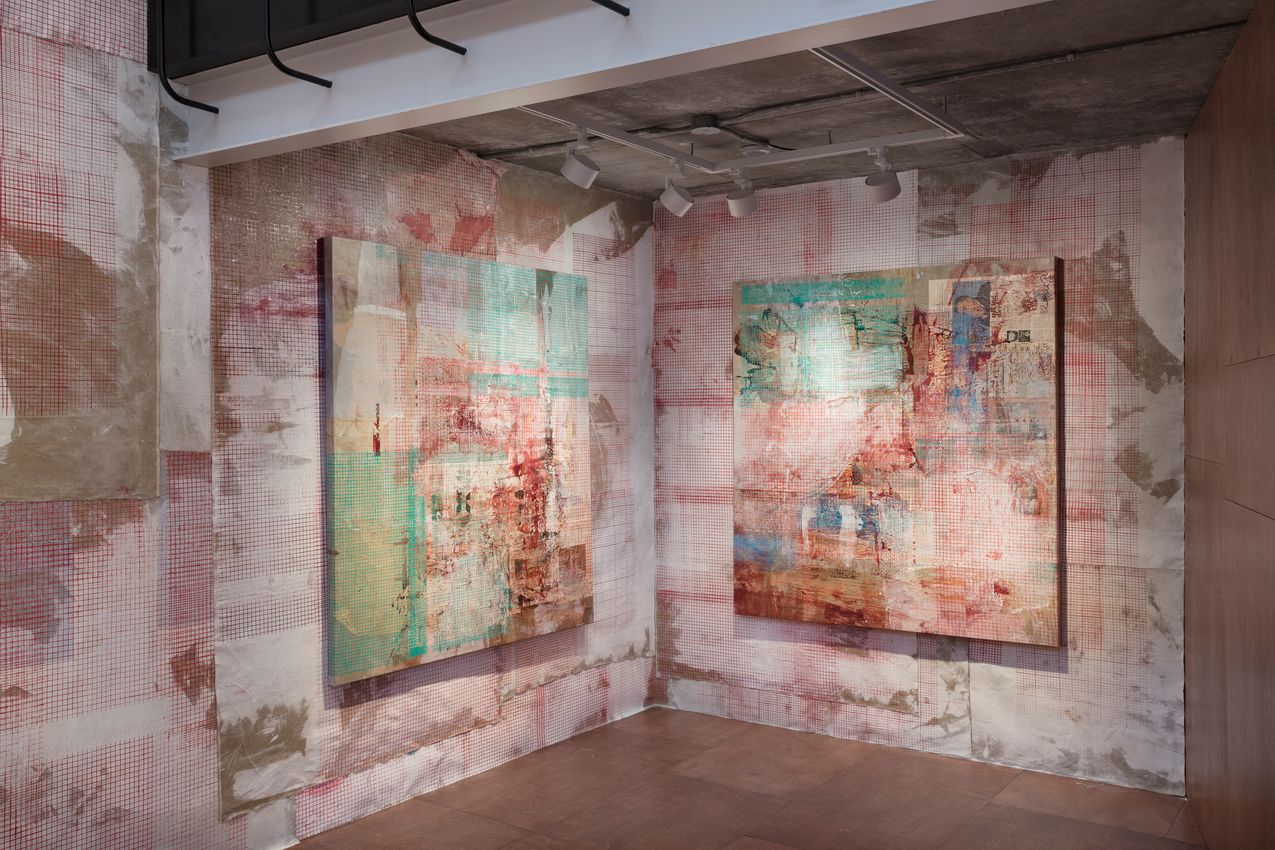
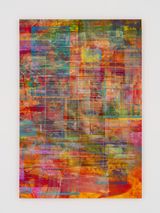
For this exhibition, El-Sayegh has created a skin of unstretched canvases that wraps the walls of the gallery, overlaid with a new suite of ‘Net-Grid’ paintings. A continuation of the artist’s ongoing ‘Net-Grid’ series (begun in 2013), this installation offers insight into the method of their making. Created through the assemblage of material and overlaid with hand-painted grids, these works represent the process of trapping, distilling, and retaining information, capturing both intended meaning and happenstance associations. Beneath each clean, schematic exterior lies a bruised surface that evokes wounded flesh. This dense material layering is echoed in the accompanying sound work, which reverberates throughout the space, breathing and vibrating in a low hum. Here, El-Sayegh’s dense red grids, intense layers of colour, and aural environment work in tandem to create a visceral experience that is both bodily and cerebral.
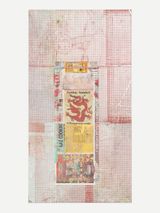
Drawing on the Buddhist idea of the nine stages of decomposition, El-Sayegh infuses each painting with interstices and flesh-like pigment that represent an ambiguous process, the direction of which (towards healing or towards decay) is deliberately obscured. Here, El- Sayegh’s grid becomes a protective sheath, a girdle holding the damaged tissue of the body together. In one painting, Net-Grid (Pratisara Dharani), El-Sayegh draws on traditional Buddhist woodblock prints, which were often printed on rice paper and worn on the body as a talisman for protection. This work is composed of layers of blue, red, and green pigment, combined with silk-screened images of a Buddhist print, the artist’s father’s calligraphy, Financial Times articles, muslin, and surgical gauze. A self-harm injury, referred to as dermatitis artefacta—a deliberate self-infliction of lesions—is carefully rendered, and is the only hand-painted element in Net-Grid (Pratisara Dharani) apart from the grid itself. The subtitle, Pratisara Dharani refers to the specific woodblock print that appears throughout, featuring the eight-armed Bodhisattva Mahapratisara in the centre surrounded by the dharani (Buddhist mantra), 33 ritual objects of esoteric Buddhism, mudras, and Bodhisattvas on lotus pedestals.
The soundscape, chalk, is inspired by Buddha Machines—small portable chanting devices used to aid in prayer and meditation. A collaboration with composer Lily Oakes, chalk layers sounds from disparate sources. It pulses through the body, activating a vibration that engages the senses in the act of looking, observing, and experiencing. The work is composed of ambient and industrial sound, bells, electronic music, and chanting. The layering process in chalk echoes the material and historical layering of El-Sayegh’s practice, in which she weaves together dislocated fragments from her own history, crafting them into an organic system, or body. The visual and auditory compositions in Protective Inscriptions deliberately confuse any defined order or interpretation. El-Sayegh leaves analysis open, remaining mindful of the potential for systems of categorization to tip over into prejudice or violence, or lead to the pathologization of difference. Indebted to the anti-taxonomical and the nonsensical, El-Sayegh’s Protective Inscriptions creates a space where dominant modes of meaning-making can be broken down and reimagined.
About the Artist
Mandy El-Sayegh (born in 1985, Malaysia; lives in London) received her BFA in 2007 from the University of Westminster, London, followed by her MFA in painting in 2011 from the Royal College of Art, London. Solo exhibitions of El-Sayegh’s work have been organised at the Sursock Museum, Beirut, Lebanon (2019); Bétonsalon, Paris, France (2019); Chisenhale Gallery, London, United Kingdom (2019); The Mistake Room, Guadalajara, Mexico (2018); and Carl Kostyál, London, United Kingdom (2017). She has been featured in various group exhibitions including Searching the Sky for Rain, Sculpture Center, Long Island City, NY (2019); Ecologies of Darkness, SAVVY Contemporary, Berlin, Germany (2019); Deterioro y Poder, Instituto de Vision, Bogota, Colombia (2018); Lessons in Agronomy, Sifang Art Museum, Nanjing, China (2017); Boundary Work, Sharjah Biennial 13: Tamawuj, Sharjah, United Arab Emirates (2017); Room Services (with Oscar Murillo and Yutaka Sone), New York Art Book Fair at MoMA PS1, New York, NY (2016); For Pete’s Sake, Carl Kostyál, Stockholm, Sweden (2016); Elizabeth House, Elizabeth House, London, United Kingdom (2011); Responsive Eye, London Gallery West, London, United Kingdom (2011); and RCA Painting Degree Show, Royal College of Art, London, United Kingdom (2011). El-Sayegh’s work is in public and private collections, including Collection Nicoletta Fiorucci Russo, London; and Start Museum, Shanghai, China. In 2017 El-Sayegh was shortlisted for the Max Mara Art Prize for Women in collaboration with the Whitechapel Gallery, London and was invited to participate in the Chisenhale Gallery Commissions Programme 2017–19, supported by the LUMA Foundation.
Mandy El-Sayegh (Born in 1985, Malaysia; lives in London) received her BFA in 2007 from the University of Westminster, London, followed by her MFA in painting in 2011 from the Royal College of Art, London. El-Sayegh has exhibited with The Mistake Room, Guadalajara, Mexico, (2018); Carl Kostyál, London (2017); Sharjah Biennial 13: Tamawuj, Sharjah, UAE ( 2017); and Carlos/Ishikawa, London (2016), among others.


Rachel Lehmann and David Maupin founded Lehmann Maupin in 1996. The gallery represents a diverse range of American artists, as well as artists and estates from across Europe, Asia, Africa, South America, and the Middle East. It has been instrumental in introducing numerous artists from around the world in their first New York exhibitions.

A respected voice in contemporary art discourse.
Focusing on ambitious storytelling and insightful art-world commentary. Ocula Magazine publishes in-depth interviews, critical essays and timely analysis on the artists, exhibitions and ideas driving the global art world.
Learn more about Ocula Magazine
Showcasing the best of the art world.
Ocula partners with galleries from around the world to highlight their artists, artworks and exhibitions. Gallery membership is by application and invitation, with each member vetted by an independent panel.
Learn more about Ocula Membership

Specialises in the sale of major artworks.
Led by a team with deep ties to the world’s leading auction houses, galleries and collectors. Ocula’s advisory team offers bespoke services to high-net-worth clients from around the world who are looking to acquire the best of contemporary and modern art.
Learn more about our team and services