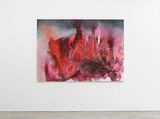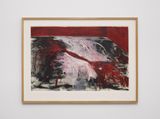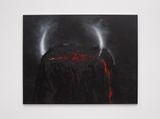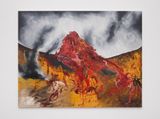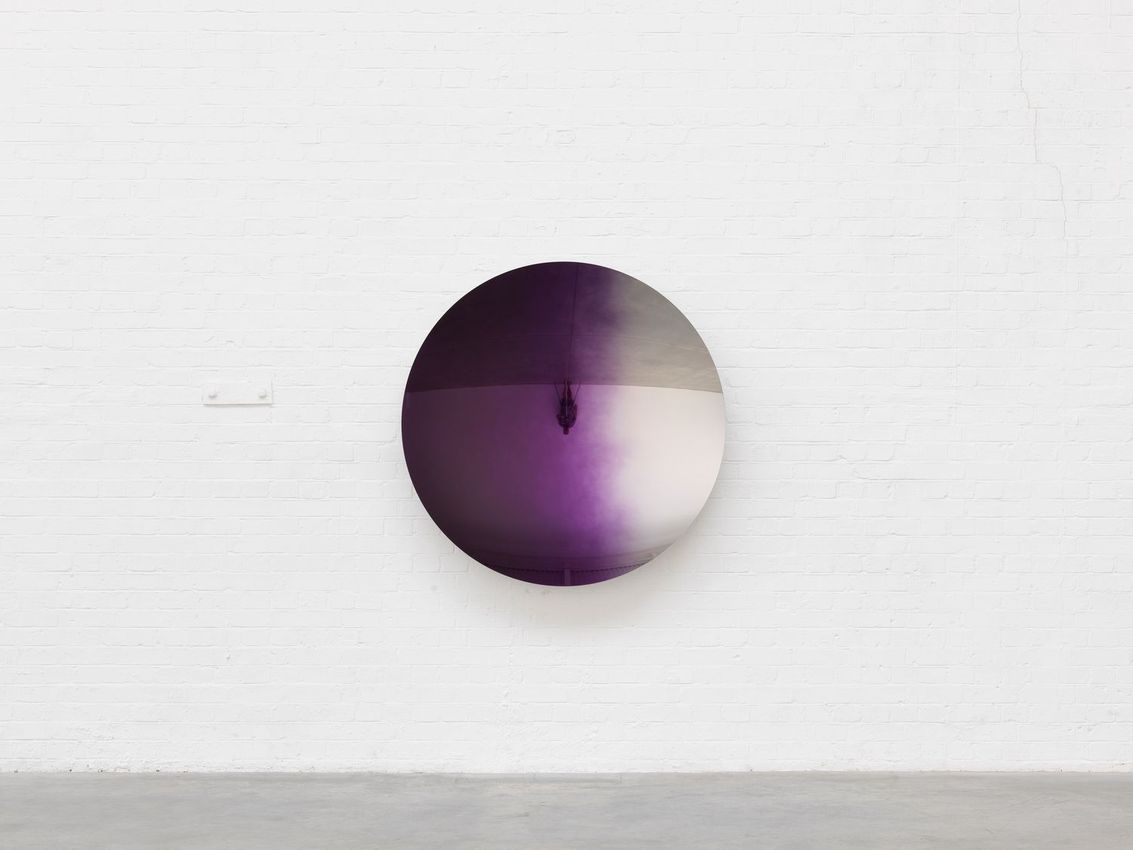
From 11 December – 11 January, Anish Kapoor presents a special exhibition of six concave mirror sculptures. Painted in shades of deep purple, displayed together they form a dynamic and transcendent environ that encompasses the viewer.
Through a deep-rooted impulse to experiment with the phenomenology of space, Kapoor’s oeuvre has long embraced the mirrored surface for its play with reflection and distortion, forcing the viewer to reassess their relationship to the stability of their own mirrored self in the world. Over the decades, these mirror works – as witnessed in this new body of semi-reflective, concave sculptures – have become increasingly painterly, embodying in them the artist’s own journey exploring the potential of painting through multiple mediums.
This series of works – including Wild Cherry, Magenta and Burple (2023), Clear to Purple (2024) and Dark Purple to Light Purple (2024) – fade subtly across shades of deep purple, creating a lyrical oscillation of colour that further emphasises or distorts the formal structure of the object and its reflection. The spiritual and magnetic quality of the colour derives from its existence as a horizon point; it sits between the opposing colours of blue (the source of black, the abyss and infinite heavenly sky) and red (the elemental shade of the internal, human and base). While much of Kapoor’s practice has been characterised by a powerful encounter with these two colours, the artist is now delving into the sublime meeting point of this hue, also associated with a sensation of other-worldliness, the magical and the spiritual, something just out of reach.
Kapoor has, through a committed and experimental practice since the 1980s, sought to explore and manipulate space in new ways. This has manifested in many forms: from monumental and ambitious public sculptures that inspire awe and wonder, to a suite of visceral, ethereal paintings that delve deep into the inner world of our mind and body. The mirrored, flawless concave surfaces subtly warp one’s perception of physical reality by reflecting light to pull the painted image from the traditional pictorial plane on the wall and projecting the focused image metres in front of the mirror, engrossing the viewer into a three-dimensional painterly landscape of colour.
“The interesting thing about a polished surface to me is that when it is really perfect enough it literally ceases to be physical; it levitates; it does something else, especially on concave surfaces...What happens to concave surfaces is in my view, completely beguiling. They cease to be physical and it is that ceasing to be physical that I’m after.” - Published in ’Past, Present, Future’, Institute of Contemporary Arts, Boston, 2008
The exhibition coincides with Kapoor’s first solo exhibition with Lisson Gallery Shanghai, Drawings, which runs until 25 January 2025. This exhibition features a series of recent gouache drawings on paper, focusing primarily on the void – a central motif for Kapoor – and the tensions between the inner and outer world, light and dark.
Anish Kapoor is one of the most influential sculptors of his generation. Perhaps most famous for public sculptures that are both adventures in form and feats of engineering, he manoeuvres between vastly different scales, across numerous series of work. Immense PVC skins, stretched or deflated; concave or convex mirrors whose reflections attract and swallow the viewer; recesses carved in stone and pigmented so as to disappear: these voids and protrusions summon up deep-felt metaphysical polarities of presence and absence, concealment and revelation. Forms turn themselves inside out, womb-like, and materials are not painted but impregnated with colour, as if to negate the idea of an outer surface, inviting the viewer to the inner reaches of the imagination. Kapoor’s geometric forms from the early 1980s, for example, rise up from the floor and appear to be made of pure pigment, while the viscous, blood-red wax sculptures from the last ten years – kinetic and self-generating – ravage their own surfaces and explode the quiet of the gallery environment. There are resonances with mythologies of the ancient world – Indian, Egyptian, Greek and Roman – and with modern times, where 20th century events loom large.


Established in 1967 in London, Lisson Gallery is one of the most well-known galleries operating globally. Boasting an influential and continuing legacy, including playing a pivotal role in the careers of many pioneers of historically important art movements, the gallery works with some of the most significant contemporary artists today.

A respected voice in contemporary art discourse.
Focusing on ambitious storytelling and insightful art-world commentary. Ocula Magazine publishes in-depth interviews, critical essays and timely analysis on the artists, exhibitions and ideas driving the global art world.
Learn more about Ocula Magazine
Showcasing the best of the art world.
Ocula partners with galleries from around the world to highlight their artists, artworks and exhibitions. Gallery membership is by application and invitation, with each member vetted by an independent panel.
Learn more about Ocula Membership

Specialises in the sale of major artworks.
Led by a team with deep ties to the world’s leading auction houses, galleries and collectors. Ocula’s advisory team offers bespoke services to high-net-worth clients from around the world who are looking to acquire the best of contemporary and modern art.
Learn more about our team and services