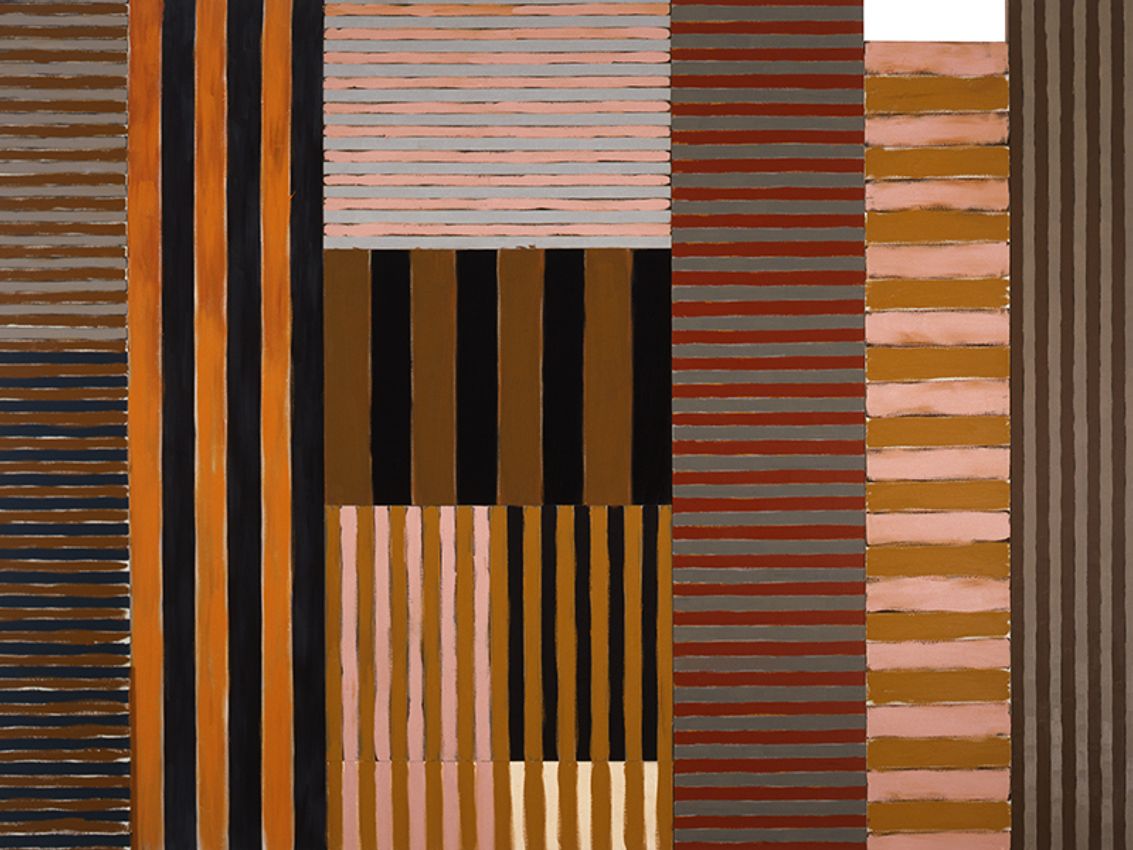
’They are very ‘New York’ paintings, but the city they evoke is not the foreigner’s imagined grid of perfect planes; rather it is gritty, heavy, slapped-together lower Manhattan, where Scully has his studio: the hoardings of warped plywood, the metal slabs patching the street.’ – Robert Hughes, ‘Earning His Stripes’, Time Magazine, 1989
Lisson Gallery is proud to mount an ambitious exhibition exploring one of Sean Scully‘s breakthrough bodies of work, incorporating loans of historic pieces from the early 1980s. They include a legendary, 11-panel work entitled Backs and Fronts, which was last exhibited in New York at MoMA PS1 in 1982, a year after it was made. This monumental composition was extended from an earlier work, known as Four Musicians (painted after Picasso’s Three Musicians of 1921), which Scully combined using reclaimed wooden struts, in the loft space of an old textile warehouse on Duane Street, in the then unfashionable and run-down neighbourhood of Tribeca.
Seven such constructions from this period, all made at the Duane Street studio, are included in this show, marking a significant break from Scully’s earlier, tighter striped canvases, as well as from the strictures of mainstream, hard-edged Minimalist painting of the 1970s. A tripartite work, Araby (1981), named after a short story by James Joyce, represents a midway point between his use of masking-taped lines and the removal of such aids in favour of more fluid gestures, leading Scully to describe this piece as being ‘in a fight with itself.’ This move, towards a freer, rougher and more architectural series, enabled him, as the artist has said himself, to slice and cut through the staid field of abstract art and allowed these works to literally ‘stand up for themselves’.
Another major work, Adoration (1982), the second-largest he made after Backs and Fronts, comprised nine conjoined elements, inserting or stacking canvases vertically, one on top of the other, in addition to a horizontally aligned and consecutively numbered sequence on either side. This title alludes to various Old Master versions of The Adoration of the Magi, among other art historical influences – from Van Gogh to William Blake – occupying Scully during this period, suggesting a figurative or emotional reading of the upright, human-scaled panels, with a Holy Family at its core. These assemblages were, however, resolutely looking forwards, as well as pushing the flat plane out into three dimensions, through portions of the paintings that overlapped or jutted out in relief. Blame (1983) begins this breaking of the rectangular picture plane with two dark-hued overhanging sections teetering over a sandier, candy-striped base.
While this series was variously hailed for its ambition, expression and scale by critics of the time, Scully was also introducing new elements including the first use of the inset canvas; in addition to novel techniques, including the shifting heights of neighbouring panels; as well as changes to his use of the striped motif – fluid gestures, mixed colour palettes – all of which still resonate in his practice to this day.
Scully’s sculptures are currently on show in ‘Broadway Shuffle’, a public trail of outdoor works organised by the Broadway Mall Association, until March 2025.
Sean Scully is one of the most important painters of his generation, whose work is held in major museum collections around the world. While known primarily for his large-scale abstract paintings, comprised of vertical and horizontal bands, tessellating blocks and geometrical forms comprised of gradated and shifting colours, Scully also works in a variety of diverse media, including printmaking, sculpture, watercolour and pastel. Having developed a style over the past five decades that is uniquely his own, Scully has cemented his place in the history of painting. His work synthesises a thoroughly international collection of influences and personal perspectives–ranging from the legacy of American abstraction, with inspiration from the likes of Mark Rothko and Jackson Pollock, and that of European tradition, with nods to Henri Matisse and Piet Mondrian, as well as references to classical Greek architecture. While monumental in scale and gesture, Scully’s work retains an undeniable delicacy and sincerity of emotion.


A respected voice in contemporary art discourse.
Focusing on ambitious storytelling and insightful art-world commentary. Ocula Magazine publishes in-depth interviews, critical essays and timely analysis on the artists, exhibitions and ideas driving the global art world.
Learn more about Ocula Magazine
Showcasing the best of the art world.
Ocula partners with galleries from around the world to highlight their artists, artworks and exhibitions. Gallery membership is by application and invitation, with each member vetted by an independent panel.
Learn more about Ocula Membership

Specialises in the sale of major artworks.
Led by a team with deep ties to the world’s leading auction houses, galleries and collectors. Ocula’s advisory team offers bespoke services to high-net-worth clients from around the world who are looking to acquire the best of contemporary and modern art.
Learn more about our team and services