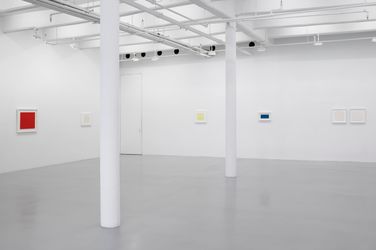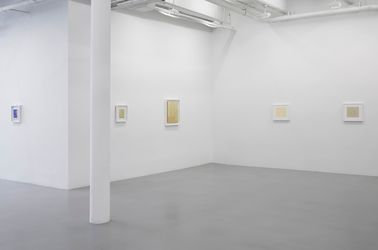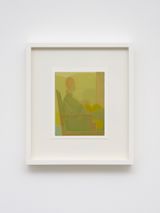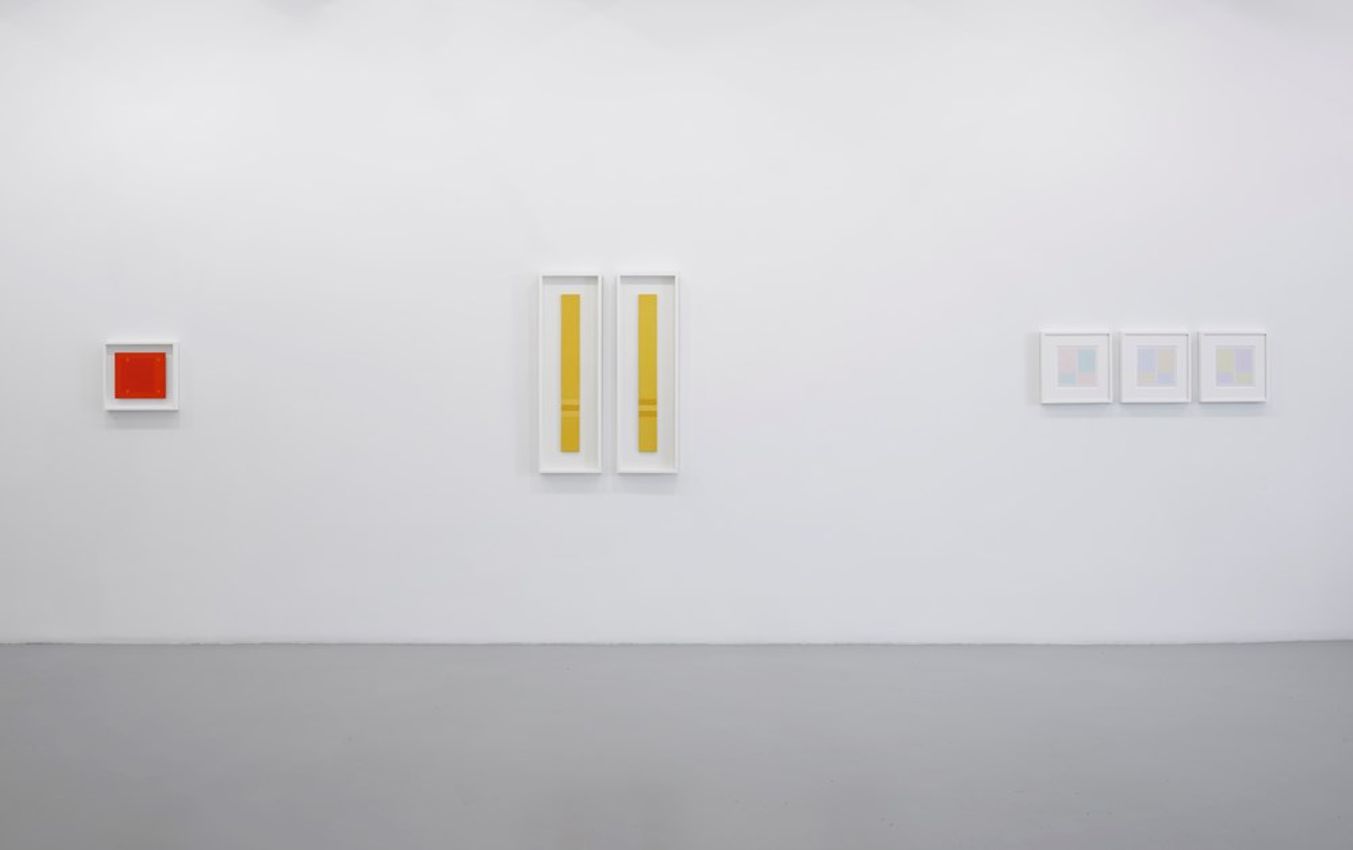
Lisson Gallery is staging the first ever solo exhibition in a New York gallery of post-war Italian Modernist painter Antonio Calderara (1903-1978). This introductory presentation spans the painter’s transition away from the official style of 1940s figuration towards his own unique mode of lyrical abstraction in the 1950s and ‘60s, partly influenced by the Metaphysical movement of Giorgio de Chirico and then informed by other artists based in Milan such as Lucio Fontana and Piero Manzoni. The show centres on Calderara’s predilection for ‘doubling’ or mirroring forms in his work, as seen in an early self-portrait, a canvas featuring twin girls with matching ponytails or in many of his later, vertically split geometric compositions.
The motif of the double can be seen in both the 1953 Autoritratto, featuring the artist’s doppelganger and a pair of Siamese cats impossibly reflected and refracted in a studio mirror, as well as in the 1957 double portrait entitled Noi (meaning ‘We’), featuring him and his wife, Carmela, superimposed on top of one another. While this was one of the last portraits Calderara made, he also stopped painting curved lines a year later, employing instead simple flat blocks, squares and lines of colour. Situated neither within Constructivist nor Minimalist movements, his pared-down vocabulary and precise measurements nevertheless positioned Calderara closely with other Modernist painters of the time, including Piet Mondrian and Josef Albers, both of whom the artist admired greatly.
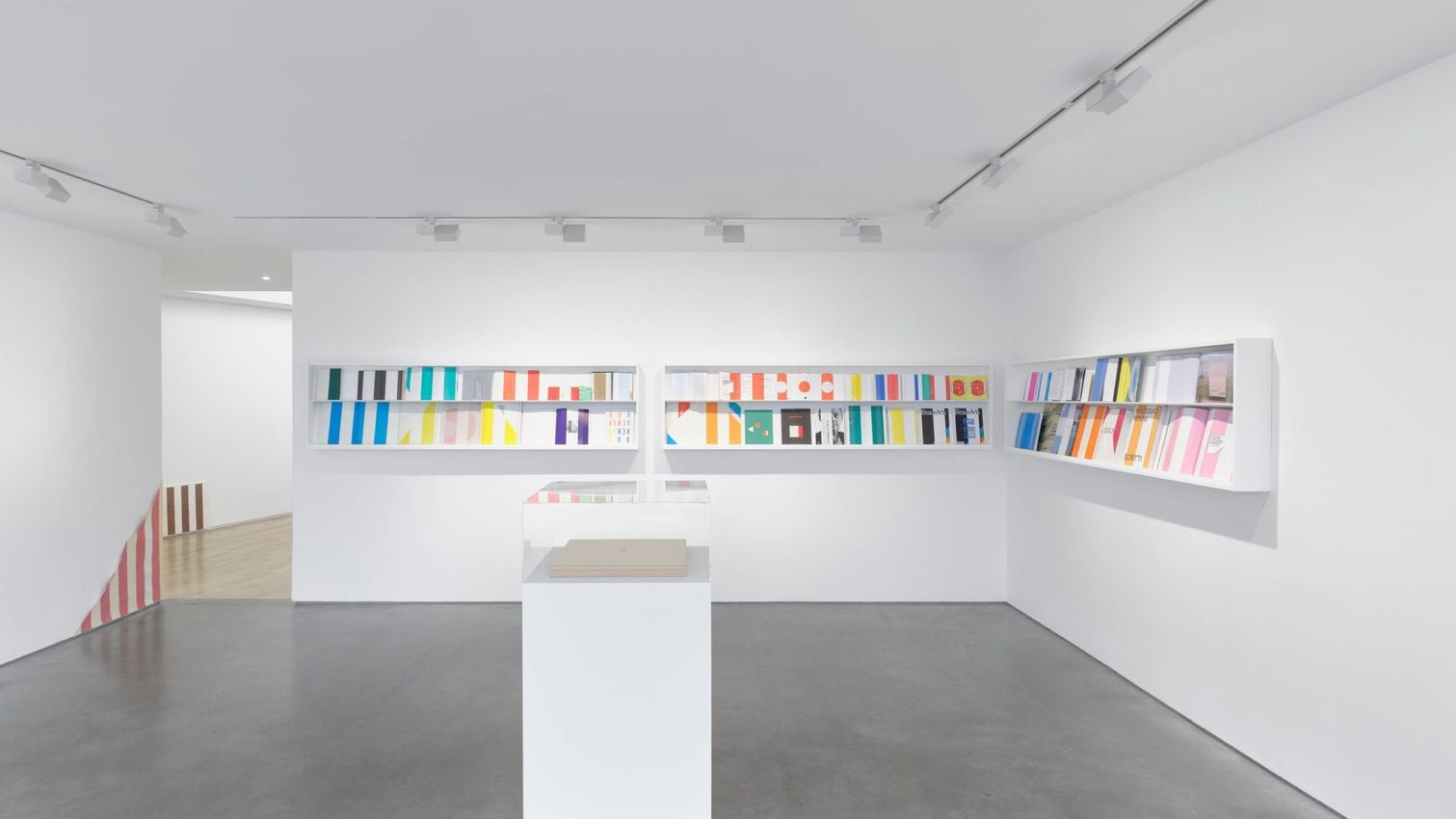
Among the later works produced during the 1960s and ‘70s, Calderara’s use of a single picture plane-across which the dual forms tend to share space on either side of a central division line, either real or imagined-now become fractured and begin to shatter into multiple panels, including one horizontally aligned series of chromatic variations from 1969-1971, which is split into 18 individual parts. The show is deliberately not hung in chronological progression, in order to highlight the constant reference and return to the duplication and doubling of images, instead relying on pairings or juxtapositions of works. A newspaper-inspired guide to the exhibition features a new essay by the show’s curator, Andreas Leventis, as well as archival reviews and photographs of Calderara at work and alongside his contemporaries.


Self-taught as a child growing up in Milan, and later mentored for a time by a young Lucio Fontana, the earliest influences of Antonio Calderara were of the figuration and light effects of Piero della Francesca, Seurat and the Milanese Novecento painters. After abandoning his university studies in engineering in 1925 the young man dedicated himself fully to experimenting with colour and form. Through portraiture, landscapes and still lifes, Calderara depicted the people, scenes and objects of his native Italy - all suffused by a delicate, misty light inspired by the atmospheric glow of Lake Orta in Vacciago, where the artist moved in 1934 with his wife Carmela, and where he would work for most of his life. By the mid-1950s, Calderara began to move away from figurative painting to embrace a more geometric approach, radically reducing both the scale and the compositional elements of his paintings through use of simple forms and flat blocks of nebulous and subtle colour. Situated neither within Constructivist nor Minimalist movements, his pared-down vocabulary of lines and squares, refined colour palette and precise measurements nevertheless positioned Calderara closely with other minimalist painters at the time, including Piet Mondrian and Josef Albers, both of whom the artist admired greatly.


Established in 1967 in London, Lisson Gallery is one of the most well-known galleries operating globally. Boasting an influential and continuing legacy, including playing a pivotal role in the careers of many pioneers of historically important art movements, the gallery works with some of the most significant contemporary artists today.

A respected voice in contemporary art discourse.
Focusing on ambitious storytelling and insightful art-world commentary. Ocula Magazine publishes in-depth interviews, critical essays and timely analysis on the artists, exhibitions and ideas driving the global art world.
Learn more about Ocula Magazine
Showcasing the best of the art world.
Ocula partners with galleries from around the world to highlight their artists, artworks and exhibitions. Gallery membership is by application and invitation, with each member vetted by an independent panel.
Learn more about Ocula Membership

Specialises in the sale of major artworks.
Led by a team with deep ties to the world’s leading auction houses, galleries and collectors. Ocula’s advisory team offers bespoke services to high-net-worth clients from around the world who are looking to acquire the best of contemporary and modern art.
Learn more about our team and services