




ROE ETHRIDGE
b. 1969, United StatesIn his international exhibitions American photographer Roe Ethridge wittily melds an eclectic and obscure collection of conceptual, commercial, and everyday images. Recombining and recontextualising them in wry and disjointed non-linear narratives he subverts the conventional boundaries within photography.
Early years and education
Raised in Atlanta, Roe Ethridge studied photography at the Atlanta College of Art, graduating with a BFA in 1995. He moved to New York in the same year as his first solo show overseas—Floral Arrangements at Scalo Galerie, Zurich (1997)—and his inclusion in the Atlanta Biennial at Atlanta’s Nexus Contemporary Art Center (now Atlanta Contemporary), preceded by several other significant group shows in Atlanta and New York.
Career development
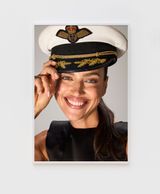
Roe Ethridge’s hallmark approach of cross-pollinating disparate genres made its first public appearance in 2001 at MoMA PS1, the Queens branch of The Museum of Modern Art. Seizing an appealing outtake from a professional shoot for the magazine Allure and mixing that with an image of a UPS Mail Innovations store, the artist blurred the boundaries between his ‘artistic’ and ‘commercial’ practices. He cites Lee Friedlander and Andy Warhol as early inspirations—artists who subvert the distinctions between the different functions and sub-genres of art.
Style and subject matter
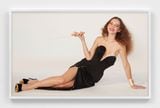
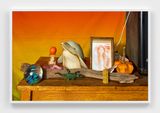
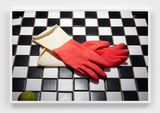
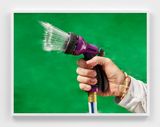
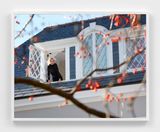
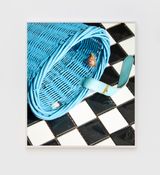
Working in New York, Roe Ethridge captures the world around him through the classic genres of portrait, landscape, and still life, taking pictures ranging from the spontaneous snap to the meticulously staged set. He combines conceptual art with family photos, commercial photography—outtakes of his own professional work for publications like The New York Times and Vice—and borrowed imagery. Thus the artist creates an uneasy tension between the generic art historical and the disturbingly intimate.
There is always something not quite right with the images Roe Ethridge chooses to bring together: odd associations, visual disparity, convoluted hidden themes. His imagery is, as he described to David Campany, ’“right” in its wrongness.’
Key series
While often bringing together seemingly unconnected images, there is usually some common thread for which they have been collectively repurposed. Roe Ethridge’s artwork examines themes that range from the imagery and feeling of a summer vacation nearing its end—such as the series ‘Shelter Island’ (2016)—to the superfluity of luxury, as explored in the series ‘Le Luxe’ (2011).
Sometimes Roe Ethridge’s themes are even less tangible, as seen in the photobook American Spirit (2017). Referencing a cigarette brand whose packages appear in some of his works, pages of the book are layered photocollages drawn from a random collection of images stored on Ethridge’s computer, subverting and challenging the conventions of art photography.
Exhibitions
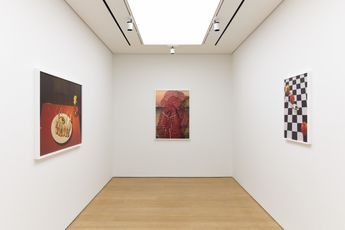
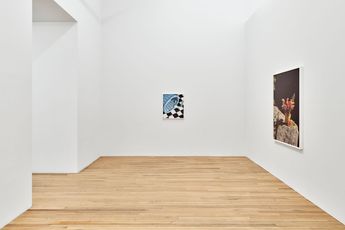
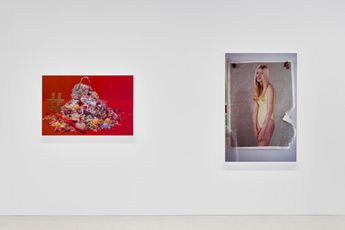
The content of Roe Ethridge’s exhibitions and recent survey, such as Old Fruit at Gagosian, New York (2020), reveals strong contrasts in style, sentiment, and subject between individual works. The detached Pigeon (2001) and the quietly atmospheric Rockaway Beach (2008) are jarringly different from the highly emotive but staged Ambulance Accident (2000).
In 2001 Roe Ethridge also featured in the exhibition the americans. new art. at the Barbican Centre, London, which examined the new wave of American contemporary art. Since then he has continued to feature in key exhibitions at prominent museums and institutions.
Selected solo exhibitions include:
- Louise McQueen 2011. Neither, London (2024)
- AMERICAN POLYCHRONIC, Andrew Kreps Gallery and Gagosian, New York (2024)
- Roe Ethridge: Beach Umbrella. Gagosian, New York (2021)
- Roe Ethridge: Sacrifice Your Body. Capitain Petzel, Berlin (2014)
- Sunset Studio, Gladstone Gallery, Brussels (2009)
Selected group exhibitions:
- Inaugural Exhibition, The Campus, Hudson, NY (2024)
- Objects of Desire. Photography and the Language of Advertising, Los Angeles County Museum of Art (2022)
- New Visions: The Henie Onstad Triennial for Photography and New Media, Henie Onstad Kunstsenter, Høvikodden, Norway (2020)
- I will be dead, König Galerie, London (2019)
- The Poetics of Place: Contemporary Photographs from the Met Collection, Metropolitan Museum of Art, New York (2016)
Awards and accolades
Beyond the contemporary art events and institutions of the United States, Roe Ethridge has gained significant recognition in Europe. In 2011 he was shortlisted for the Deutsche Börse Photography Prize in Berlin. His first major survey, curated by Anne Pontégnie, was shown at Le Consortium in Dijon (2012) followed by Belgium’s Museum Leuven (2012).
Roe Ethridge FAQs
Where did Roe Ethridge study photography?
He received a BFA in Photography from the Atlanta College of Art in 1995, before relocating to New York, where he built a dual career in commercial and fine art photography.
What is distinctive about Roe Ethridge’s photography?
Ethridge is known for repurposing editorial, fashion, and stock photography outtakes into fine art contexts, highlighting photography’s mutability across formats and industries.
Where can I see Roe Ethridge’s work?
His work is held in collections at institutions such as the Museum of Modern Art in New York, the Whitney Museum of American Art, MOCA Los Angeles, and Tate Modern. He is represented by galleries including Andrew Kreps, Gagosian, and Gladstone.
What themes does Ethridge explore in his work?
His work reflects on consumerism, memory, and photographic repetition, often blurring the boundaries between authenticity and artifice.
Ocula | 2025

View Roe Ethridge's Artworks

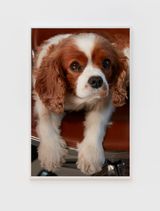

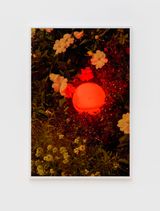

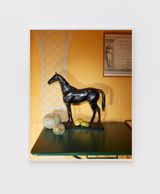


















Explore Roe Ethridge's Exhibitions








Explore and Follow Artists Shaping Contemporary Art
A respected voice in contemporary art discourse.
Focusing on ambitious storytelling and insightful art-world commentary. Ocula Magazine publishes in-depth interviews, critical essays and timely analysis on the artists, exhibitions and ideas driving the global art world.
Learn more about Ocula Magazine
Showcasing the best of the art world.
Ocula partners with galleries from around the world to highlight their artists, artworks and exhibitions. Gallery membership is by application and invitation, with each member vetted by an independent panel.
Learn more about Ocula Membership
Specialises in the sale of major artworks.
Led by a team with deep ties to the world’s leading auction houses, galleries and collectors. Ocula’s advisory team offers bespoke services to high-net-worth clients from around the world who are looking to acquire the best of contemporary and modern art.
Learn more about our team and services