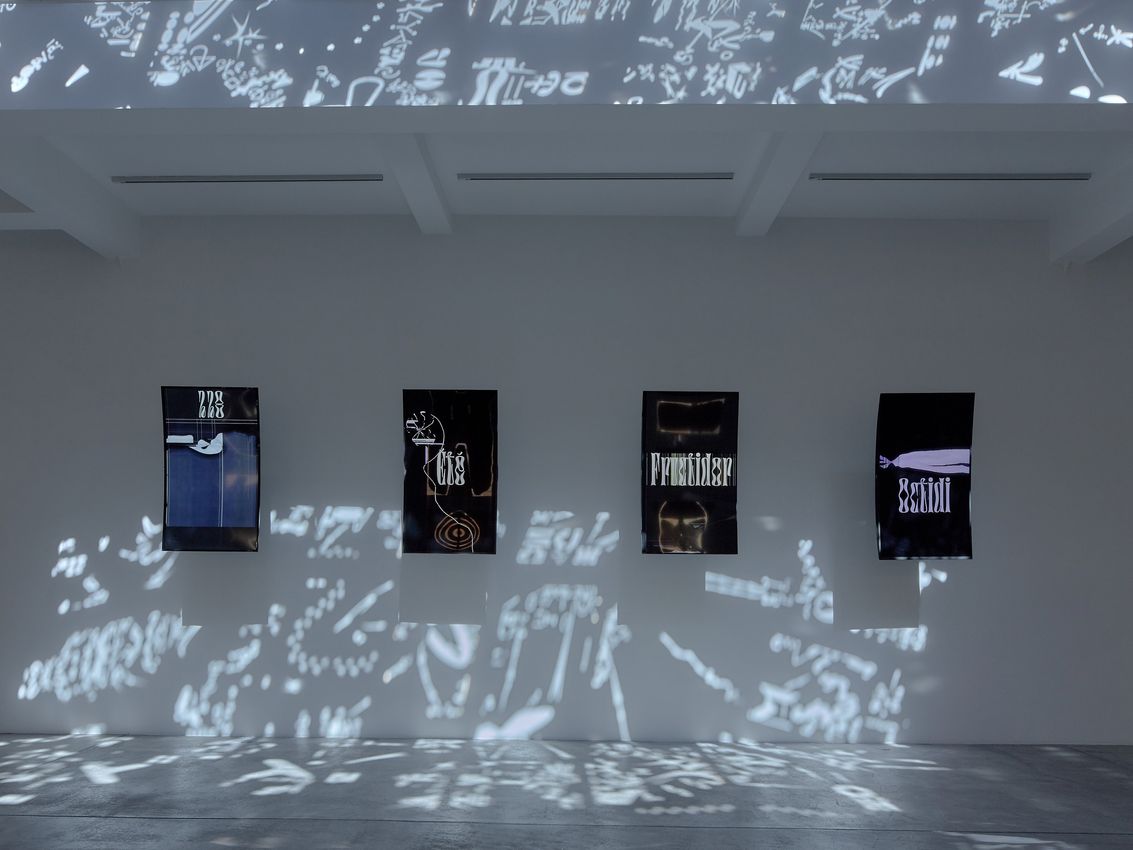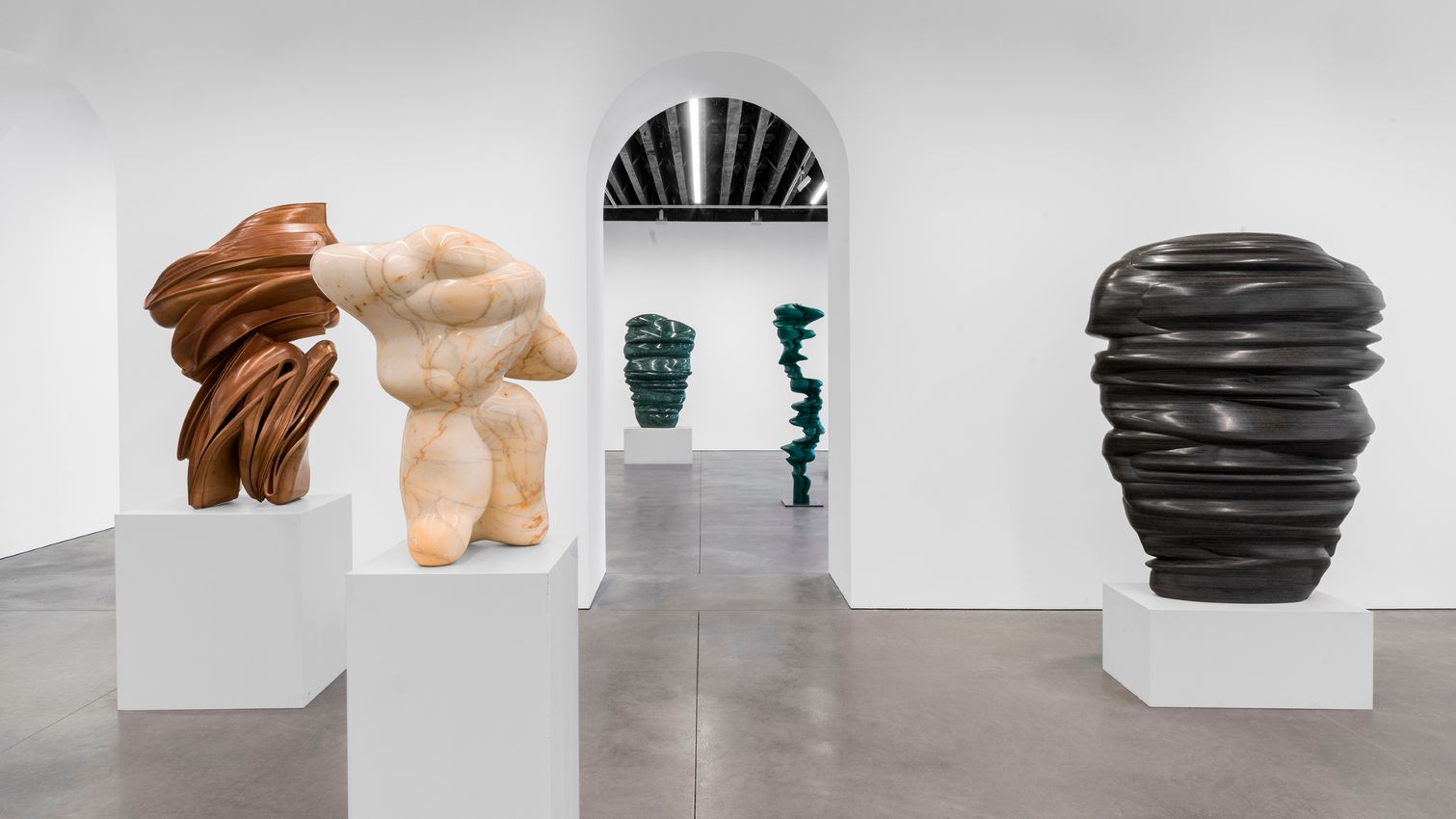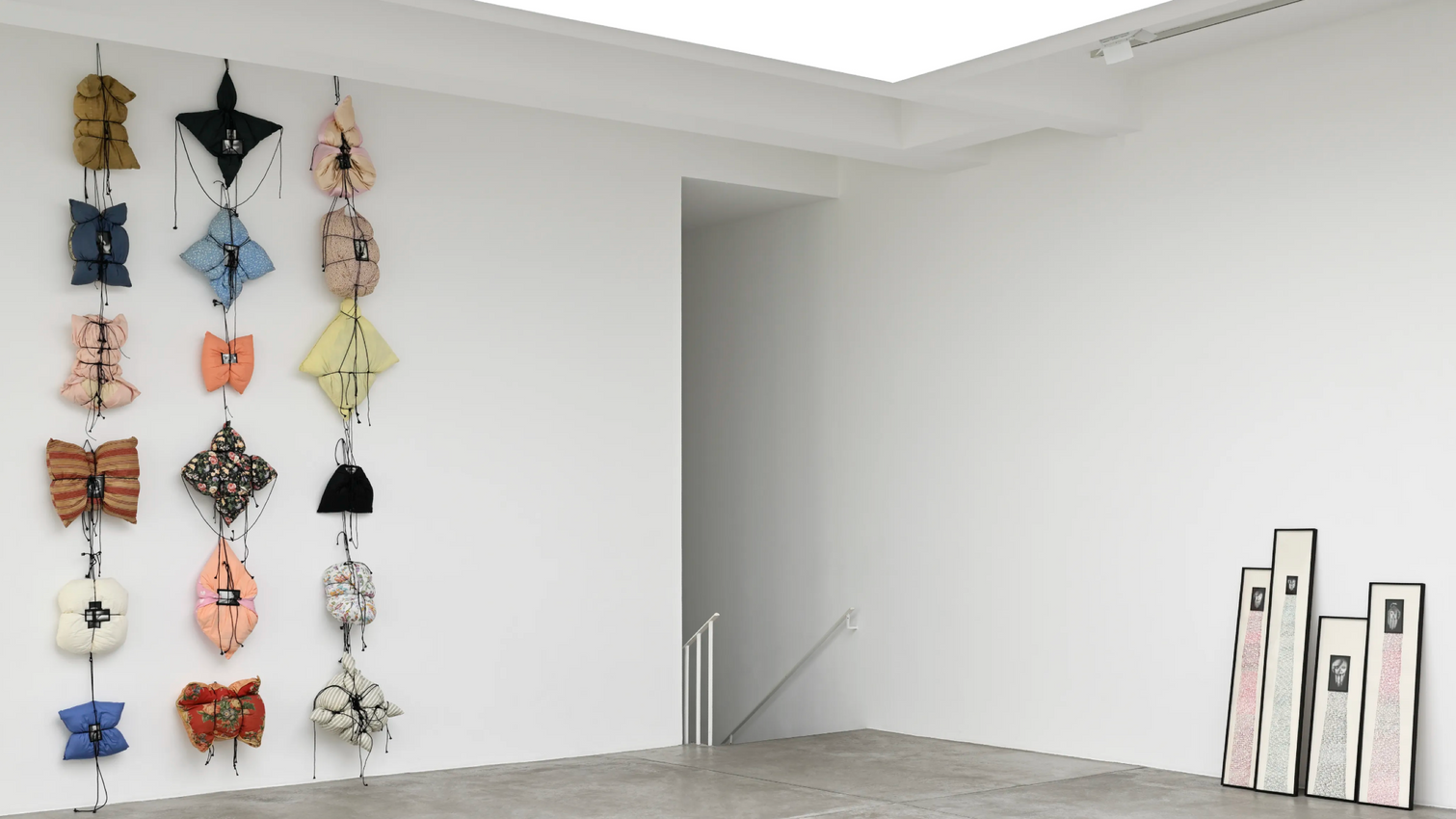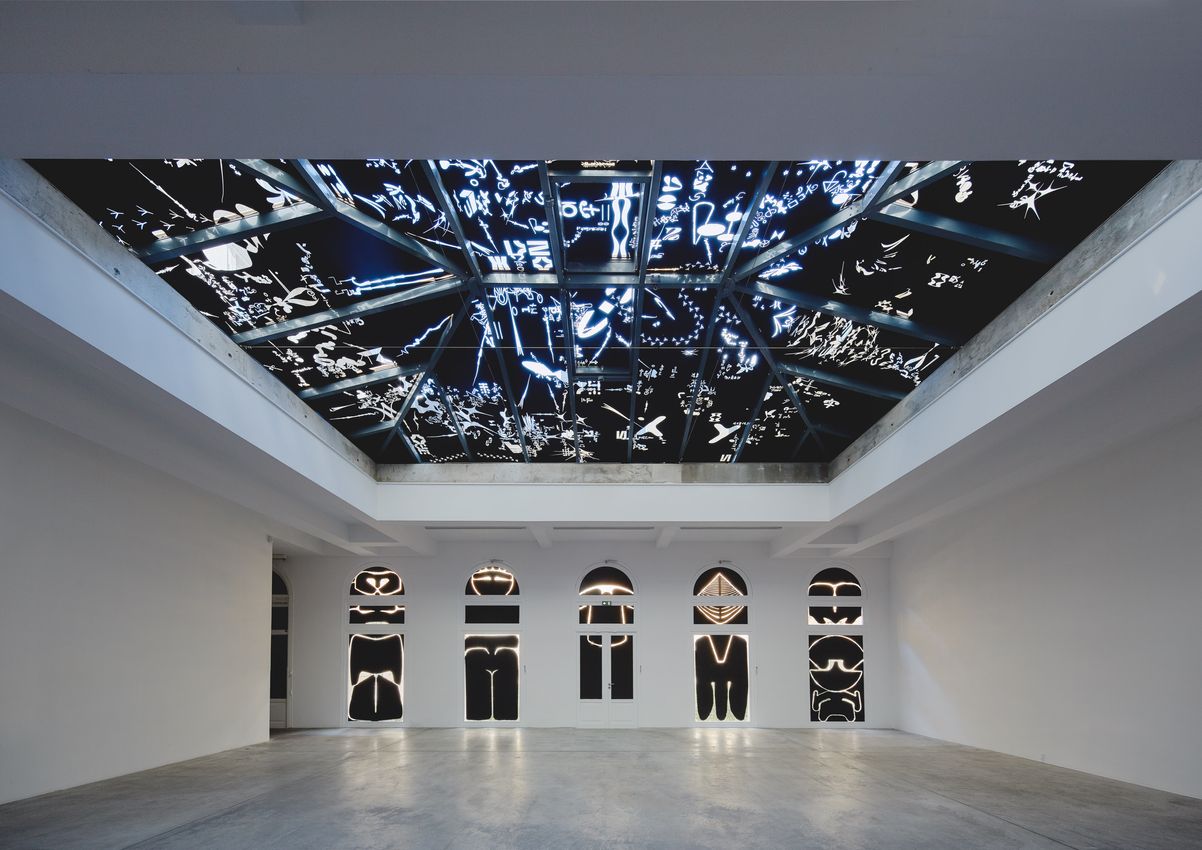
Galerie Marian Goodman is pleased to announce its first major exhibition by Adrián Villar Rojas. It is perhaps one of the most comprehensive interventions in the history of the gallery in Paris, encompassing and connecting each of its rooms, and invoking the past essence of the building as a former domestic environment.
The artist’s speculative inquiry on the nature of the human imagination emerged from time spent during the lockdown watching and recording thousands of hours of publicly available CCTV streams online, from caged orangutans in quarantined zoos to underwater algae and feeds from NASA satellites. In La fin de l’imagination, Villar Rojas asks how COVID-19 is affecting time—our human time, our language, our systems of representation. For example, if meaning is created by our imagination, a clock or a calendar is no less fantasious than a Jackson Pollock painting. Clocks and Pollocks are equally subjective. But, all fabulations are supported by a decisive element: power. The power of revolutionary France in 1793 was not enough to implement Napoléon’s newly invented decimal calendar worldwide, it survived a mere 12 years in France, but the wealth and influence of the United States after World War II was certainly enough to position Abstract Expressionism in the contemporary art canon. Through Villar Rojas’ world-building, echoes of these constructs, the clock and the calendar, return to Paris like ghosts in a haunted house.
At the end of the 1990s and early 2000s, with the Internet yet to come and books impossible to borrow or too expensive to buy, Villar Rojas’ generation of arts students in Rosario, Argentina, depended on booklets (cuadernillos) comprised of photocopies usually taken not from the original source (i.e., books), but other copies, always losing more information from one to the next series of copies. The distorted grainy, black and white reproductions of such artists as Rothko and Pollock were an unpredictable subversion of the ‘subject matter’ and a silent revolution in those students’ subjectivity.
Thus, the teaching of ‘Art History’ in the School of Fine Arts at the National University of Rosario, which in fact is Western Art History that rarely includes Latin American narratives, is turned into the barely decipherable remains of a lost visual heritage where the imagination of those young students found a fertile ground to breed their own mutants, made more of fantasy than of information: ‘It was almost like these photocopies were shouting: there are no hard facts, only fabulation and speculation!’ says Villar Rojas. ‘Art Histories, or rather Art Stories, are for us students to reclaim and hack’.
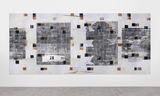
New disrupting imaginations become evident in the lower gallery, where Villar Rojas introduces a sequence of site-specific murals transposing reproductions of pages from his own preserved booklets of photocopies onto an archive of posters, invitation cards and envelopes that embody a physical history of printed matter produced over Galerie Marian Goodman’s 25-year history. Here, different juxtaposed layers of Capitalocene artistic heritage seem to expose a new visual genetic code resulting from the infinitely singular story of the art education of an individual coming from Rosario, Argentina, a country inscribed in a region that historian Alain Rouquie calls the Far West.
But, is humanity in a terminal crisis or in an era of light-speed revolutions? Perhaps, as in quantum mechanics, humanity now finds itself in both processes at the same time. La fin de l’imagination can thus also be the possibility of new disrupting imaginations with its own revolutionary conventions. In this spirit, Villar Rojas proposes a fabulative mutant panhuman language that may be used in a thousand years’ time, or tomorrow. This mark-making system gathers various forms with different levels of association to current and past human writing mechanisms. First appearing for a comic-publication accompanying Villar Rojas’ solo show Poems for Earthlings at the Oude Kerk (Amsterdam, 2019), this former graphic apparatus migrates to Paris and sprouts and mutates into a friendly vandalising force, like Godard’s La Chinoise, to become a central element of La fin de l’imagination ecosystem.
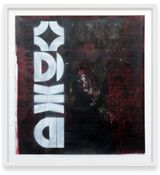
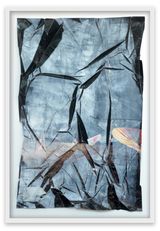
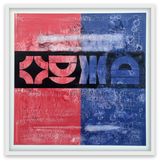
La fin de l’imagination also encompasses an exhibition of works on paper at Librairie Marian Goodman. Created using 12 designs of his own past exhibition posters from 2003 to 2020, the posters have been folded, creased, covered or enhanced with coloured pigments. They are predominantly intervened by panhuman stencils, transforming—in the artist’s own narration—into political propaganda or battle flags recovered from futuristic wars.
Adrián Villar Rojas has built a practice working across media to create immersive environments and experiences that seem to be in a state of perpetual space-time travel. Evolving over years towards the development of topography-based, mutant, organic-inorganic systems, Villar Rojas invites viewers to become explorers of an unpredictable microcosmos of his design,where the future, past, and alternate versions of our own present interact as a constantly changing totality. By way of this world building, Villar Rojas posits the question: what if we could see and think of ourselves—humanity—from an alien perspective; detached, unprejudiced, even amoral? What if we could see and think of ourselves from the border of our own completed path?
Adrián Villar Rojas was born in Rosario, Argentina, in 1980. He lives and works nomadically. Solo exhibitions include Poems for Earthlings, Oude Kerk, Amsterdam (2019); Sometimes you wonder, in an interconnected universe, who is dreaming who?, Tank Shanghai, China (2019); The Theater of Disappearance, The Geffen Contemporary at MOCA, Los Angeles (2017); NEON Foundation at Athens National Observatory, Greece (2017); Kunsthaus Bregenz, Austria (2017), The Metropolitan Museum of Art, New York (2017); Rinascimento, Fondazione Sandretto Re Rebaudengo, Torino (2015); Fantasma, Moderna Museet, Stockholm (2015); Today We Reboot the Planet, Serpentine Sackler Gallery, London (2013); and La inocencia de los animales, MoMA PS1, New York (2013).
Participation in international group exhibitions include 12th Gwangju Art Biennale, South Korea (2018); 14th Istanbul Biennial, Turkey (2015); 12ª Bienal de La Habana, Cuba (2015); Sharjah Biennial 12, Kalba (2015); The 2012 New Museum Triennial (2012) ; dOCUMENTA (13), Kassel and Kabul (2012); and 54th International Art Exhibition: La Biennale di Venezia, Argentina’sNational Pavilion, Venice (2011).
Adrián Villar Rojas was born in Rosario, Argentina in 1980. He lives and works nomadically. Villar Rojas is best known for his large-scale, site-specific sculptural installations. Within his work there is often a sense of crumbling humanity; a futuristic culture come and gone. Villar Rojas’ works combine the daunting scale of conventional public sculptures with an unstable fragility, reminding his viewers of the ephemerality of even the most imposing structures. His work demonstrates its own temporality, offering—at the risk of its own oblivion—a representation of the transitory nature of all things.


For over forty years, Marian Goodman Gallery has played an important role in helping to establish a vital dialogue among artists and institutions working internationally. Marian Goodman Gallery was founded in New York City in late 1977. In 1995 the Gallery expanded to include an exhibition space in Paris – with an additional exhibition space and bookshop added in 2016 - and in 2014 an exhibition space in London. The London space transitioned to Marian Goodman Projects in 2021, a new initiative to present exhibitions and artist projects in London and other select cities around the world.

A respected voice in contemporary art discourse.
Focusing on ambitious storytelling and insightful art-world commentary. Ocula Magazine publishes in-depth interviews, critical essays and timely analysis on the artists, exhibitions and ideas driving the global art world.
Learn more about Ocula Magazine
Showcasing the best of the art world.
Ocula partners with galleries from around the world to highlight their artists, artworks and exhibitions. Gallery membership is by application and invitation, with each member vetted by an independent panel.
Learn more about Ocula Membership

Specialises in the sale of major artworks.
Led by a team with deep ties to the world’s leading auction houses, galleries and collectors. Ocula’s advisory team offers bespoke services to high-net-worth clients from around the world who are looking to acquire the best of contemporary and modern art.
Learn more about our team and services