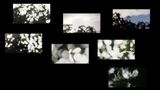




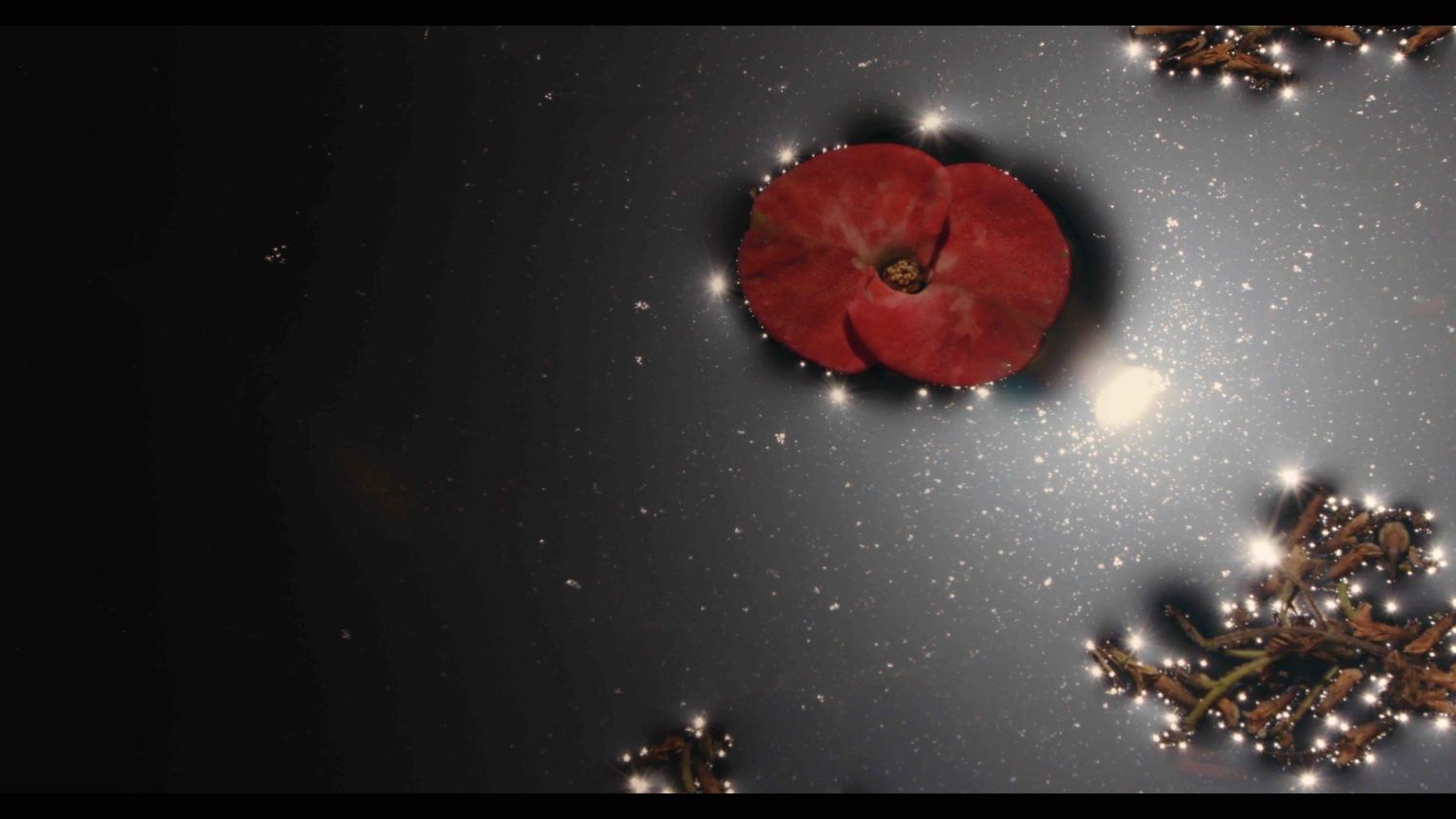
Marian Goodman Gallery is pleased to present an exhibition of Amar Kanwar’s most recent work, The Peacock’s Graveyard (2023). Originally commissioned for Sharjah Biennial 15, the multi-channel installation weaves together images and sounds that meditate on the transience of existence.
Comprised of a set of projections onto seven screens, the lyrical images in The Peacock’s Graveyard emerge and recede individually and then simultaneously, leading us on an abstract journey. Forming a visual haiku across distinct channels in the exhibition space, these images are overlaid with texts; stories written by Kanwar, that draw upon received narratives and oral histories, blending ancient and modern folklore traditions with personal experience.
Offering a unique vantage point through which to consider collective and individual truths, Kanwar here employs a variety of editing and staging methods which invite viewers to reflect on non-canonical wisdom. In this way, The Peacock’s Graveyard departs from earlier documentary strategies within his work, articulating the need for a metaphysical re-organisation of thought from which it is possible to glimpse another world. Kanwar’s work has always operated with the premise that rationality and power cannot and do not exhaust the possibilities of life. Remaining critically engaged with the array of forces on individual lives, the work presents a suite of parables which more obliquely take up questions of responsibility and ethos, dignity and loss.
Of the work, the artist writes that it is ’[...] not a lament or mourning, but perhaps a kind of gift, a collection of stories, some ancient, some new, something to keep by one’s side every day, or take along if going someplace, or to help us reconfigure life, ideologies, politics, solidarities, social movements. These stories lay the groundwork for reflecting on our unbearable arrogance, delusions and deep desire for violence.’
Kanwar’s poetic films and video installations have explored the political, social, economic and ecological conditions of our times, often focusing on the Indian subcontinent. His work traces the legacy of globalisation and decolonisation, land use and border rights, environmental concerns, human rights and free expression; and sexual violence. Interwoven throughout these inquiries are disparate narrative structures which ground his philosophical investigations. Through hybrid installations which incorporate images, literature, poetry and music, Kanwar creates meditative works that do not aim to represent trauma, so much as to find ways through them. How does a landscape comprise beauty and violence; how does poetry stand in for evidence; how do visions within darkness engender light and new pedagogies? Kanwar’s work looks deeply into the causes and effects, and of how they are translated into everyday life and cultural forms.
Amar Kanwar was born in 1964 in New Delhi, India, where he currently lives and works.
Recent solo exhibitions of Kanwar’s work have been held at the Metropolitan Museum of Art, New York (2022); Ishara Art Foundation, Dubai, UAE and NYU Abu Dhabi Art Gallery, UAE (2020), Museo Nacional Thyssen-Bornemisza, Madrid (2019), Tate Modern, London; Minneapolis Institute of Arts, USA and Marian Goodman Gallery, New York, USA (2018), Bildmuseet, Umea, Sweden and Frac Pays de la Loire, Carquefou, France (2017), Goethe Institut, Mumbai (2016) and at the Assam State Museum in collaboration with Kiran Nadar Museum of Art and North East Network, India (2015). Earlier solo exhibitions include the Art Institute of Chicago (2014), the Yorkshire Sculpture Park (2013), the Fotomuseum Winterthur, Switzerland (2012), Stedelijk Museum, Amsterdam (2008), Whitechapel Art Gallery, London (2007), National Museum of Art, Architecture and Design, Oslo (2006), and the Renaissance Society, Chicago (2004).
Kanwar has participated in Documenta 11, 12, 13 and 14 in Kassel, Germany (2002, 2007, 2012, 2017) as well as in the Kochi-Muziris Biennial, India (2013, 2022). In 2023 Kanwar participated in Signals: How video transformed the World at the Museum of Modern Art, USA and at the Sharjah Biennial 15, United Arab Emirates.
Amar Kanwar has been the recipient of several awards including an Honorable Mention at the Sharjah Biennial 2023, the IHME Helsinki Commission (2022); Prince Claus Award (2017); Creative Time’s Annenberg Prize for Art and Social Change (2014); an Honorary Doctorate in Fine Arts, Maine College of Art, USA (2006); the Edvard Munch Award for Contemporary Art, Norway (2005); the Golden Gate Award, San Francisco International Film Festival, USA (1999), as well as the Golden Conch, Mumbai International Film Festival, India (1998).
Amar Kanwar was born in New Delhi in 1964. In 1984, while he was studying history at the University of Delhi, two events occurred that impacted his subsequent philosophical and artistic development. On October 31, Prime Minister Indira Gandhi was assassinated by Sikh bodyguards, resulting in mass retaliatory violence against Sikhs in Delhi. Then, on December 3, a toxic gas leak at the Union Carbide pesticide plant, known as the Bhopal disaster, killed thousands of people and exposed hundreds of thousands more. These pivotal experiences instilled in Kanwar a commitment to social activism. Enrolling in the film school at the Mass Communications Research Center of Jamia Millia Islamia University, Delhi, he began to work on pushing the poetic limits of documentary filmmaking. He later expanded his practice to multi-channel video installation, adding other audiovisual elements. Kanwar was the recipient of the MacArthur Fellowship in India (2000), the first Edvard Munch Award for Contemporary Art (2005), and an Honorary Doctorate in Fine Arts from Maine College of Art (2006).


For over forty years, Marian Goodman Gallery has played an important role in helping to establish a vital dialogue among artists and institutions working internationally. Marian Goodman Gallery was founded in New York City in late 1977. In 1995 the Gallery expanded to include an exhibition space in Paris – with an additional exhibition space and bookshop added in 2016 - and in 2014 an exhibition space in London. The London space transitioned to Marian Goodman Projects in 2021, a new initiative to present exhibitions and artist projects in London and other select cities around the world.

A respected voice in contemporary art discourse.
Focusing on ambitious storytelling and insightful art-world commentary. Ocula Magazine publishes in-depth interviews, critical essays and timely analysis on the artists, exhibitions and ideas driving the global art world.
Learn more about Ocula Magazine
Showcasing the best of the art world.
Ocula partners with galleries from around the world to highlight their artists, artworks and exhibitions. Gallery membership is by application and invitation, with each member vetted by an independent panel.
Learn more about Ocula Membership

Specialises in the sale of major artworks.
Led by a team with deep ties to the world’s leading auction houses, galleries and collectors. Ocula’s advisory team offers bespoke services to high-net-worth clients from around the world who are looking to acquire the best of contemporary and modern art.
Learn more about our team and services