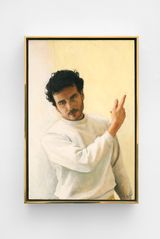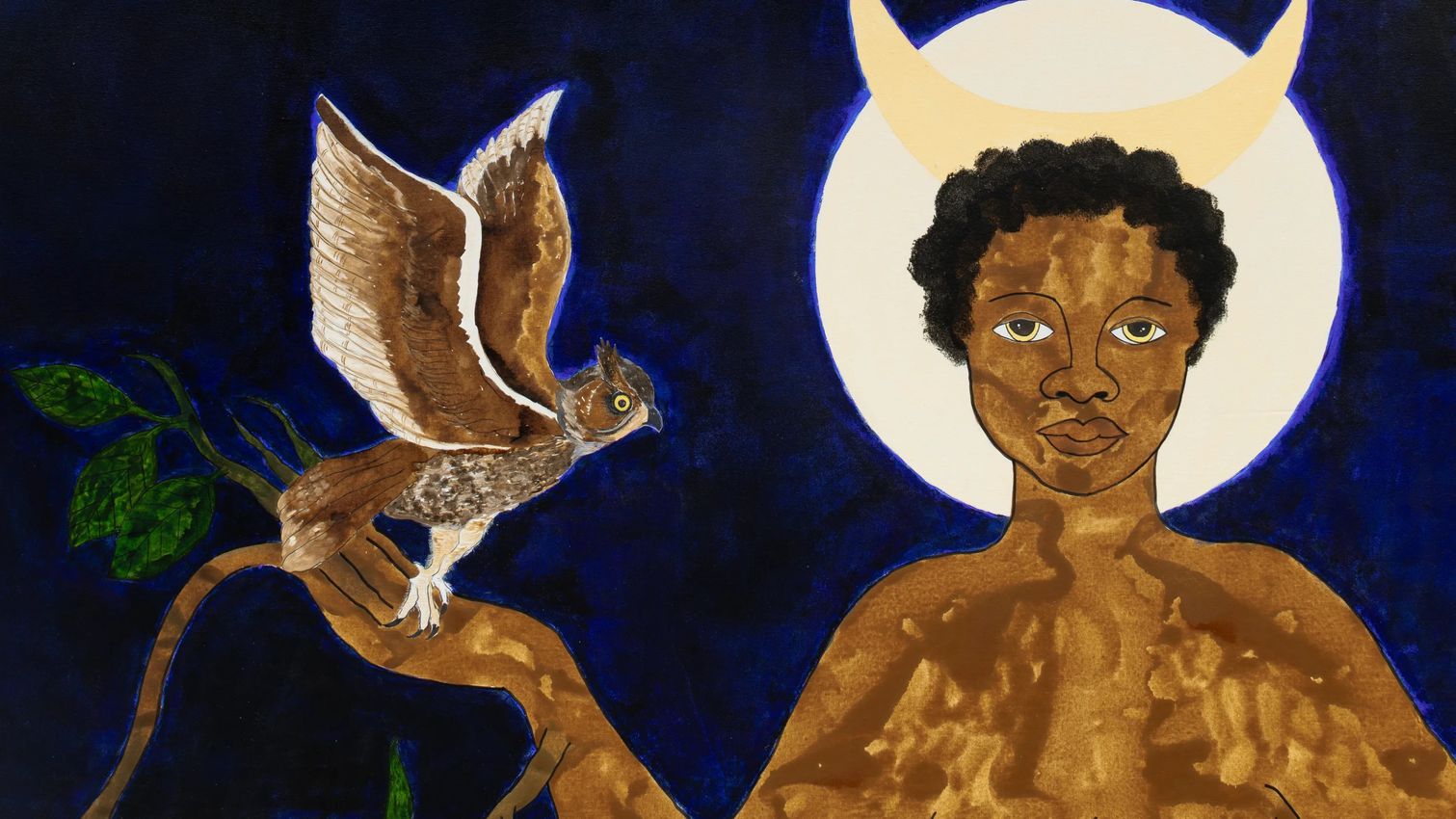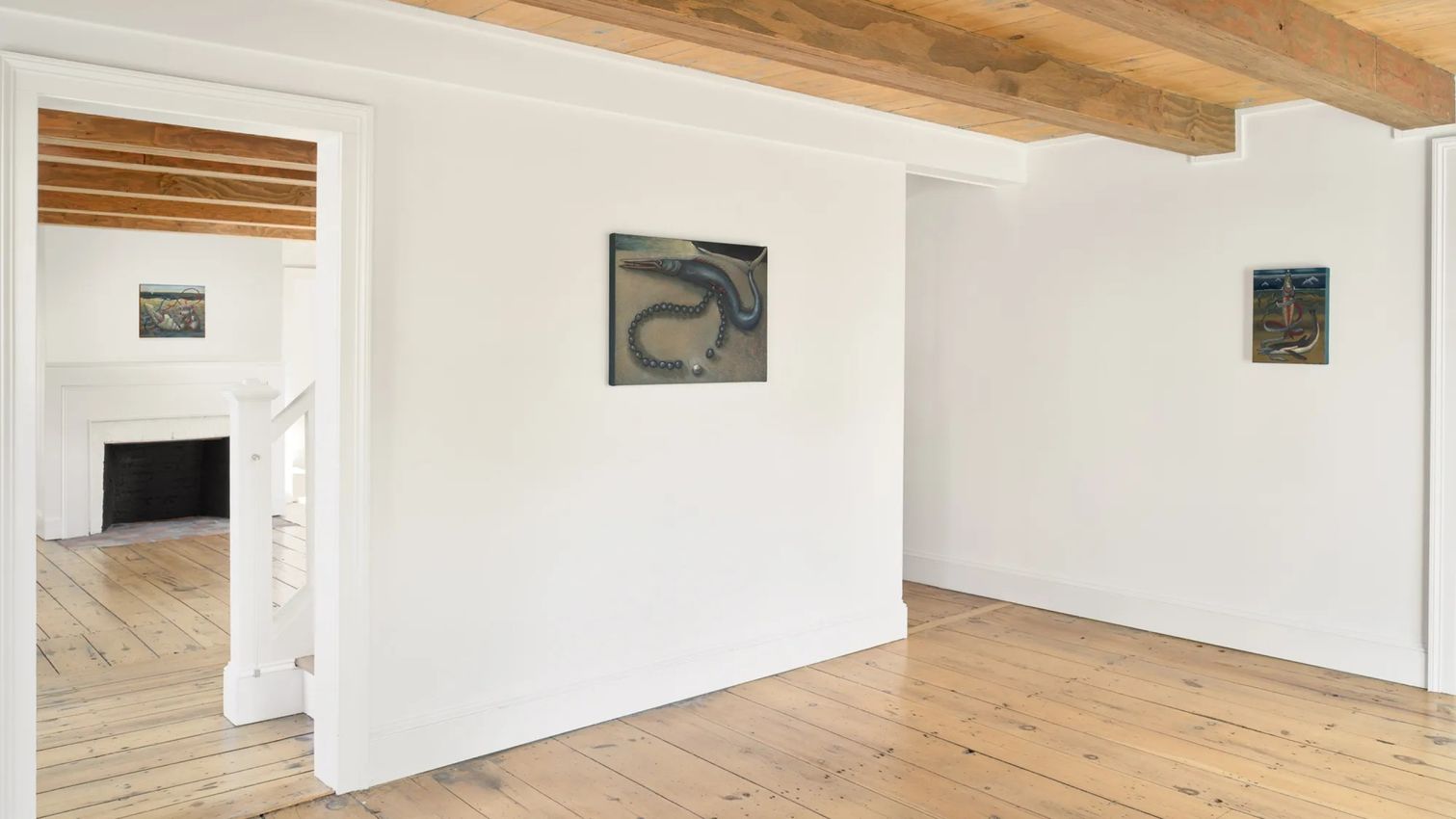




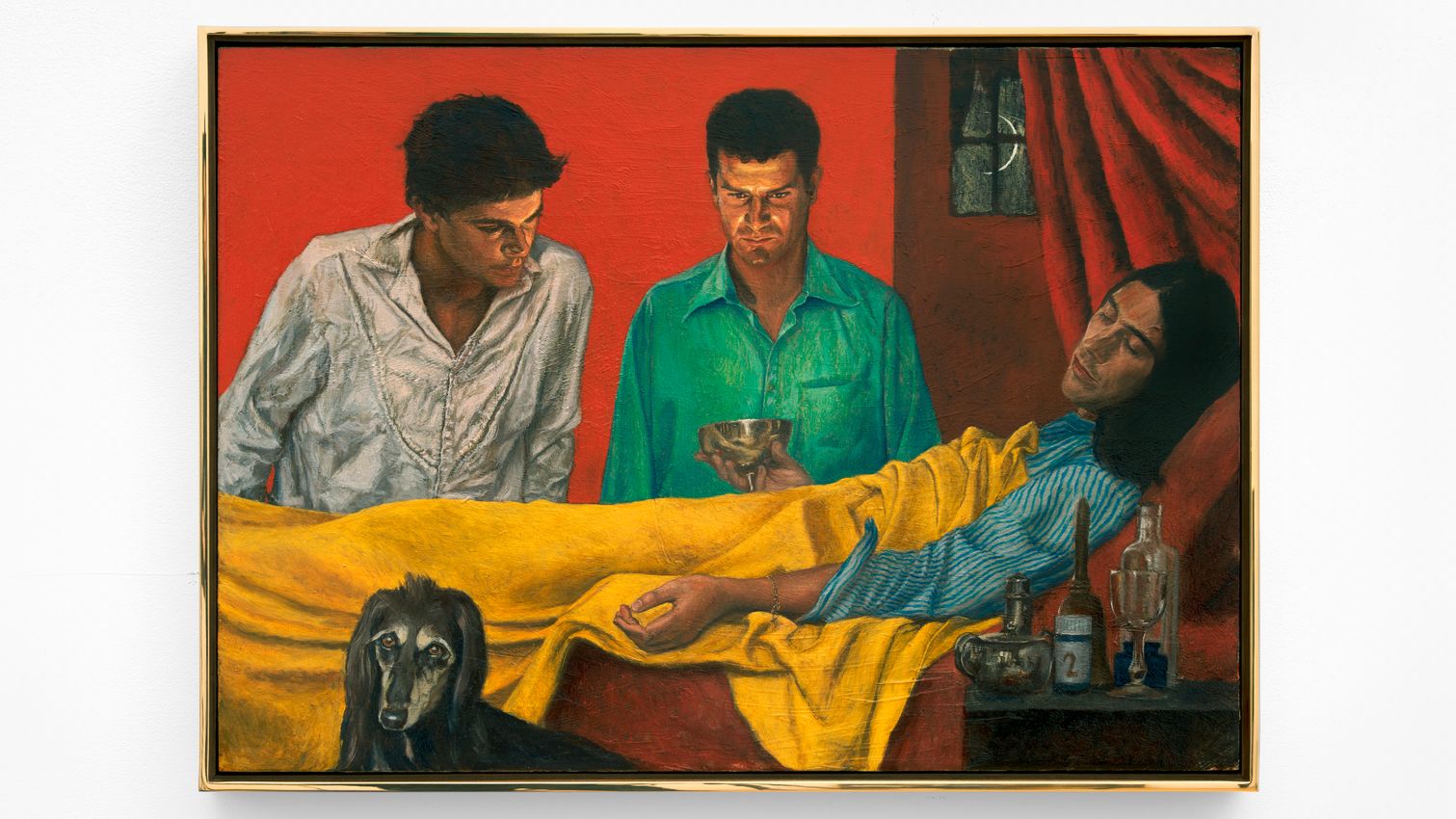
In Résurrectine, Giangiacomo Rossetti creates an atmosphere of self-enclosed, mausoleum-like entombment. Sleepwalking characterizes the intermediary state enacted onto the painter’s subjects, who gaze through windows and passageways (The Party, all works 2025), into or out of mirrors (Counting the Teeth, Here Comes the Child), and other mysterious sources of illumination (Golden Bowl). Rossetti’s paintings operate within a system of chance and patterning that hinges on the doubleness of visual puns and the repetition and difference of form. Reworkings of Francesco Hayez’s Mary Magdalene as a Hermit (1833) and Renoir’s The Umbrellas (1880 – 1886) feature within this constellation of paintings, as do motifs from Domenico Fetti’s elaborate 1615 allegory of melancholy – a marble sculpture of a severed human bust, a skull, the spherical curve of the moon. And there is the dash of arsenic yellow which rhythmically undulates throughout the show, in the way Jacques Deray’s film La Piscine (1969) orbits around the lemon-tinted Gae Aulenti patio furniture (Locus Solus, Poltronova, 1967); the color’s brightness belies the toxicity and instability of its material, serving as a kind of Chekhov’s gun throughout the film and this exhibition.
Rossetti’s intimations of mortality and rebirth suggest an eschatological desire to bring his subjects back to life. Alongside recurrent self-portraits, there are nods to Leonardo, including one of his last pictures depicting the young St. John the Baptist. St. John was modeled after da Vinci’s pupil and lover Salaì (alias of Gian Giacomo Caprotti da Oreno). The painting, as a work of the artist’s unconscious, would remain unfinished come quasi intervene di tutte le cose sue (“as happened more or less to all his works”), as, citing a contemporary of Leonardo’s, Freud noted in his biographical study of da Vinci.
”Résurrectine” is borrowed from Raymond Roussel’s 1914 novel Locus Solus, in which the central character and scientist Martial Canterel re-animates cadavers. Under the influence of two fluids of Canterel’s invention, “résurrectine ” and “vitalium,” these quasi-subjects are posed to re-enact the most important moments of their lives. Like Roussel’s imaginary scenes, Rossetti’s paintings infuse a dreamlike precision and hallucinatory acuity that coexist with the works’ incessant tendency to collapse back into the social and historical world it longs to lock out.
Roussel was found dead from an overdose on July 14, 1933; twelve copies of Locus Solus were found near his corpse by police. He was later interred in Père Lachaise cemetery, in a thirty-two-person plot – the number of squares on a folded chessboard, a game with which Roussel became obsessed near the end of his life. The total possible variations of moves in chess are astronomically huge; the mathematician Claude Shannon estimated the number of possible chess games to be far more than the number of atoms in the universe. The limitlessness of the Shannon Number is the other side of the confining limitations of art. Here, we witness Rossetti rediscovering a child’s vision as he examines the rubble of his own associations. He thinks of the grave, in which one is indefinitely buried, an outcast from time. He grapples with the remains of lost histories and confronts something, some excess, which he cannot assimilate.
– Hiji Nam
Courtesy Mendes Wood DM.
Giangiacomo Rossetti was born in Milan in 1989. He attended the Accademia di Belle Arti di Brera in Milan and in 2019 graduated from Die Institut Kunst FHNW in Basel. His solo exhibitions include DEEPSTARIA ENIGMATICA, Riverside, Bern (2018), KRIS, Federico Vavassori, Milan (2017) and Bellarmina, Warm, São Paulo (2016). His work has been featured in several group exhibitions such as Techniques of the Observer at Greene Naftali Gallery, New York (2019); Nightfall at Mendes Wood DM, Brussels (2018); Tra l’inquietudine e il Martello at Federico Vavassori, Milan (2018). Rossetti’s recent projects include I got the Moon in the Morning and the Sun at Night at WallRiss, Fribourg (2019) as well as the exhibition Amadeo Luciano Lorenzato at Mendes Wood DM, Brussels (2019).


A respected voice in contemporary art discourse.
Focusing on ambitious storytelling and insightful art-world commentary. Ocula Magazine publishes in-depth interviews, critical essays and timely analysis on the artists, exhibitions and ideas driving the global art world.
Learn more about Ocula Magazine
Showcasing the best of the art world.
Ocula partners with galleries from around the world to highlight their artists, artworks and exhibitions. Gallery membership is by application and invitation, with each member vetted by an independent panel.
Learn more about Ocula Membership

Specialises in the sale of major artworks.
Led by a team with deep ties to the world’s leading auction houses, galleries and collectors. Ocula’s advisory team offers bespoke services to high-net-worth clients from around the world who are looking to acquire the best of contemporary and modern art.
Learn more about our team and services