To observe. This is the verb that comes to mind when I think of Marcos Siqueira’s paintings. Perhaps this is because the term recurs so often in our conversations. Siqueira frequently refers to his habit of sustained looking, of close attention, that he carries into his everyday activities.
This daily exercise of slowing down and calibrating the senses has given him a discipline of attention to which almost nothing escapes: the geometric variation of the branches, leaves, and flowers of Brazil’s Serra do Cipó (some of which visit his paintings); the changing angles of incidence of light over the course of the day, with its refractions and reflections – among the trees, in the water, in the air, and on natural objects; and the great formations of shadows, born of the moving projections of one mountain over another. Descriptions like these emerge in detail in Siqueira’s words. His practice arises from this insistent commitment to what the world offers.
Observation, however, is not a neutral activity. On the contrary, it involves selection, framing, and a certain closeness that allows the object to impose its own rhythms. It means remaining long enough to perceive. And it is in this process that Siqueira’s painting begins: “My work starts from what I find in my everyday life,” is something of a refrain for the artist.
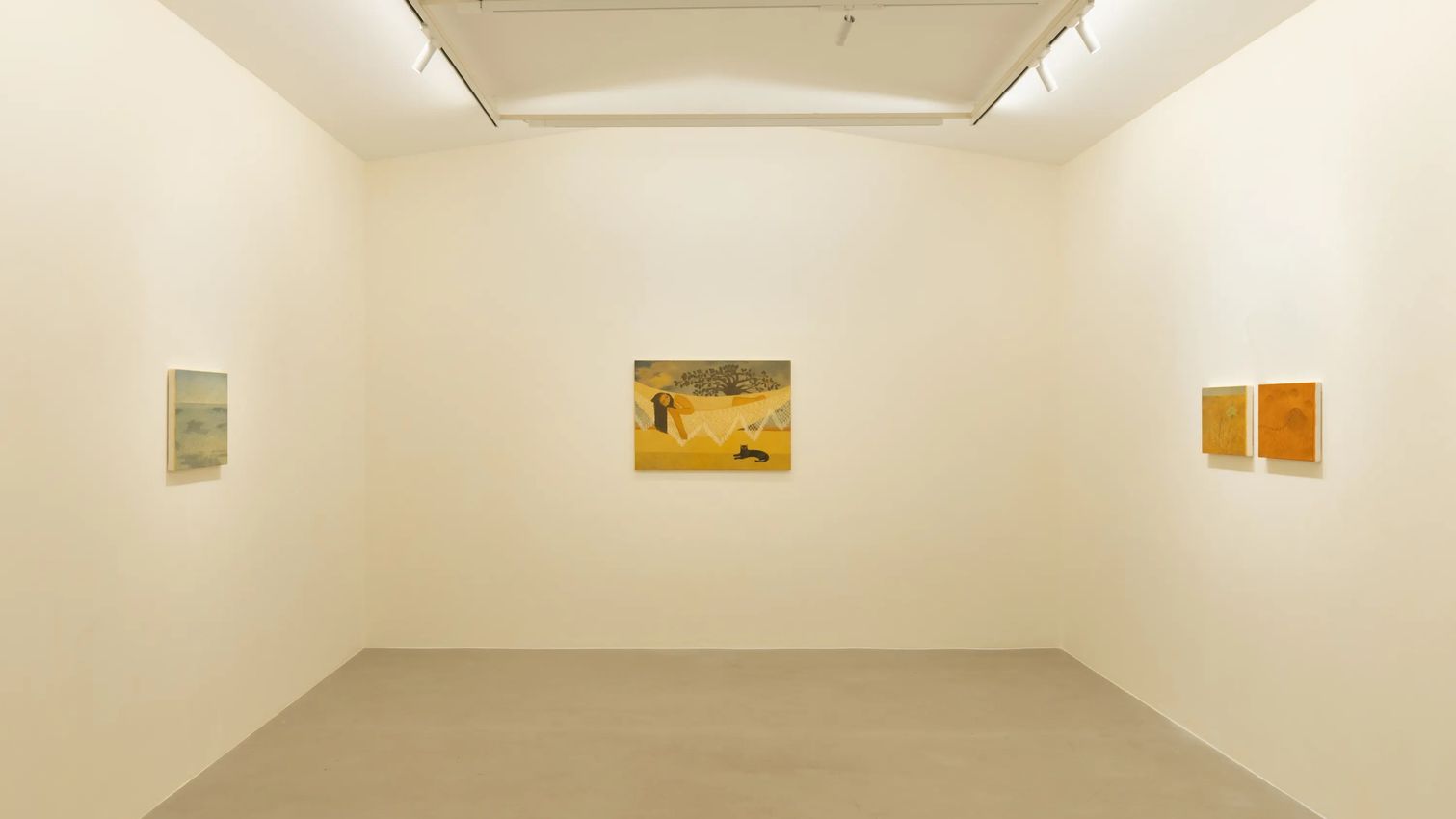
Because Siqueira’s paintings are figurative and engage closely with the Serra do Cipó’s landscape and everyday life, they risk being read as relating mimetically to the world. Yet the works in this exhibition show that Siqueira’s project makes room for other operations and moves away from a direct correspondence between the world he contemplates and what appears in the painting. Consider, for example, the uncanny quality of a person balancing on a tightrope, a wire (electrical, perhaps) tied to a fallen pole, resting on a black hole. The impossible balance contrasts with the harmony achieved in the composition, with the way Siqueira articulates the elements within the pictorial field. The splash of white paint in the upper right corner of the panel obscures the path of the wire and makes the composition all the more intriguing.
By using natural pigment – earth gathered along the paths he travels every day – Siqueira brings the materiality of place to his works, thereby complicating the opposition between the real and the imagined: while the image seems to move away from direct representation, the matter of the painting remains radically connected to the territory, which becomes, at once, an object of observation, pictorial matter, and a field of imagination.
And yet, in Siqueira’s practice, imagining stays close to the real. He reorganises the observed world and (re)composes the landscape, transforming it into new configurations. Imagining presents itself as an expanded, stretched, frayed observation, an observation that keeps working until it becomes painting. Could imagination be the form observation takes when it remains alive in memory?
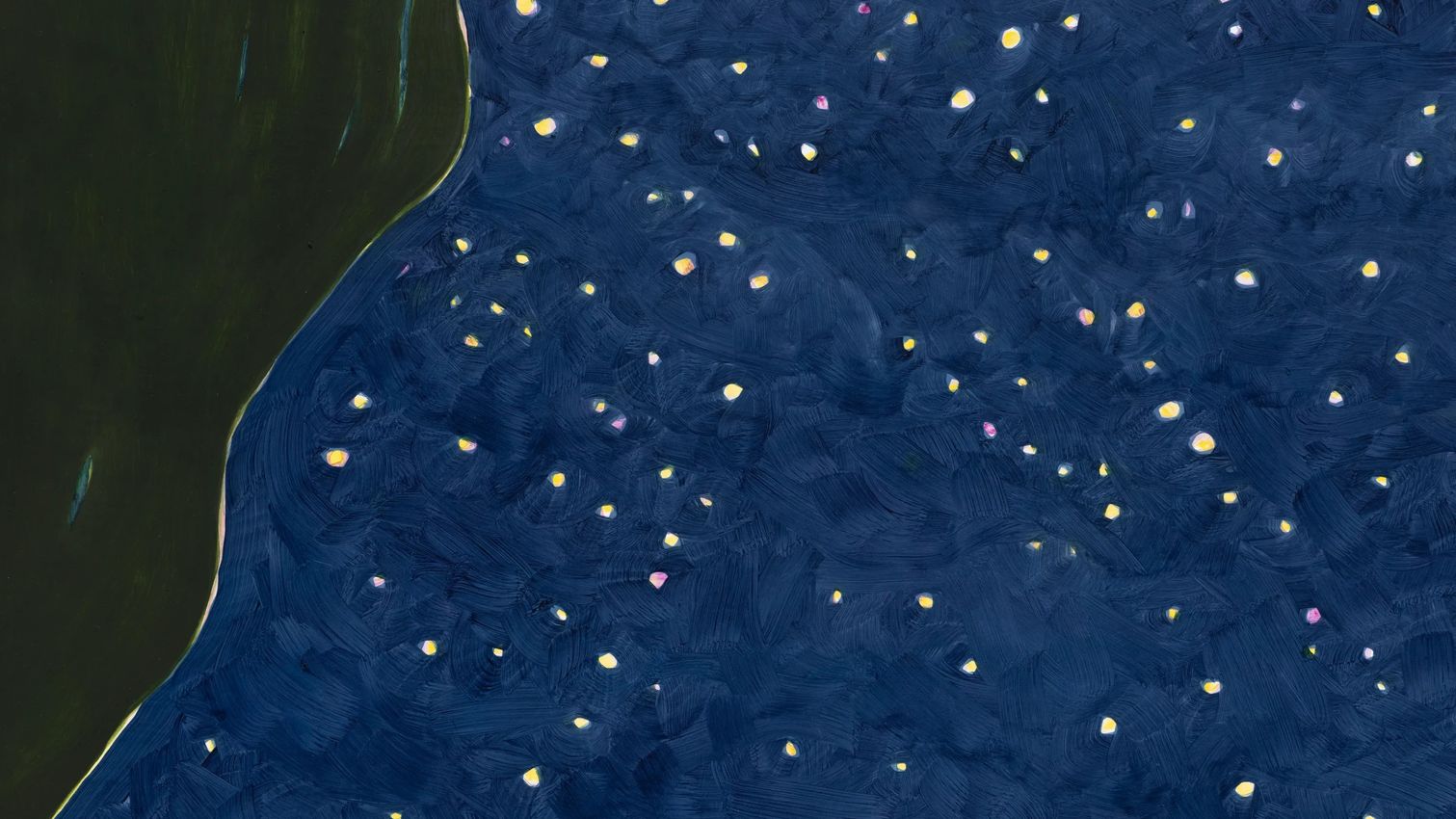
Other traces of this imagining, of this expanded, stretched, frayed observation, appear in the instability suggested by certain scenes and in the presence of ghostly figures. In one, water springs from the centre of a small boat on a river and seems to reach the sky. At either end of the boat, two seated human figures appear as a kind of shadow-body, spectre-body. The image raises a doubt. Are the figures really at the end of the boat or on the surface of the water nearby? Another trace-scene depicts a winding, dark river beginning at the lower centre of the pictorial field and running toward the night, merging with it. In the upper plane, or suspended in the panel’s dark sky, the spectre-shadow of a boat carries a human figure, itself ghostly.
Among the many nocturnal scenes in this group of works, two beautiful moments of imagined observation or observed imagination: one presents a forest with those bare-branched, leafless trees recurrent in the artist’s work. Setting out from different points of the pictorial field, beams of light seem to take on a life of their own: they move among the trunks, swerve away from them, and coil around them. Another presents the striking setting of a long, winding route that begins at the lower centre of the plane and continues “climbing” toward the upper right of the work. Traced in yellow, in contrast with the dark tones of the rest of the work, this path marks the division between two diagonal planes: in the upper plane, once again, a nocturnal forest. This time, however, the trees appear blurred, almost disfigured, by insistent brushstrokes. Between the branches and trunks, shafts of light emerge from different angles like small lanterns, almost like contemplative gazes. In the other plane, starting from the upper part of the “path”, two vertical bands of brushstrokes create marks in descending flows – a reference to water, to light, to cascading?
And perhaps this is where Siqueira’s practice unfolds, in this extension: in what happens when the observed world keeps on working in memory, in matter, in painting.
Courtesy Mendes Wood DM.


Marcos Siqueira is formed by his intimacy with the cerrado, the grasslands of eastern Brazil. A guardian of Serra do Cipó, an environmentally protected area in Minas Gerais, the autodidact Siqueira has many understandings of the richness present in the earth beneath his feet. Against the ethics of exploitation, he respectfully gathers the natural pigments of his paintings from the ground itself, from the paths and routes that he knows so well.


A respected voice in contemporary art discourse.
Focusing on ambitious storytelling and insightful art-world commentary. Ocula Magazine publishes in-depth interviews, critical essays and timely analysis on the artists, exhibitions and ideas driving the global art world.
Learn more about Ocula Magazine
Showcasing the best of the art world.
Ocula partners with galleries from around the world to highlight their artists, artworks and exhibitions. Gallery membership is by application and invitation, with each member vetted by an independent panel.
Learn more about Ocula Membership

Specialises in the sale of major artworks.
Led by a team with deep ties to the world’s leading auction houses, galleries and collectors. Ocula’s advisory team offers bespoke services to high-net-worth clients from around the world who are looking to acquire the best of contemporary and modern art.
Learn more about our team and services