




RICHARD HUNT
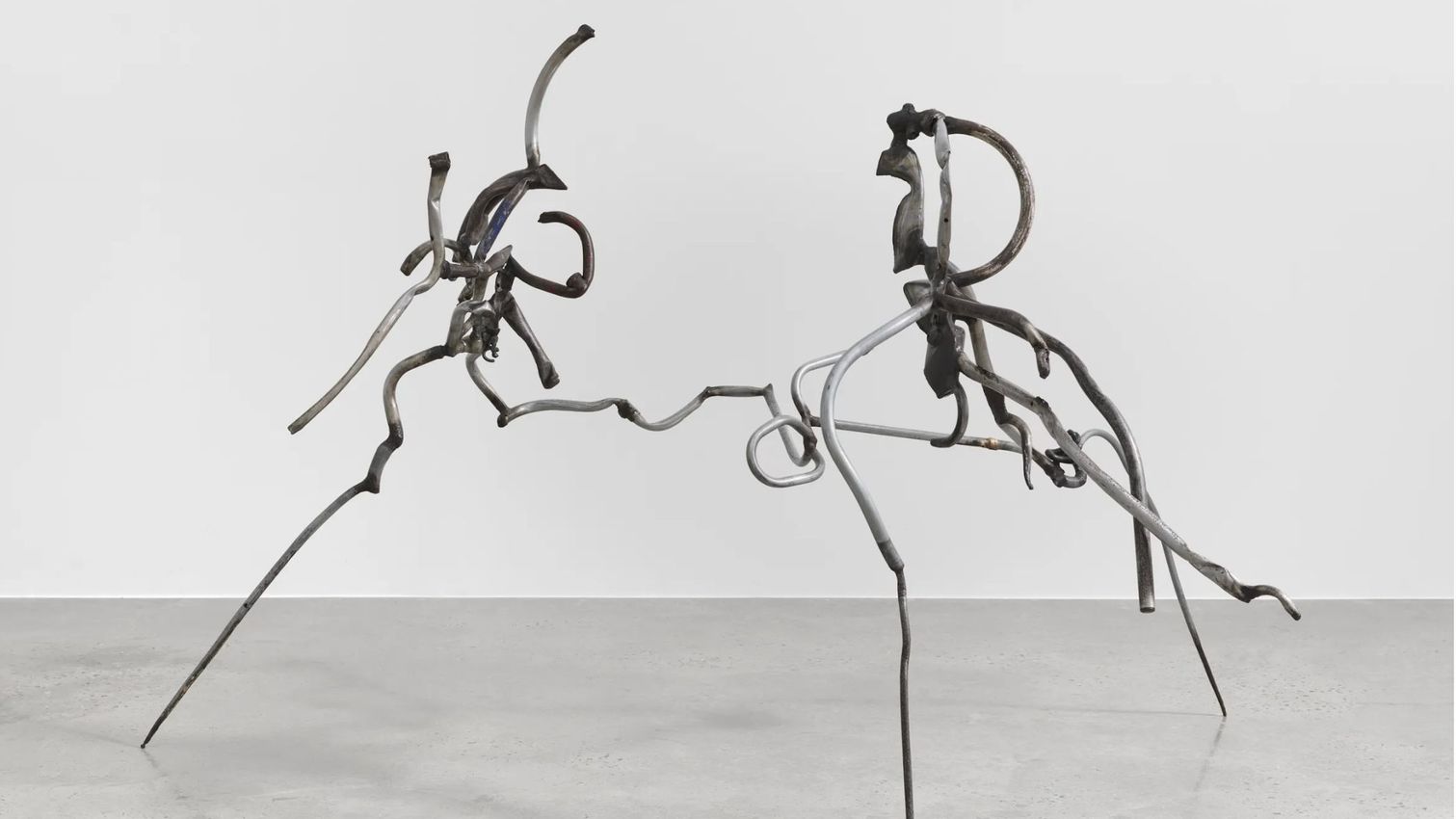
1935-2023, United StatesAmerican sculptor Richard Hunt (1935–2023) is a celebrated figure in African American art history. Over a seven-decade career, he staged more than 170 solo exhibitions and completed over 160 public commissions worldwide, making him one of the most prolific sculptors in modern American art.
The artist lived and worked in Chicago until his death in 2023.
Early life and Education
Richard Hunt was born in 1935 in Chicago, United States. His parents supported his interest in art from a young age, enrolling him in classes. Hunt began sculpting with clay at 15 in his bedroom studio, later moving to a basement workspace in his father’s barbershop.
Hunt earned a B.A.E. from the School of the Art Institute of Chicago (SAIC) in 1957. The artist received multiple prizes during his studies and his metalworking career was catapulted in 1956 when the Museum of Modern Art (MoMA) in New York acquired one of his pieces.
After graduation, Hunt was awarded the 1957 James Nelson Raymond Foreign Travel Fellowship, which allowed him to travel to England, France, Spain, and Italy. In 1971, at 35, Hunt became the first African American sculptor to hold a retrospective at MoMA.
Hunt’s work as an artist and educator active during the Civil Rights movement (1954–1968) has become an emblem and pillar for the community. His archive was added to the collection of Getty Research Institute’s African American Art History Initiative in 2022.
Richard Hunt Artworks
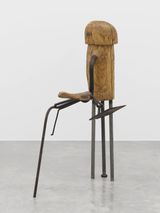
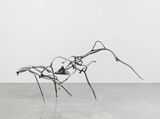
Richard Hunt’s welded bronze sculptures are rooted in the exploration of growth and freedom, commonly open form and composed from discarded metals from junk shops.
Early Career
Hunt was greatly inspired by Spanish sculptor Julio González after seeing his work in the 1953 exhibition Sculpture of the Twentieth Century at SAIC. Two years later, Hunt mastered welding and started integrating metals as a central element to his work.
In 1957, the MoMA acquired his steel work Arachne (1956). The sculpture, which is composed of welded found objects such as an automobile muffler and lampshades, depicts the mythological story in which the goddess Athena transforms a weaver into a spider.
Open form Sculptures
Taking inspiration from González’s oeuvre, Hunt similarly employed the techniques of open form sculpture, a movement that embraced negative space over solid masses. Throughout the 1960s, his welded forms took more abstract and linear shapes.
In Opposed Forms (1964), he created a human-sized sculpture that extends both vertically and horizontally, imbibing a certain loftiness to the material despite its physical qualities. Peregrine Forms (1965) similarly evokes a lofty atmosphere as the form leans to one side as if preparing to take flight.
Public Commissions
Hunt’s attentiveness to metal, found material, and open form sculpture enabled him to work across a range of scales and public spaces. He has secured over 160 public commissions globally, most of which are found in the U.S.
Hunt’s monumental pieces have been commissioned by local governments, places of worship, and arts institutions. Among them, Swing Low (2016), commissioned by Washington’s National Museum of African American History and Culture, presents a large-scale gold arrangement of welded bronze suspended from the museum’s ceiling.
The Light of Truth Ida B. Wells National Monument (2021), sited in Chicago’s Bronzeville neighbourhood, is an outdoor piece with monumental columns viewers can walk through. Standing with three prongs, the sculpture is topped with a burning flame in commemoration of the Black journalist, publisher, and civil rights activist, Ida B. Wells.
Richard Hunt Exhibitions
Richard Hunt has held over 150 solo exhibitions in his lifetime. Solo exhibitions have been held at institutions, including The Studio Museum Harlem, New York (2016); Museum of Contemporary Art, Chicago (2014); The Sculpture Center, Cleveland; Midwest Museum of American Art, Indiana (both 2008); and Charles H. Wright Museum of African American History, Detroit (1998).
Recent and current exhibitions:
- Richard Hunt: Pressure, Institute of Contemporary Art Miami, Miami, USA, 2 December 2025 – 30 March 2026.
- Freedom in Form: Richard Hunt, Loyola University Museum of Art (LUMA), Chicago, USA, 11 July 2025 – 15 November 2025.
- Richard Hunt: Metamorphosis – A Retrospective, White Cube Bermondsey, London, UK, 25 April 2025 – 29 June 2025.
- A Tale of Today: Materialities (including works by Richard Hunt), Driehaus Museum, Chicago, USA, 7 February 2025 – 27 April 2025.
- Richard Hunt: From Paper to Metal, Amon Carter Museum of American Art, Fort Worth, USA, 12 October 2024 – 2 March 2025.
- Freedom in Form: Richard Hunt, Abraham Lincoln Presidential Library and Museum, Springfield, USA, 25 October 2024 – 20 April 2025.
- Line to Form: Richard Hunt’s Prints and Sculpture, Madison Museum of Contemporary Art, Madison, USA, 5 September 2024 – 5 January 2025.
- Richard Hunt: Early Masterworks, White Cube, New York, USA, 13 March 2024 – 13 April 2024.
Selected public collections include De Young Museum, San Francisco; The Metropolitan Museum of Art, New York; Museum Moderner Kunst, Vienna; and Whitney Museum of American Art, New York.
Richard Hunt’s Miami Exhibition
Richard Hunt: Pressure at the Institute of Contemporary Art, Miami, is a major survey of the artist’s welded metal sculptures, anchored around themes of force, resilience and transformation. Timed with Miami Art Week 2025 and crossing over with Art Basel Miami Beach, the exhibition gathers key works from the 1950s through the late 20th century—alongside archival materials—highlighting how Hunt’s abstract forms respond to histories of industrial labour, the Civil Rights era and the evolving language of public sculpture.
Richard Hunt FAQs
Who is Richard Hunt?
Richard Hunt was a pioneering American sculptor known for transforming welded metal into abstract, open form works that explore themes of growth, freedom and transformation. Over a seven-decade career, he became one of the most prolific sculptors in the United States, with more than 170 solo exhibitions, over 160 public commissions, and works held in major museums such as The Metropolitan Museum of Art, the Whitney Museum of American Art and the de Young Museum.
What is Richard Hunt best known for?
Richard Hunt is best known for his welded steel, bronze and stainless-steel sculptures that combine industrial materials with an organic sense of movement and open form. His work often incorporates discarded metal from junkyards, reimagined as soaring abstract structures that reference nature, myth and African American history, especially in large-scale public commissions like Swing Low and The Light of Truth Ida B. Wells National Monument.
Where can I see Richard Hunt’s sculptures?
Richard Hunt’s sculptures can be seen in both museum collections and public spaces across the United States and abroad. Major institutions holding his work include The Metropolitan Museum of Art and the Whitney Museum of American Art in New York, the de Young Museum in San Francisco, and Museum moderner Kunst in Vienna, while his public commissions appear in cities such as Chicago, Washington, D.C., and many other U.S. locations.
What is ‘Richard Hunt: Pressure’ at ICA Miami focused on?
Richard Hunt: Pressure is a major survey exhibition at the Institute of Contemporary Art, Miami, running from 2 December 2025 to 30 March 2026. The show, presented during Miami Art Week, brings together a focused selection of sculptures from the 1950s onward to examine how Hunt’s abstract metal forms engage with ideas of force, resilience, and the social histories surrounding the Civil Rights era and public space.
Who represents Richard Hunt’s estate?
Richard Hunt has been represented by White Cube and Kavi Gupta, who continued to work with museums and collectors to steward his legacy following his death in 2023. The artist’s archive is held in part by the Getty Research Institute’s African American Art History Initiative, ensuring that his papers, records and research materials are preserved for future scholarship.
Ocula | 2025










Explore and Follow Artists Shaping Contemporary Art
A respected voice in contemporary art discourse.
Focusing on ambitious storytelling and insightful art-world commentary. Ocula Magazine publishes in-depth interviews, critical essays and timely analysis on the artists, exhibitions and ideas driving the global art world.
Learn more about Ocula Magazine
Showcasing the best of the art world.
Ocula partners with galleries from around the world to highlight their artists, artworks and exhibitions. Gallery membership is by application and invitation, with each member vetted by an independent panel.
Learn more about Ocula Membership
Specialises in the sale of major artworks.
Led by a team with deep ties to the world’s leading auction houses, galleries and collectors. Ocula’s advisory team offers bespoke services to high-net-worth clients from around the world who are looking to acquire the best of contemporary and modern art.
Learn more about our team and services