





LUCIO FONTANA
1899-1968, ArgentinaLucio Fontana, the visionary founder of Spatialism, forever transformed contemporary art by slashing and puncturing his canvases, inviting viewers to contemplate the infinite space beyond the surface. His radical gestures—most famously the Concetto spaziale series—redefined the boundaries of painting, sculpture, and installation, making Fontana one of the most influential artists of the 20th century.
Early Years
Born in Rosario, Argentina, to Italian parents, Fontana grew up between Argentina and Italy, deeply influenced by his father Luigi Fontana, a renowned sculptor. He began his artistic training in his father’s atelier in Rosario, producing public and commemorative sculptures before returning to Milan in 1927 to study at the Accademia di Brera under Adolfo Wildt.
Fontana’s early career was marked by a blend of figurative and abstract works, and he took part in the first exhibition of Nexus, a group of young Argentine artists, in 1926. He would later split his time between the two countries, establishing studios and exhibiting on both continents.
Lucio Fontana Artworks
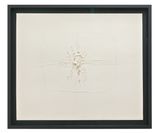
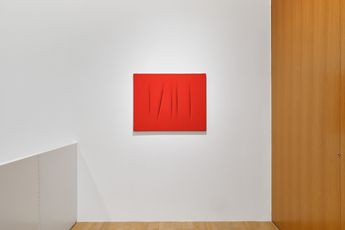
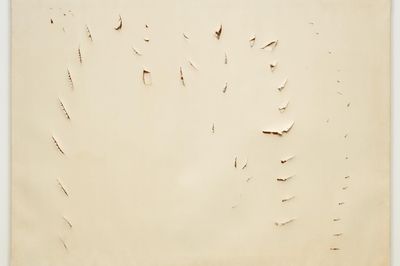
Fontana’s art is defined by a relentless pursuit of new dimensions, merging painting, sculpture, and architecture to create works that transcend traditional boundaries. His Concetto spaziale (Spatial Concept) series, begun in the late 1940s, features canvases slashed or punctured to reveal the void, symbolising an ‘endless space’ and the artist’s desire to move beyond the picture plane.
Early Sculpture and Abstract Works
Fontana’s earliest works were public sculptures and reliefs, including commissions in Rosario and Milan in the 1920s and 1930s. In the 1930s, he joined the Abstraction-Création group in Paris and held his first solo exhibition of abstract works at Galleria del Milione, Milan, in 1935.
The Birth of Spatialism
After the destruction of two world wars, Fontana asked himself, ‘What can I now paint?’ He felt a need to start again, from the beginning. In 1946, Fontana founded the Altamira Academy in Buenos Aires and co-authored the White Manifesto, which called for a new art form integrating matter, color, sound, and space. Returning to Milan in 1948, he began his iconic Concetto spaziale works, first with buchi (holes) and later with tagli (slashes), transforming the canvas into a three-dimensional object.
Major Series and Innovations
- Concetto spaziale (buchi): Punctured canvases forming patterns or abstract designs, challenging the flatness of painting.
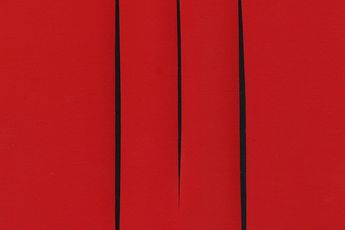
- Concetto spaziale (tagli): Monochrome canvases sliced with a blade, exposing black gauze beneath to evoke the cosmos and infinity.
- Fontana also experimented with ceramics, embedding glass, sand, and other materials into his works, and created large-scale environmental installations and public commissions.
Select Public Commissions
- Monument to educator Juana Elena Blanco, El Salvador cemetery, Rosario.
- Bas-relief models for the façade of the Parochial Church of the Assumption in Piani, Celle Ligure (1958).
Select Awards and Accolades
- Grand Prize for Painting, Venice Biennale (1966).
- 2018 Global Fine Art Award, Best Impressionist and Modern category, for ‘Lucio Fontana. Ambienti/Environments’ at Pirelli HangarBicocca, Milan.
Exhibitions
Lucio Fontana has been the subject of both solo exhibitions and group exhibitions at important institutions. Below is a selection of important exhibitions.
Solo Exhibitions
- Lucio Fontana. Ambienti/Environments, Pirelli HangarBicocca, Milan (2017–2018)
- Lucio Fontana: On the Threshold, The Metropolitan Museum of Art, New York (2019)
- Musée d’Art Moderne de la Ville de Paris, Paris (2014)
- Hayward Gallery, London (1999)
- Peggy Guggenheim Collection, Venice (2006)
Group Exhibitions
- Venice Biennale, Italy (1930, 1948, 1950, 1954, 1958, 1964, 1966, 1968)
- Documenta, Kassel, Germany (1959, 1968)
- Centre Pompidou, Paris (1987)
- Museum Moderner Kunst Stiftung Ludwig, Vienna (1996)
- Whitechapel Gallery, London (1999)
Website
Lucio Fontana’s official foundation website can be found here.
Lucio Fontana FAQs
Where can I see Lucio Fontana’s artworks?
Lucio Fontana’s works are held in major public collections worldwide, including the Tate Modern in London, the Museum of Modern Art in New York, the Centre Pompidou in Paris, and the National Gallery of Art in Washington, D.C. Notable recent exhibitions have taken place at The Metropolitan Museum of Art, New York, and Pirelli HangarBicocca, Milan.
What is Lucio Fontana best known for?
Lucio Fontana is best known for his Concetto spaziale series, in which he slashed or punctured canvases to create a new spatial dimension in art. This radical gesture is seen as a defining moment in twentieth-century contemporary art.
Did Lucio Fontana receive any major awards?
Fontana received the Grand Prize for Painting at the Venice Biennale in 1966, one of the highest honours in the art world.
Are there any random and interesting facts about Lucio Fontana?
Fontana’s Concetto spaziale, La fine di Dio (1964) set an auction record for the artist, selling for over $29 million in 2015. He also co-authored the influential White Manifesto, which helped define the Spatialist movement.
How do you pronounce Lucio Fontana’s name?
Lucio Fontana is pronounced: LOO-cho fon-TAH-nah.
What impact did Lucio Fontana have on contemporary art?
What is the official foundation for Lucio Fontana?
The Fondazione Lucio Fontana in Milan is dedicated to preserving and promoting his legacy, supporting research, exhibitions, and publications about the artist.
Ocula | 2025


Explore Lucio Fontana's Exhibitions






Lucio Fontana in Ocula Magazine







Explore and Follow Artists Shaping Contemporary Art
A respected voice in contemporary art discourse.
Focusing on ambitious storytelling and insightful art-world commentary. Ocula Magazine publishes in-depth interviews, critical essays and timely analysis on the artists, exhibitions and ideas driving the global art world.
Learn more about Ocula Magazine
Showcasing the best of the art world.
Ocula partners with galleries from around the world to highlight their artists, artworks and exhibitions. Gallery membership is by application and invitation, with each member vetted by an independent panel.
Learn more about Ocula Membership
Specialises in the sale of major artworks.
Led by a team with deep ties to the world’s leading auction houses, galleries and collectors. Ocula’s advisory team offers bespoke services to high-net-worth clients from around the world who are looking to acquire the best of contemporary and modern art.
Learn more about our team and services