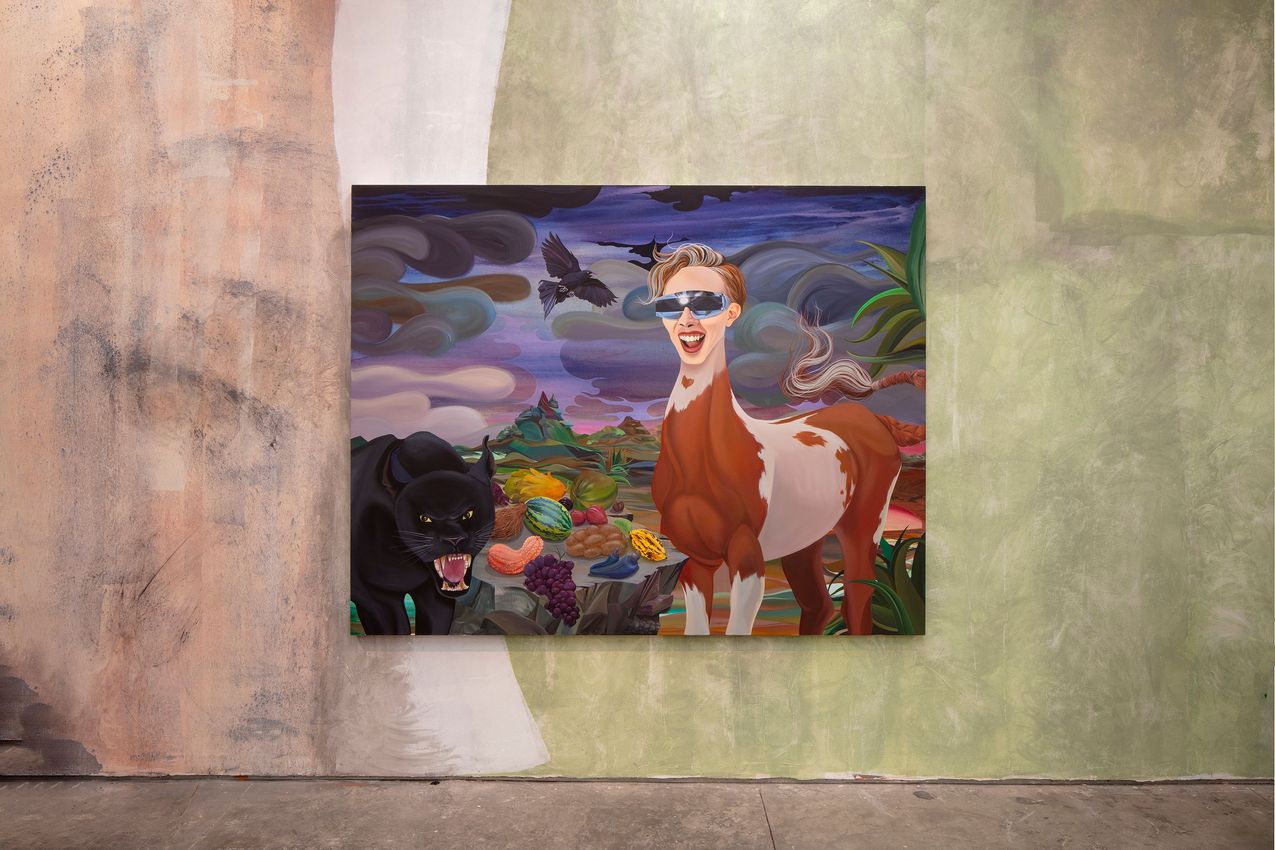
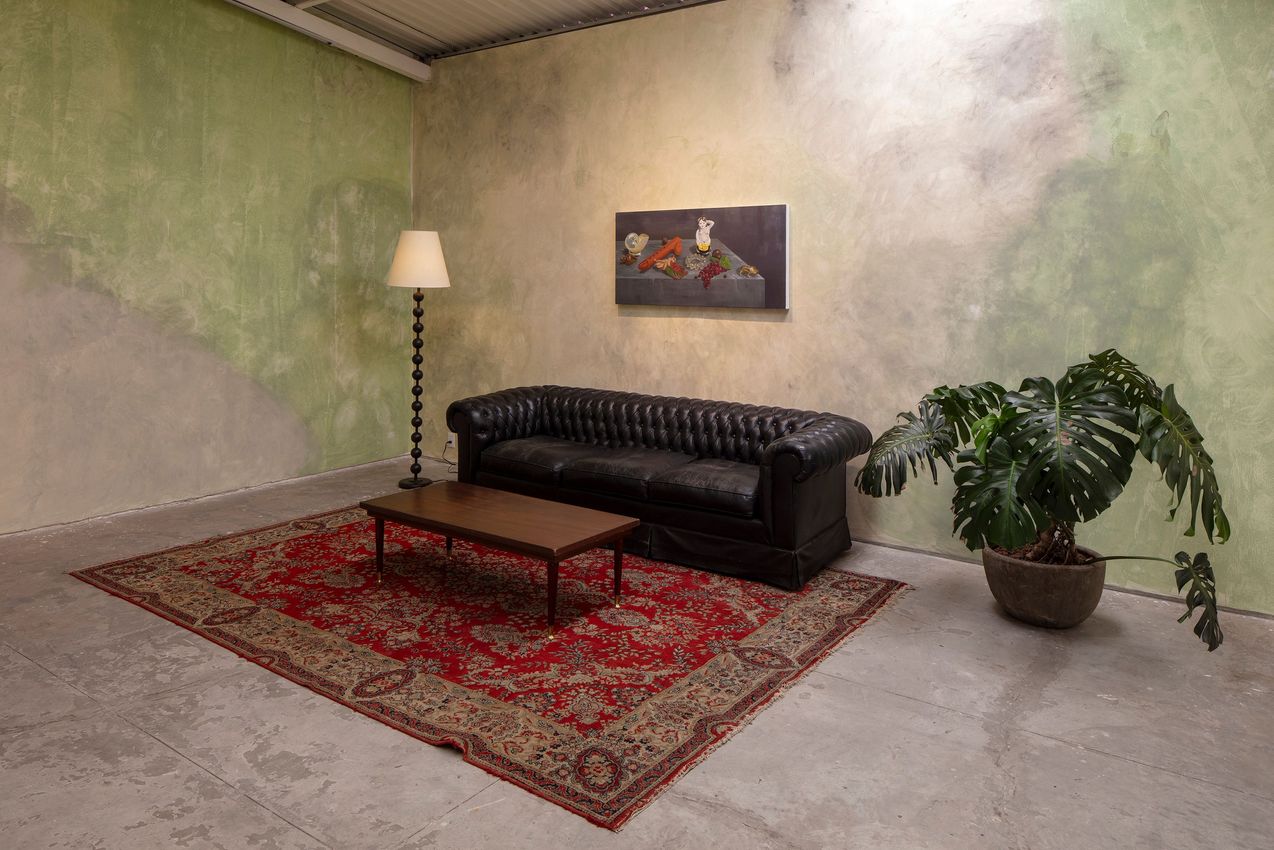
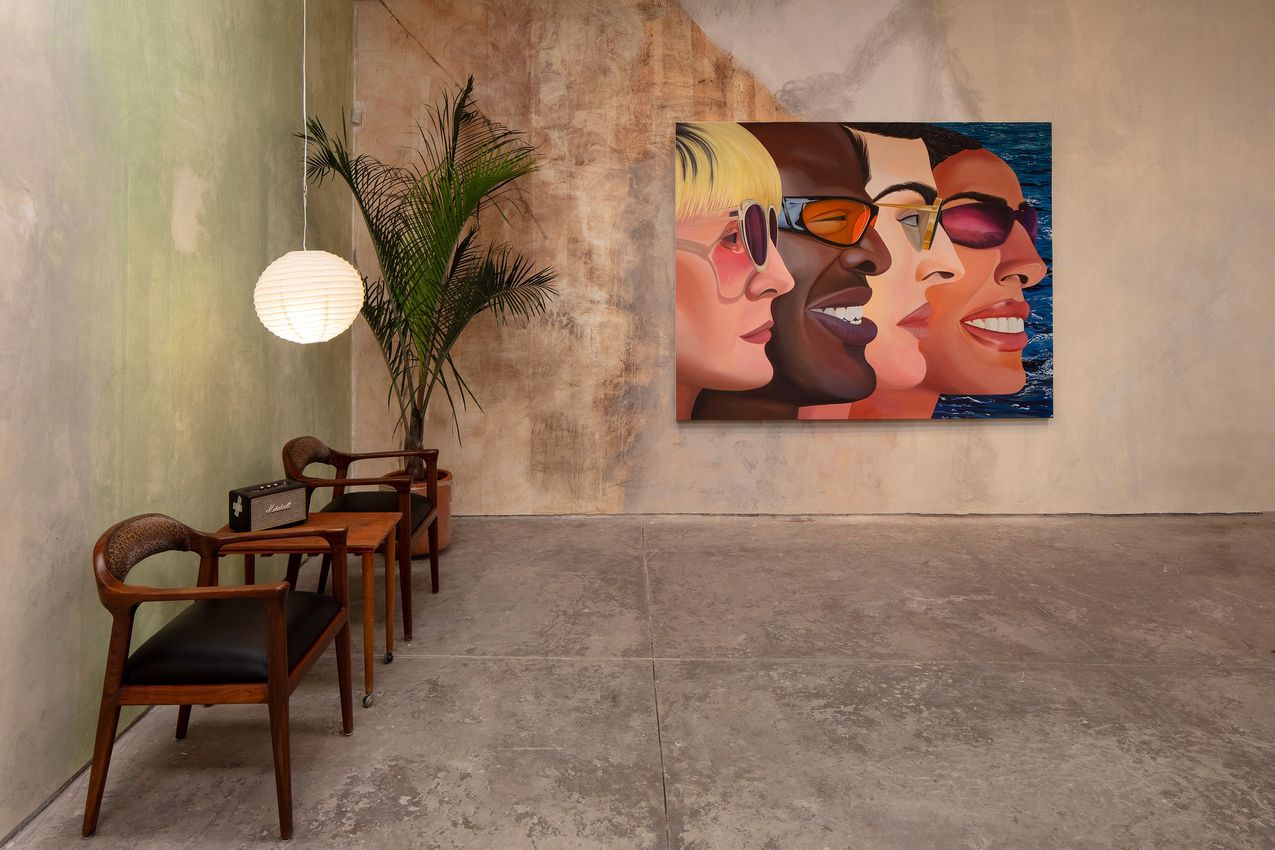
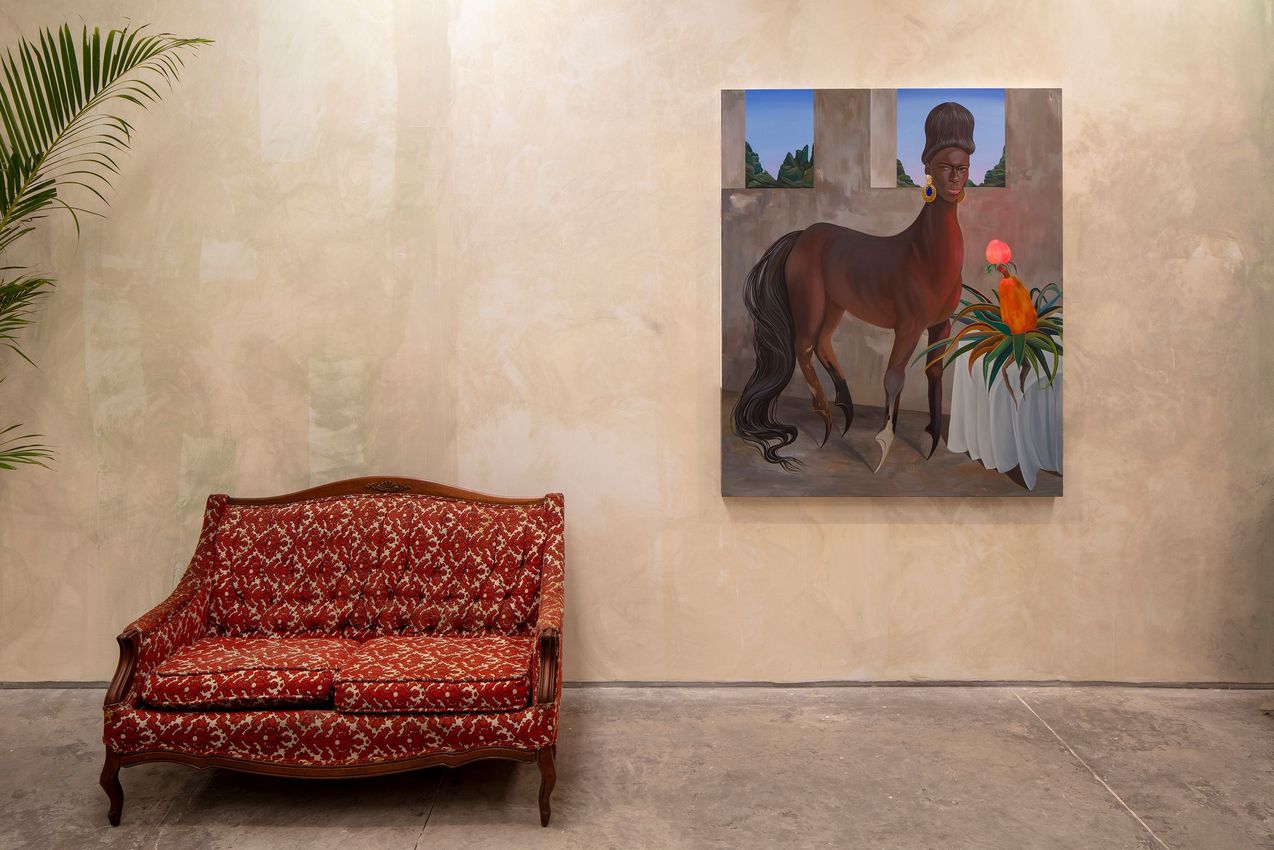
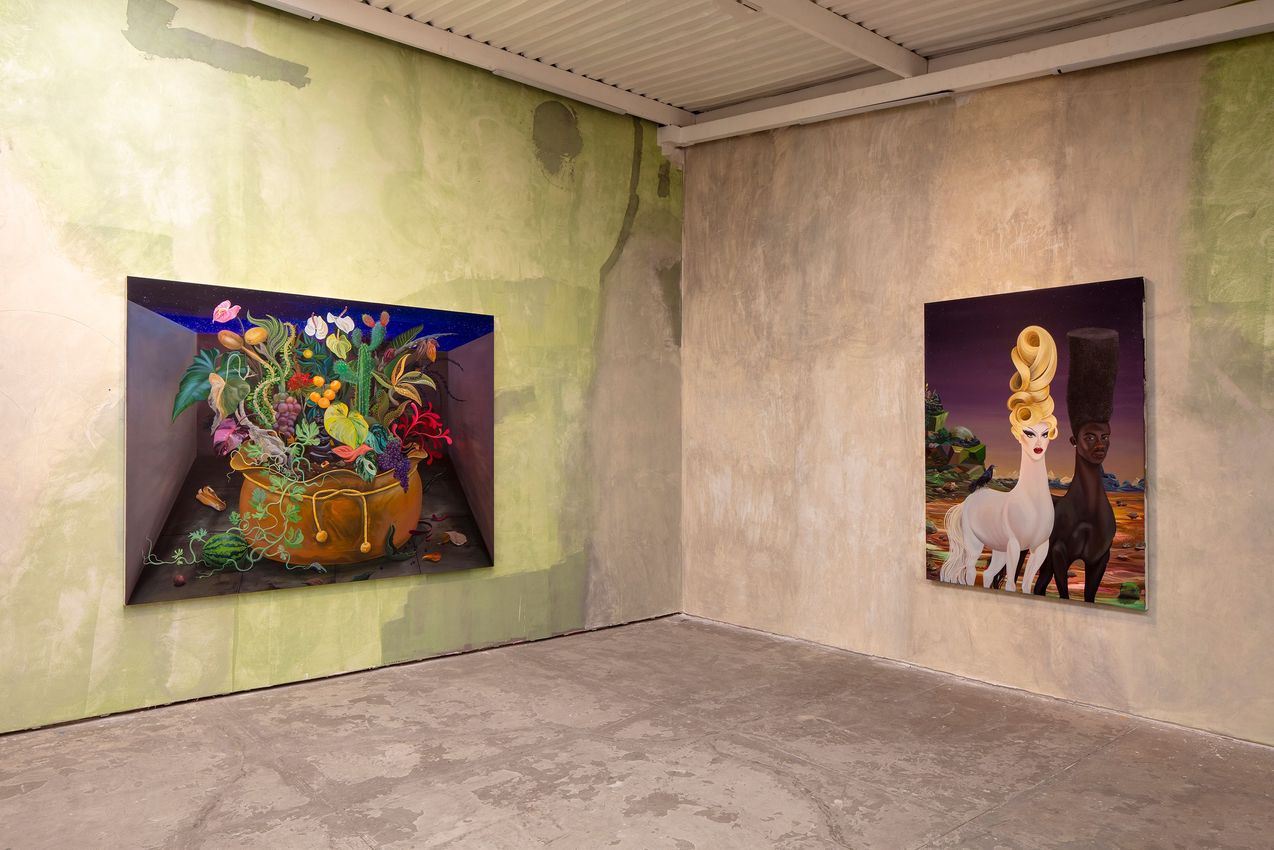
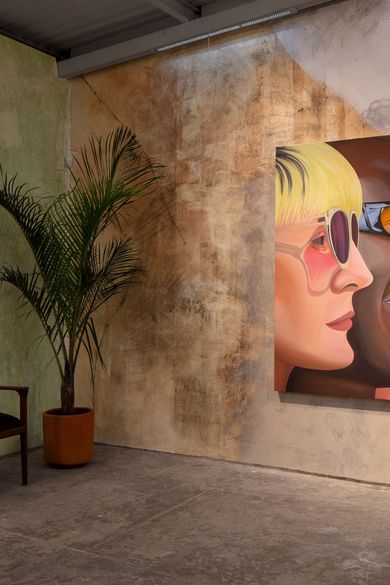
Dalton Gata’s paintings complicate the usual encounter between subject and landscape in order to transgress portraiture as a genre. His protagonists, beautified beyond what is normally and arbitrarily defined as ‘natural,’ are always surrounded by impossible, similarly artificial landscapes: glittery, endless oceans, alien wastelands, utterly dysfunctional brutalist structures. Gata doesn’t limit himself to depicting the human—or the quasi-human—,he also turns his eye to botanical subjects. It is never about faithful representation, like the colonial catalogs of flora and fauna, no, just like his human-animal chimeras, his plants are in a state of mutant florescence: fruits that give birth to other fruits, branches growing maracas, cacti of disorienting proportions—a show of flamboyant, psychedelic exuberance.
Gata’s creatures appear not only aware, but defiant of that tangled knot—what Sylvia Wynter describes as the ‘symbolic code of life/death’—from which the highly surveilled, lethal, and arbitrary borders that justify sexism, racism, homophobia, transphobia, and speciesism emerge. Gata’s beings understand this perfectly, and luckily, they know a couple tricks: they shimmy a little and suddenly the knot comes loose, they’re free, gazing optimistically at a new horizon, or confronting the viewer with a smile, “So when are you going to let go?” His beasts beckon us to their hybrid confines, their overlapping categories confront us with the monstrous that is simultaneously beautiful.
The chimeras pose—they know they are being watched, professionally lit. They’re used to the judgmental, envious gaze of the normative eye, and they even expect it: they adorn and arrange themselves to welcome it. They’re the stars of their own mythological fashion editorial. They embody that photographic, editorial quality in Gata’s painterly eye: the defiant stare of his subjects, the sharpness and the hyper-saturated colors align more with the poetic yet revindicating fashion imagery of Tyler Mitchell, Deana Lawson, or Omar Victor Diop, than with the art historical, white, canon.
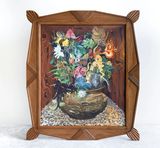
It’s in that against-the-grain spirit that the party and its dislocations become important as well—a break for mutual celebration, for the euphoria of escapism and pleasure, of postponing the rigor of existence. And perhaps because occasional liberation doesn’t guarantee utopia, the party here is not a placeholder for the promised land: it involves chaos, sweat, pleasure, frenzy, and risk. In Gata’s creation, ruin appears as the counterpart to fantasy: his still lifes wear lively drag, they are memento mori of Caribbean exuberance. It’s a lavish, island ruin—surrounded by the sea’s corrosive breeze, by humidity that eats away at yellowing walls, by flesh shining with salty sweat.
These works also aim to evoke an itinerant existence, the ordinary but no less heavy burdens of constant relocation, of always carrying one’s own instability, even if it goes hand in hand with the will to beautify one’s surroundings, to give a quick “manita de gato” (a touch-up) to what we know is not our own—the vulnerable beauty one snatches from that which doesn’t seem willing to cooperate. Gata sublimates his lived experience in these fantastic compositions—within them are traces of his intimacy, of his scrolling, of his lovers, his recent past, the friendships and loved ones that rescued his boat from the high seas of precarity, that harbored his imagination. They are migrant beings, revelers, inhabitants of a kitsch domesticity—beasts of the night, of the beach, and of the future.
The beast-works accompany one another—they make up their own world: more fabulous, more glamorous, one day maybe possible.
— Gaby Cepeda
Courtesy of OMR, Mexico City.


OMR is a contemporary art gallery in Mexico City, founded by Patricia Ortiz Monasterio and Jaime Riestra in 1983. Over the past four decades, the gallery has fostered and developed the careers of numerous emerging and established artists throughout Latin America and globally; OMR has established itself as a pioneering Mexican contemporary art space, presenting over 400 exhibitions across all media and genres, and participating in art fairs around the world.
Calle Dr Liceaga 41
Col. Doctores
Tuesday - Friday; 10am-6pm

A respected voice in contemporary art discourse.
Focusing on ambitious storytelling and insightful art-world commentary. Ocula Magazine publishes in-depth interviews, critical essays and timely analysis on the artists, exhibitions and ideas driving the global art world.
Learn more about Ocula Magazine
Showcasing the best of the art world.
Ocula partners with galleries from around the world to highlight their artists, artworks and exhibitions. Gallery membership is by application and invitation, with each member vetted by an independent panel.
Learn more about Ocula Membership

Specialises in the sale of major artworks.
Led by a team with deep ties to the world’s leading auction houses, galleries and collectors. Ocula’s advisory team offers bespoke services to high-net-worth clients from around the world who are looking to acquire the best of contemporary and modern art.
Learn more about our team and services