Press Release

There’s something mutinous about a horizontal arc, toppled over. As art historian Maurice Fréchuret notes in his writing on French conceptual artist Bernar Venet, the archway has long been asymbol of power. And it’s true: upright at city entrances, archescorral bodies and attention toward the center. They tunnel ustoward meaning, order, and control. Venet’s leaning, fallen arcs reject all that indoctrination. (After all, an arc for Venet is neutral, amonosemic unit of geometry.) With an impulsive flare, he let’s go of structure, meaning, and even artistic authority. The rest is gravity.

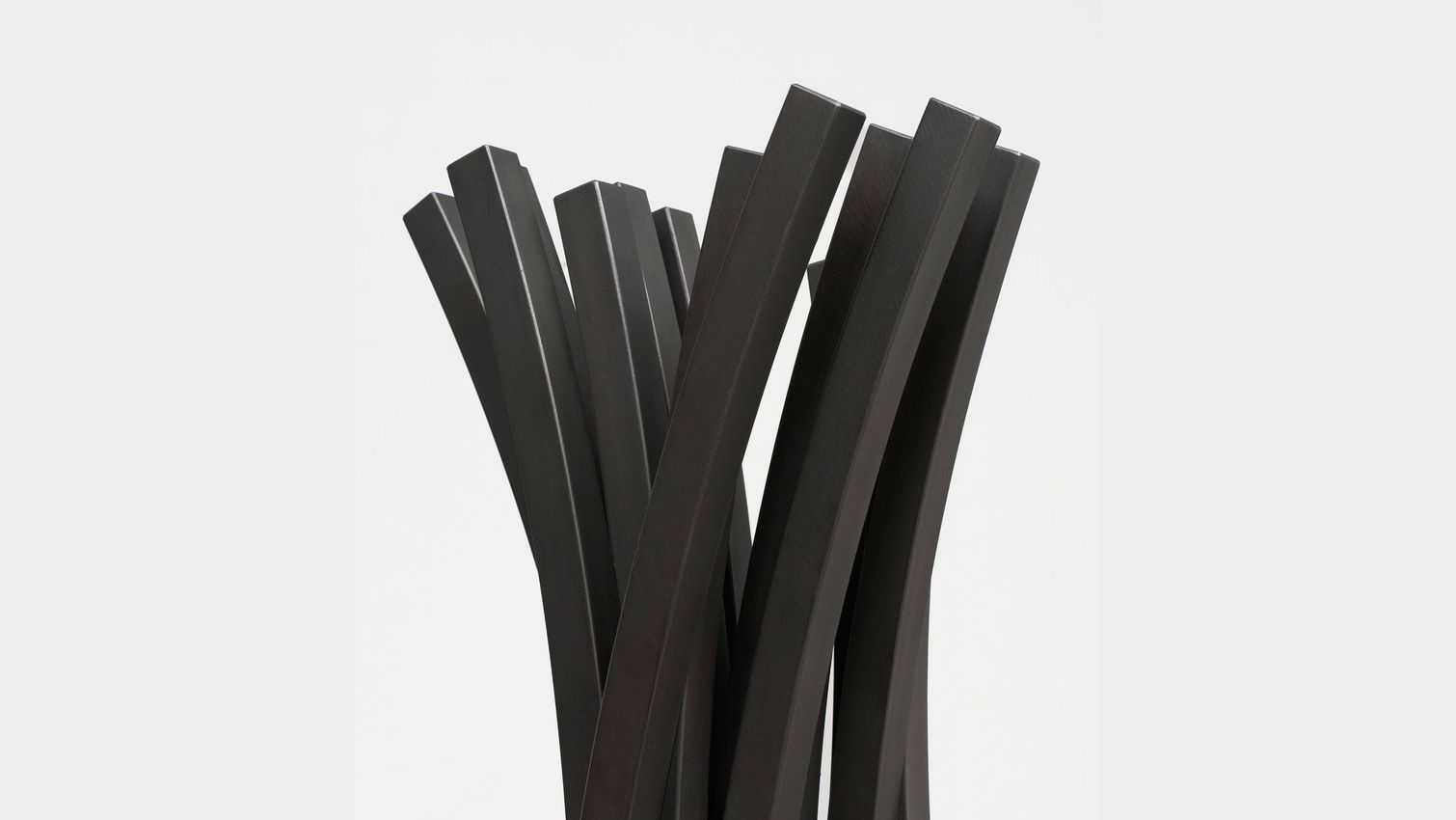
Archetypes, Venet’s solo show at Perrotin Shanghai, is a candidand philosophical meditation on the curved line. The exhibition features a performance, four works on paper, and five sculptures. The arcs, tangled parentheses of black patina or rusted flush, holdan elegantly improbable allegiance to both geometry and disorder.

Indifferent to design or will, the artist’s renegade forms find theirown shape. To illustrate the point, Venet—now 84—sprang fromhis chair at a recent M+ Museum talk in Hong Kong. “Withoutlooking,” he said, as he darted in place, shuffling imaginary liquid tar in invisible arcs beneath him, “I’d move my feet this way and thatacross the paper to make uncontrolled artworks. Just like I’m still doing today!”

Venet has likened his artistic path to sleepwalking, a “combination of accidents and discoveries.” Early on, in the 1960s, he set out to dematerialize art altogether using mathematical equations, diagrams, and maps. These sterile, blank-eyed compositions were pure information, and, brilliantly enough, pure abstraction. They asked, ineffect: Can raw data, stripped of narrative or style, be art?

It was a radical advancement in conceptualism, and Venet knew it. In 1967, he said as much, albeit politely, to Marcel Duchamp,who was then more than 50 years his senior. Duchamp, in hischaracteristically quick-witted way, replied: “La vente de vent estl’event de Venet.” The sale of wind is the event of Venet.

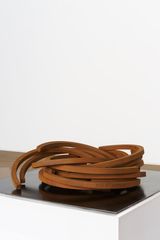
That early logic, buoyed now by a greater scientific andphilosophical rigor, continues in Archetypes. On one side of the gallery, four maquettes rest on two pedestals, their radicality easy to overlook. These low-slung nests of arcs, dating from 1998 to 2025,share an affinity for entropy found in Venet’s earliest works: theartist’s body sprawled amid trash in Performance in Garbage (1961);the mound in Pile of Coal (1963) collapsing across the gallery floor.

At scale, Venet’s arcs grow cinematic. Versailles Effondrement: 85.8˚ Arc x 16 (2018), now installed outdoors in the south of France, begins with the drama of one towering arc capitulating. The rest follow, sixteen steel giants cascading into a whimsical heap. This spectacle of gravity and chance reappears in Archetypes, during aperformance on opening night. A four-and-a-half-meter curved steelbar, rolled in paint and suspended from the ceiling, is swung by theartist against the wall. The residual marks will remain in the gallery, a site-specific industrial fascia of a painting.

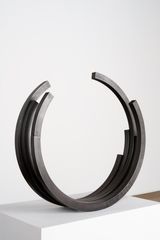
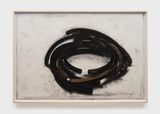
Across the long gallery room, two maquettes of vertical arcsstretch upwards. Flanking them are two large charcoal and oil stickdrawings of interlocking arcs. The works here are self-referential, yetthey echo Convergence: 54.5° Arc x 14, Venet’s recent commission for the 2024 Paris Olympic Games. In that now permanent publicsculpture, fourteen arcs rise in a tented embrace, evoking the Olympic Flame.

Whether in steel or in softer charcoal, the tufted arcs build aporous architecture. Their negative spaces, the hooded eyeletsand vacancies between limbs, add a magnetism. And if they areaccidentally beautiful, it’s the beauty of dancers’ bodies, insolentand orchestral.

Text by Paige Haran, Courtesy Perrotin.

Read More
About the Artist

As a central figure on the international art scene, Bernar Venet (born in Château Arnoux in 1941) has lived mainly in New York since 1966, and now resides in Le Muy in the Var where the Venet Foundation organizes exhibitions every summer. The very radical artistic positions of his period in Nice, as well as those he adopted upon his arrival in the United States, allowed him to exhibit early on with the great representatives of Minimal and Conceptual Art of the time. Particularly recognized for his monumental sculptures in corten steel, his work has continued to flourish and to be celebrated accross diverse fields including painting, performance, poetry, sound, design and photography.

View Artist Profile

Also Exhibiting at Perrotin

About the Gallery
Emmanuel Perrotin founded his first gallery in 1989 at the age of 21. He has opened since then over 17 different spaces, with the aim of continuing to offer increasingly vibrant and creative environments to experience artists work. He has worked closely with his roster of artists, some since more than 25 years, to help fulfil their ambitious dreams and projects. The gallery is now based in New York, Paris, Hong Kong, Seoul, Tokyo, and participates in all the significant worldwide art fairs each year (Art Basel (Hong Kong, Miami, Basel), Frieze (London, New York), FIAC (Paris), Dallas Art Fair, Art Cologne, Art Stage Jakarta, Expo Chicago, Art021 & West Bund Art & Design, Shanghai, Zona Maco Mexico, amongst others).
View Gallery Profile
Address
3/F, 27 Huqiu Road
Huangpu District
Shanghai
China
Opening Hours
Tuesday – Saturday
11am – 7pm
(1)
Shanghai 3/F, 27 Huqiu Road, Huangpu District
Perrotin
3/F, 27 Huqiu Road, Huangpu District, Shanghai, China
+86 216 321 1234
http://www.perrotin.com

Opening hours
Tuesday – Saturday
11am – 7pm
The art world in focus