Press Release

Perrotin Tokyo is pleased to present Sometimes, a solo exhibition by the Beijing-based Chinese artist Chen Fei. Since the cycle of paintings centered on intimate relationships with his daughter and those around him, presented in the 2025 solo exhibition Father and Child at The Watari Museum of Contemporary Art, Chen Fei has continued to revisit themes that have long animated his practice: family, intimacy, identity, social roles, taste, and the unstable boundary between private experience and public image. The works brought together in Sometimes, however, move beyond a simple extension of autobiographical narrative. They mark a transitional moment in which Chen renews his painterly vocabulary, testing genre, surface, composition, and narrative structure through a more fluid and materially charged approach.

Working in figuration for more than two decades, Chen has often used acrylic paint for its speed, clarity, and capacity to generate an almost frictionless image. In his recent works, he pushes the medium beyond its familiar flatness, introducing tactile effects that complicate the smooth surface typically associated with his paintings.

In Afterimage (2026), for instance, the brownish, earthy figure in the foreground has been treated with a fast-drying agent, causing the paint to crack and reveal the wallpaper pattern beneath. The resulting surface opens a tension between image and support, figure and ground, visibility and concealment. What first appears as a pictorial incident gradually takes on material force, prompting viewers to consider how narrative may emerge from composition, texture, and the physical behavior of paint.

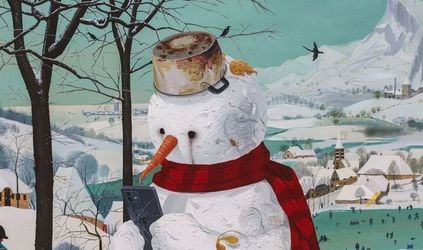
This expanded attention to surface coincides with Chen’s first attempt at introducing fictional characters into his work. The snowmen in the recent Homesickness cycle are partly informed by the popular revival of northeastern Chinese culture often described as the “Dongbei Renaissance,” as well as by the literature and cinema associated with its affective register: nostalgia, humor, economic stagnation, working-class endurance, and the melancholy of places transformed by reform, development, and decline. Chen’s snowmen become fragile, absurd, and strangely human vessels through which social experience can be displaced into fiction. Found and painted visual elements—cigarette butts, withered leaves, bottle caps, footprints, cracked ice—lend these figures a bodily and narrative density, as if the characters themselves have absorbed the traces of their surroundings.

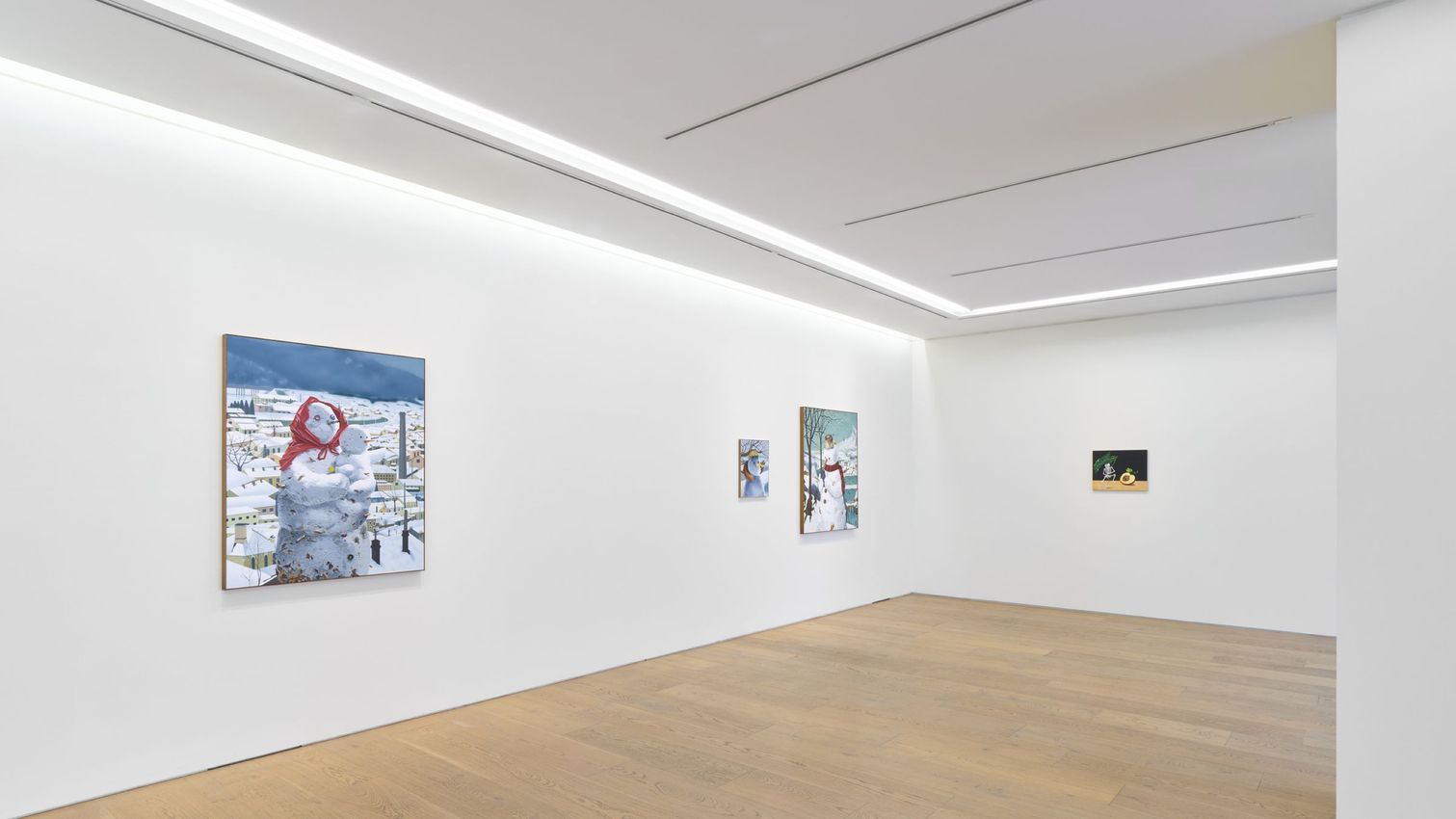
In Homesickness (2024), a snowman stands prominently in the foreground, his back turned toward the town behind him. Holding a smashed mobile phone, his body marked by stomped footprints, he appears suspended before the possibility of return. To his left, men carrying skis pass by, while the town in the distance—presumably the place he once called home—has seemingly been converted into a winter resort, marked by cheap hotels, delivery workers, and an amusement park in the distance. Chen’s composition recalls Pieter Bruegel the Elder’s The Hunters in the Snow (1565), a source that, according to the artist, emerged almost subconsciously: when a subject needs to be painted, certain images begin to surface in the mind. The affinity extends beyond form. Bruegel’s winter landscape embeds human labor, seasonal rhythm, and communal life within a panoramic world. Chen’s reworking shifts this historical structure into a contemporary condition, where homecoming is shadowed by migration, economic transformation, and the uneasy conversion of lived places into consumable scenery.

The bittersweet tension that gives _Homesickness___its impact continues in Homesickness II (2026) and Homesickness III (2026). In the former, a stay-at-home mother, longing for reunion with her husband, holds a child who may require special care. In the latter, a hollow-eyed youth looks outward with an almost exhausted vacancy, while a squirrel wrapped around his neck gnaws at the last kernels of corn on his nose, offering comic absurdity and a fragile suggestion of warmth. Remarkably, Chen sets these figures against serene, even idyllic snow-covered vistas whose stillness borders on the uncanny. With sparse human activity and a near-dormant sense of livelihood, these landscapes recall the restrained monumentality and muted psychological charge of Soviet Severe Style. Through such compositional restraint, Chen continues to test what realism might mean today, approaching it as a structure in which humor, exhaustion, tenderness, and historical pressure coexist.

The exhibition extends this collision of sensibilities into the gallery space itself. A grass-patterned motif covers part of the walls, recalling the printed fencing commonly found across construction sites in China, where images of greenery separate pedestrians from the labor and disorder taking place behind them. The two paintings in the room - Blue Giant (2025) and Blue Giant 2 (2026) - embody a friction between fantasy, violence, and idyll. By folding the iconic scene from La La Land into the opening of Masao Kakihara’s mouth—the yakuza enforcer from Ichi the Killer, here imagined playing the saxophone—Chen allows cinematic romance and macabre violence to occupy the same frame, refusing simple categories of parody or homage, forming instead a mise en abyme in which incompatible visual worlds become mutually contaminating.

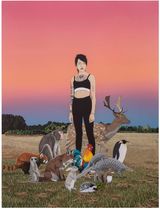
Yuko Hasegawa has observed that Chen Fei “belongs to a generation that saw the collapse of grand political narratives.”¹ This condition is crucial to understanding the way meaning operates in his work. Chen noted that a painting for him rarely begins with a fixed meaning, but often springs from fascination, personal intrigue, a visual challenge, or the desire to render a particular texture, image, or detail. Meaning arises later, through the convergence of compositional elements and through the viewer’s gaze, which he leaves deliberately open to interpretation. The copulating toads in the corner of The Animal World (2023–2024), or the ambiguous surface that may be a marble countertop, a stage, or “The Wold”—intentionally misspelled—exemplify this work approach. The image offers clues, jokes, and traps, while refusing to stabilize into a single interpretation.

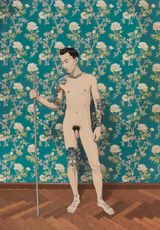
Other works in Sometimes extend Chen’s signature autobiographical approach while undermining the conventions of portraiture and still life. The two self-portraits in the exhibition tempers with the balance between recognisability and authorship in self-representation. Rather than present the human face as the privileged site of identity, Chen withholds and disperses information. What, then, do symbols, bodily marks, tattoos, appropriated images, and art-historical references communicate about the subject? In Self-portrait (1), the artist’s body becomes an eclectic archive of visual icons: Peppa Pig, an anatomical heart, Nancy reading an art book, an X-rayed Little Mermaid, and an M.C. Escher star across the chest. Are these images sufficient to construct an idea of who the artist is? Do they disclose taste, memory, humor, desire, or the instability of all such categories? What is shown only deepens the question of what remains concealed.

In Self-portrait (2), Chen offers another aspect of himself through humor and blasphemous art-historical play. The work takes up Albrecht Dürer’s engraving Adam and Eve (1504), in which the first man and woman stand frontally beneath the Tree of Knowledge in the Garden of Eden. Dürer’s image, long understood as an exemplary articulation of ideal male and female beauty, is stripped of its didactic authority when transformed into a tattoo-like image on human skin. Chen replaces Adam and Eve’s faces with smiley emojis; exchanges the cat, rabbit, ox, and elk—traditionally associated with the four humors and human temperaments—for docile dogs of his own; and rewrites Dürer’s signature into an ambiguous imperative. Through these substitutions, the work stages a broader evolution in visual dissemination: canonical images circulate, mutate, and reappear as jokes, tattoos, memes, and personal emblems.

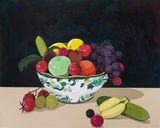
Chen’s treatment of “totality” and “completeness,” is another response to painterly conventions reinforced by his formal academic training, where the boundary between subject and context was expected to remain distinct. In recent years, he has increasingly turned toward compositions that feel open-ended, as if the painting were a fragment of an image-world that could continue indefinitely beyond the canvas. Previously explored through sprawling still lifes, this strategy reappears in Still-life (2024) and Family (2025). Without clearly defined facial structures, the subjects remain difficult to identify, even as their features are meticulously rendered. Recognition is delayed, and the image becomes less a portrait of particular individuals than an inquiry into how likeness is produced, withheld, or dispersed.

The exhibition culminates in Middle-aged Competitor, a freestanding bust portrait that extends from Chen’s 2017 work National Condition. In the earlier painting, a younger version of the artist stands on a corner coffee table, wearing a smirk of satisfaction as he looks toward a couple with a Black child in a middle-class domestic setting. In Middle-aged Competitor, that youthful self-image has been displaced by a battered middle-aged man: his hair has turned gray, his face is bruised, his eyes swollen. For Chen, part of the pleasure of being a figurative painter lies in experimenting with materials that can mimic human flesh, damage, and vulnerability. The work also asks what happens to the artist’s image over time, after ambition, self-mockery, social observation, and bodily aging begin to occupy the same surface.

In Sometimes, Chen Fei has not abandoned the clarity, humor, and narrative precision that have defined his practice. He unsettles them from within. Fictional figures absorb social realities; autobiographical images become unstable; art history returns as tattoos; surfaces crack, thicken, and reveal what lies beneath. The exhibition’s title suggests contingency rather than conclusion. In Chen’s recent work, painting becomes the place where these partial impulses gather—never fully resolved, yet made vivid, bewildering, and renewed.

Text by Fiona He

Courtesy Perrotin.

Read More

Installation Views

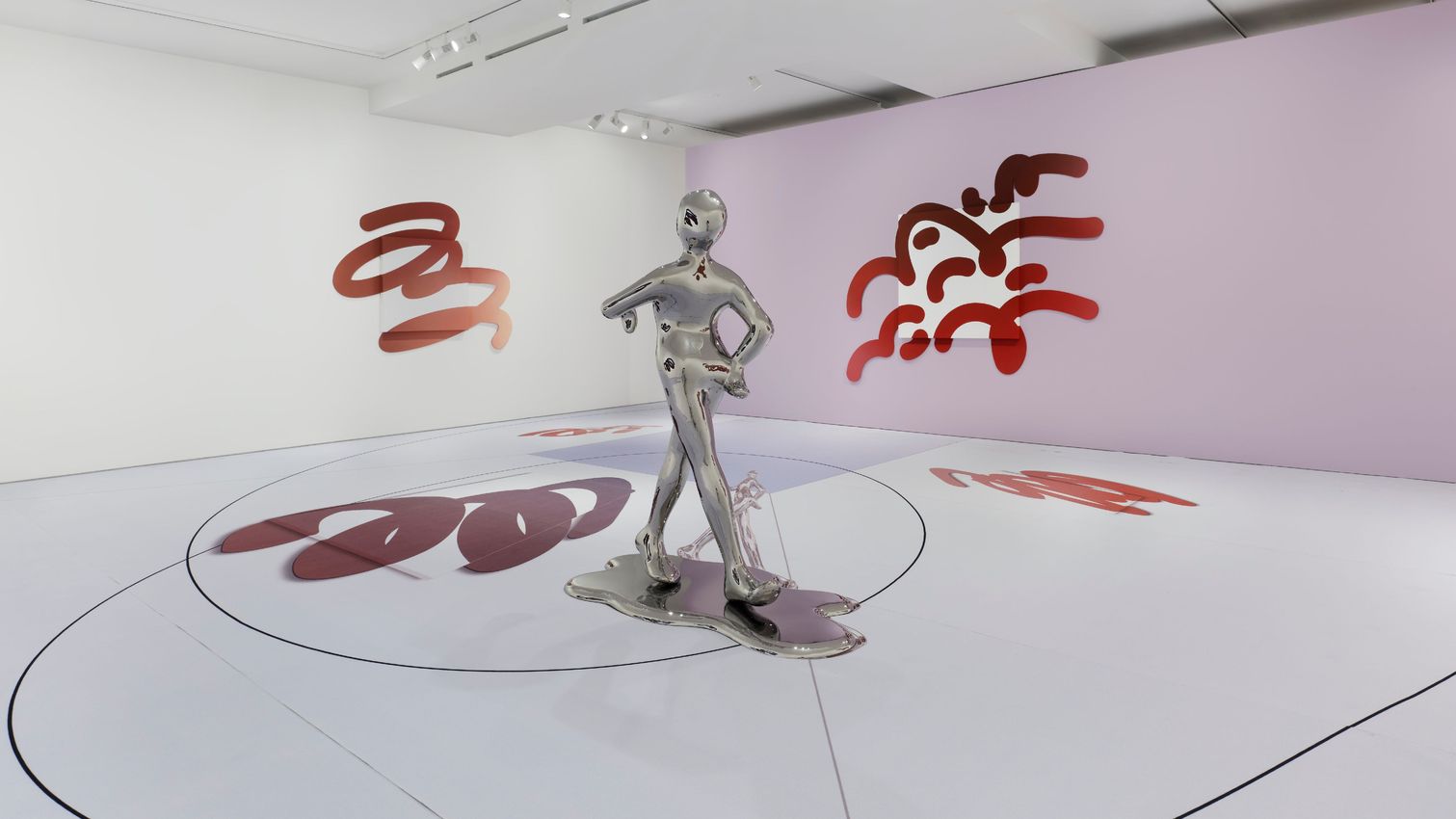
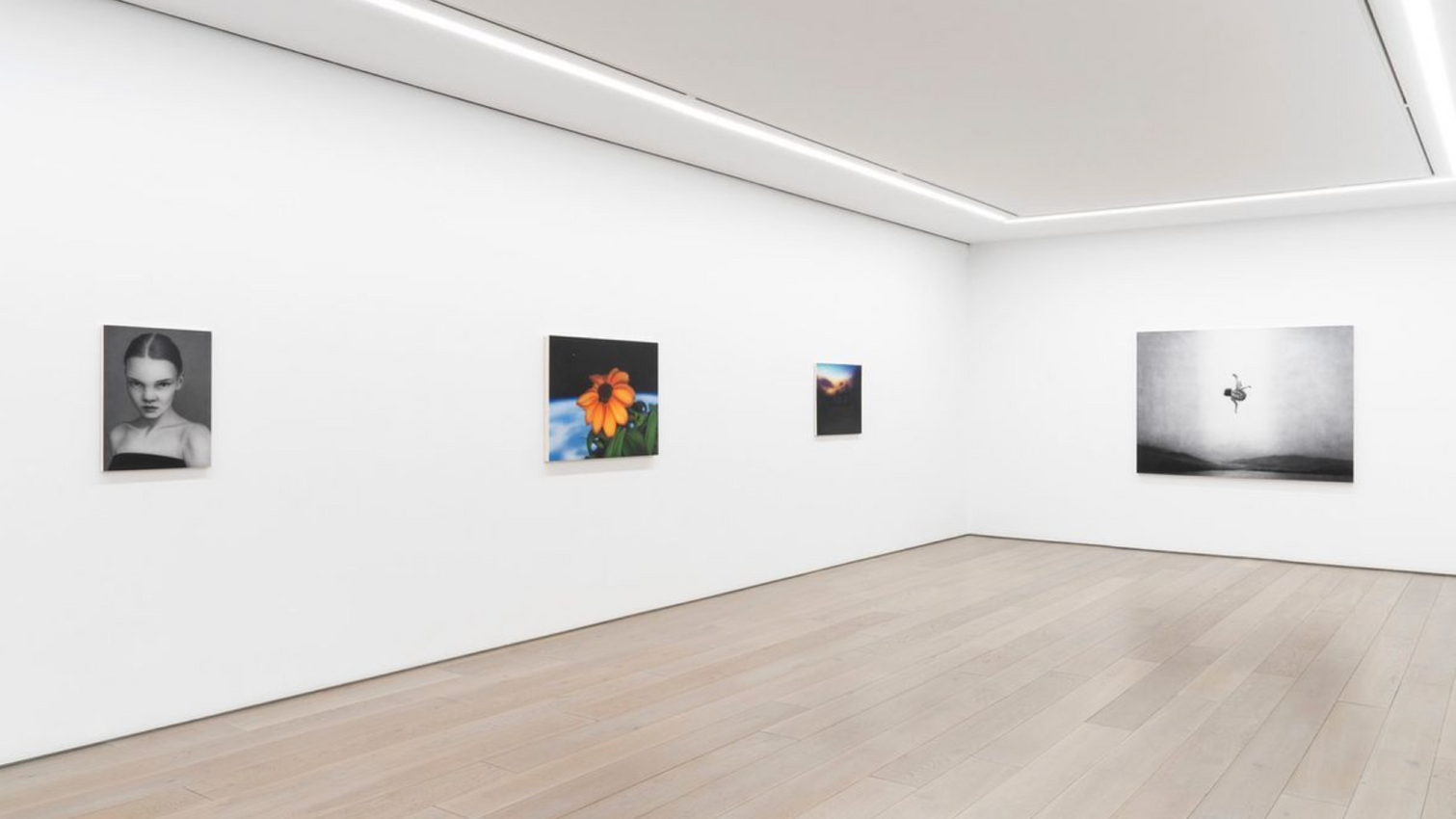
Exhibition view: CHEN Fei, Sometimes, Perrotin (15 July–29 August 2026). Courtesy Perrotin.
About the Artist

Chen Fei’s narrative paintings are fantasised, often perverted, constructs transposing elements from his personal life into either surrealistic or hyperrealistic pastiches. While he belongs to the post-1980 generation of Chinese artists raised under the one-child policy, whose overall aesthetics influenced by mainstream culture (notably manga and anime) is typically concerned with the self rather than grand history, a remarkably sharp sense of black humour informs his vibrant, ego-centred visions. Almost systematically exhibiting his own figure in his work, he satirically diverts the age-long tradition of self-portraiture to revisit Eastern and Western art-historical canons. The highly graphic quality of his lively compositions, which he envisions as film stills, playfully contrasts with the refinement of his very meticulous and detail-oriented style. Further interested in how the rapid economic growth of China has impacted its now globalised culture, Chen Fei also questions his nation’s collective taste and societal evolution.

View Artist Profile

Also Exhibiting at Perrotin

About the Gallery
Emmanuel Perrotin founded his first gallery in 1989 at the age of 21. He has opened since then over 17 different spaces, with the aim of continuing to offer increasingly vibrant and creative environments to experience artists work. He has worked closely with his roster of artists, some since more than 25 years, to help fulfill their ambitious dreams and projects. The gallery is now based in New York, Paris, Hong Kong, Seoul, Tokyo, and participates in all the significant worldwide art fairs each year (Art Basel (Hong Kong, Miami, Basel), Frieze (London, New York), FIAC (Paris), Dallas Art Fair, Art Cologne, Art Stage Jakarta, Expo Chicago, Art021 & West Bund Art & Design, Shanghai, Zona Maco Mexico, amongst others).
View Gallery Profile
Address
Piramide Building 1F
6-6-9 Roppongi
Minato-Ku
Tokyo
Japan
Opening Hours
Tuesday – Saturday
11am – 7pm
(1)
Tokyo Piramide Building 1F, 6-6-9 Roppongi
Perrotin
Piramide Building 1F, 6-6-9 Roppongi, Minato-Ku, Tokyo, Japan
+81 367 210 687
http://www.perrotin.com

Opening hours
Tuesday – Saturday
11am – 7pm
The art world in focus