



Press Release

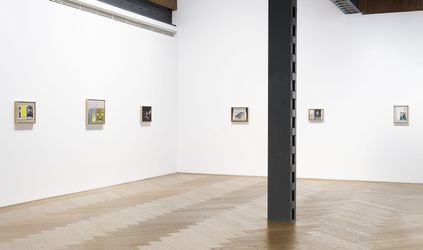
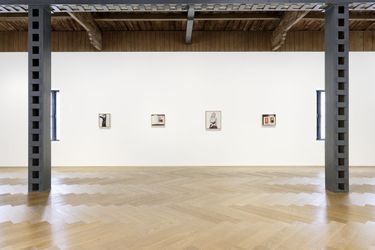
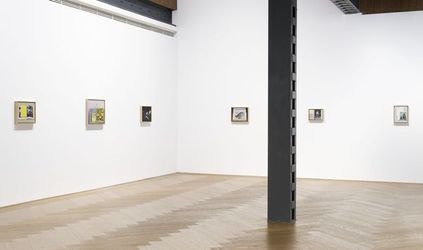
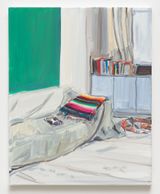
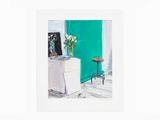
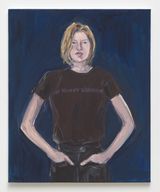
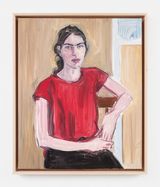
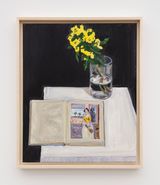
Perrotin Shanghai is pleased to present French artist Jean-PhilippeDelhomme’s first solo exhibition in China, titled House of Painting.This marks his sixth collaboration with Perrotin worldwide. Theexhibition centres on portraits and still lifes the artist capturesdaily in his studio. A new monograph dedicated to the artist will bereleased alongside the exhibition, featuring an introduction by ColinLemoine, a French art historian, critic, and writer. Colin visited thestudio, where the creative process unfolds, offering insights intoJean-Philippe Delhomme’s painting practice and everyday life. Anadapted version of his introduction follows.

The studio in question is high, short, and wide. Also, white, limewashed,relentless light. Minoan. Inside, vast, ample air, and Jean-PhilippeDelhomme, wearing denim, a tee shirt, and sneakers. Agile, discreet,intense. So few paint spots. Too few, I tell myself. Painting deservesfragments. And splotches. I think of Jean Genet in Alberto Giacometti’sThebaid, by night as by day, of the dripping of the incontinent gesturethat abolishes all measure. Milky whiteness of Delhomme’s studio: theseare the first words I write in the notebook I place on the table before me,and before him, for we have put a table between us, a little distance— a table on which rests a glass, a jug, and a book, like in a painting by Giorgio Morandi. Still Life. The light-coloured wooden easel is there. Naturally.And, against the wall, the large sofa, whose light-coloured fabric cover,as soft as alabaster, forms imperious folds, like marble. I recognisethis sofa; women often pose on it, in it, stretched out, languid, newOlympias, never nude, majas vestidas embalmed in curious thoughts. Irecognise it; it is not a sofa, it is the studio sofa, the artist’s expedient. Iam in a painting by Jean-Philippe Delhomme. There, amid the alabasterand the marble, I hardly dare sit down.

There are several paintings on the wall. Like in a painting by JeanPhilippe Delhomme. In one of them, above the sofa, the sofa is painted,with a painting above it. A feeling of vertigo. A palace of mirrors. Andthen, stacks of paintings, dozens of them, small and large, of whichI can see only the reverse, the rear, the frame, the bare back. I don’tknow if is all simulated, but it is tidy. There is order, no doubt rigour. Likein a painting by Jean-Philippe Delhomme. A studio says something; noone could reveal it innocently or enter it with impunity. A studio is like aboudoir or an alcove. It is something premeditated. Inevitably. Its degreeof intimacy is such that one cannot neglect its presentation—suchneglect would pass for a presentation. The paintings that have beenturned around escape my eye. Something is being withheld in this literaland metaphorical reserve. I love this sense of modesty, and I understandwhy the artist was invited to paint the Musée d’Orsay storerooms—their carefully arranged order and their suspended time, their promiseand their evasion, their paintings waiting to be put on display—with aparticular affinity for modest figures and objects, like in a painting byJean-Philippe Delhomme.

I look at the paintings on the wall. I recognise one of them—or rather,let’s say I think I recognise it—a young man standing, his long blond hairin the style of Stockholm or Hollywood, a blue shadow behind him, inthe style of Claude Monet or Edvard Munch. I step closer, as one doesin an art gallery, except that here the artist is present.

On the surface already, on the visible canvases, I observe the qualityof the painting—that quality that tells us immediately whether weare in the presence of painting or not, of poetry or not. I look at thecottony softness of the bodies, surrounded by the void, by emptiness,surrounded by the white of the unpainted areas, of reserve—thatword, again—as if incised into an uncertain space, caught within thatmandorla that surrounds bodies in the works of Peter Doig, Samuel Beckett, and Ingmar Bergman, that subtle sfumato where the existenceof beings plays out, their phenomenological penetration of space, theirbeauty. A floor and a wall: on this one and in front of that, beings pose,pause, and wait—for love, death, relief from boredom, Godot, Romeo, and Laure.Often the same faces, the same silhouettes. The stereotype of painting.The beige sofa, the white parallelepiped, the brown table. A decordevoid of decoration; elements that tell the eye the body is not floating but is anchored. The things are markers, lighthouses, and levees; theirpresence alone matters. They are there, and that is a good thing. Weexist among motionless things. Life is a stage, like in a painting by JeanPhilippe Delhomme.

This scene is indecipherable. The artist’s brush offers no meaning, givesno clue, provides no help, and does not stick to its course, to what we oncebelieved to be a roadmap. Instead it veers off to the left, goes up to theright, leaves its mark, makes no attempt to erase its tracks, its misdeeds,exercises its movements, and does not abolish the time of the painting sothat I can follow it and approach the duration of the painting. Nothing isconcealed, faked. Jean-Philippe Delhomme couldn’t care less about anyprimer or varnish. What he wants is not to layer, not to coarsen, not toaggregate, not to agglutinate, not to agglomerate. “He would prefer notto.” Reserve is a resistance to facile effects, to show, to icing the cake.Delhomme seeks that degree zero of writing, that bare form which is “thefirst and last instance of responsibility”, as Roland Barthes put it—thatpainting stripped of reflexivity, that empire of the sign without narrative.The painter has no wish to say anything; he simply wants to preservethe possibility of language. Jean-Philippe Delhomme couldn’t care lessabout the superego, about style.

The women and men withdraw into weary thoughts that dismiss ourgaze. Like in the work of Alex Katz, Jean-Philippe Delhomme’s figuresdo not reveal themselves—to whom, to what, for that matter? They donot open themselves; they are impenetrable. They simply appear in theworld, on the grand stage of the visible. As if separated from us. For weare, in turn, extras and then witnesses, separated by the two-way mirrorof reality. Delhomme does not seek to seduce. His painting rejectstrickery, authoritarian pre-emption, and the will to power. There is nothingto see but what one sees. It is not a question of painting ideas but thequalities of a world without qualities, that is, the sufficiency of things. Who can truly paint that, stick to painting that is anti-eventful and radicallycolourless, just as one speaks of écriture blanche (colourless writing)in relation to the nouveau roman? Between the sofa and the easel, Ifind myself thinking that Jean-Philippe Delhomme is less the painter ofmodern life than one of the agents of the nouvelle peinture.

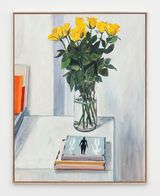
It is no coincidence that the grim-green or purplish-pearly backgroundoften features (illustrated) books set out on the brown table or whiteparallelepiped. These books are sometimes closed, sometimes open. Some are illustrated. The composition is often tightly framed, allowingfor close-ups. The book is not one of the Gospels or Saint Jerome, buta memento of civilisation, a residue of obsolescence. Jean-PhilippeDelhomme could have painted erasers; instead, he paints books—anobject lesson, the nature of things. His writing is flat. Turpentine dilutesany stylistic effects, the thickness of the paint. The linen is a plain vellum.No phosphorescence, no glaze, no Pantone colours, no anamorphosis.Just basic colours and a lustral light to reiterate humankind’s first act,which consists in preserving the imprint of our imprints. Hence thesenested images, these matryoshka dolls, these paintings of art books,these paintings within paintings within paintings. Neutral.

And it is very beautiful.

Will the mouth open? Will the book’s cover crease? And the sofa’scover? Will the flower wilt? And that black dog, will it wake up? Theneutral is a heightening of the question that condemns discourse toconjecture. Nothing is more menacing than Gustave Courbet’s open-mouthed trout or Edward Hopper’s nighthawks, than those inanimate,unsettling, and incomprehensible figures of the world, of a splendidlyunspeakable world. Like in a painting by Jean-Philippe Delhomme.

Courtesy Perrotin

Read More
About the Artist

Jean-Philippe Delhomme (born 1959) is a French artist, illustrator and writer. He has been painting for many years, but kept this side of his work private until his first exhibition in New York in 2015. Delhomme’s still lifes or landscapes are not just painted, but authored; the thread between his different forms of expression: drawing, writing and painting. Jean-Philippe Delhomme also portrays immense expression through portraiture, conveying an authorly perspective which serves as the common thread throughout his practice.

View Artist Profile

Also Exhibiting at Perrotin

About the Gallery
Emmanuel Perrotin founded his first gallery in 1989 at the age of 21. He has opened since then over 17 different spaces, with the aim of continuing to offer increasingly vibrant and creative environments to experience artists work. He has worked closely with his roster of artists, some since more than 25 years, to help fulfil their ambitious dreams and projects. The gallery is now based in New York, Paris, Hong Kong, Seoul, Tokyo, and participates in all the significant worldwide art fairs each year (Art Basel (Hong Kong, Miami, Basel), Frieze (London, New York), FIAC (Paris), Dallas Art Fair, Art Cologne, Art Stage Jakarta, Expo Chicago, Art021 & West Bund Art & Design, Shanghai, Zona Maco Mexico, amongst others).
View Gallery Profile
Address
3/F, 27 Huqiu Road
Huangpu District
Shanghai
China
Opening Hours
Tuesday – Saturday
11am – 7pm
(1)
Shanghai 3/F, 27 Huqiu Road, Huangpu District
Perrotin
3/F, 27 Huqiu Road, Huangpu District, Shanghai, China
+86 216 321 1234
http://www.perrotin.com

Opening hours
Tuesday – Saturday
11am – 7pm
The art world in focus