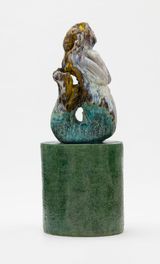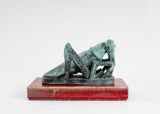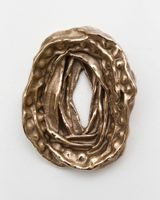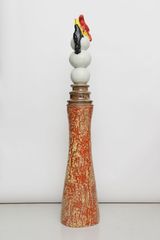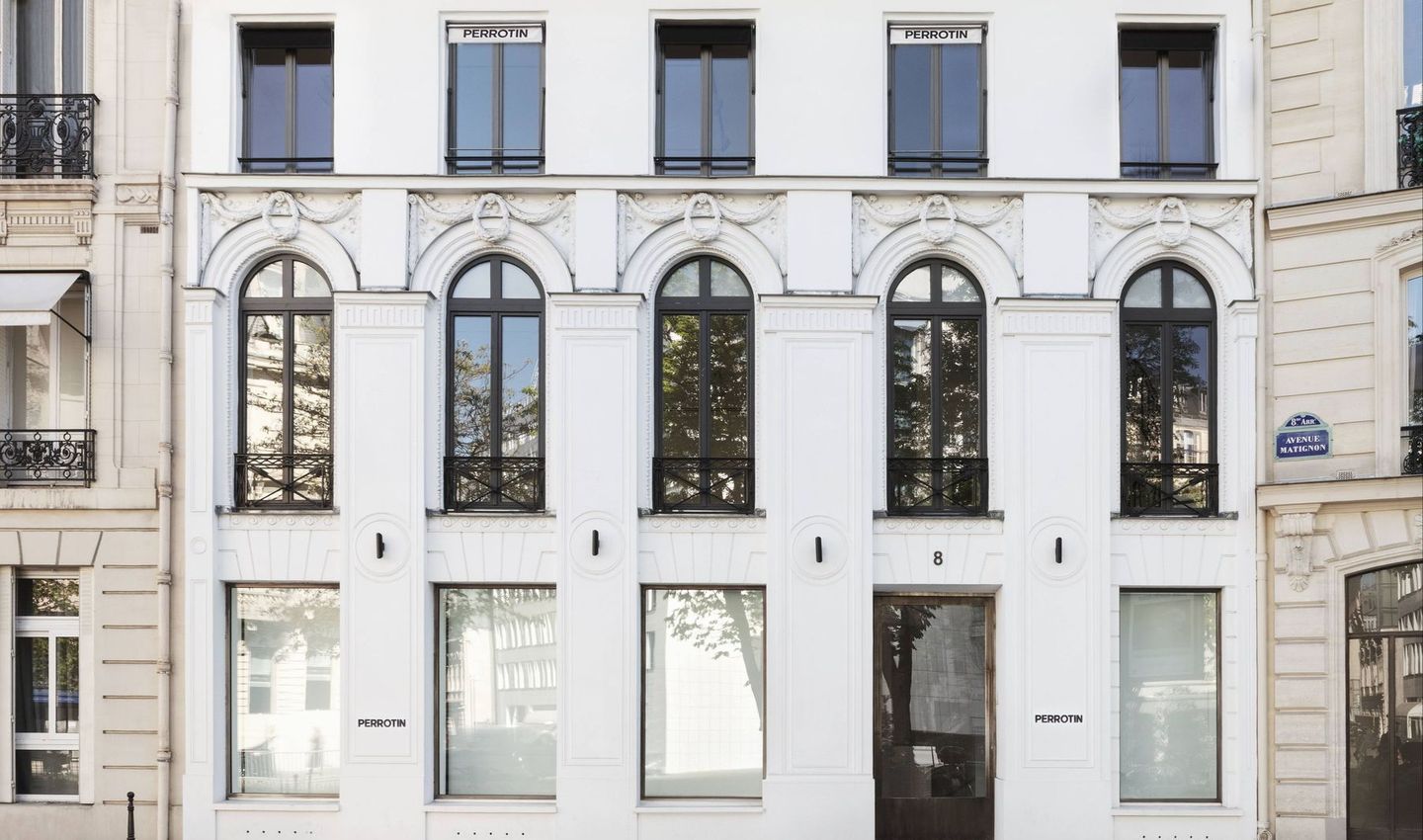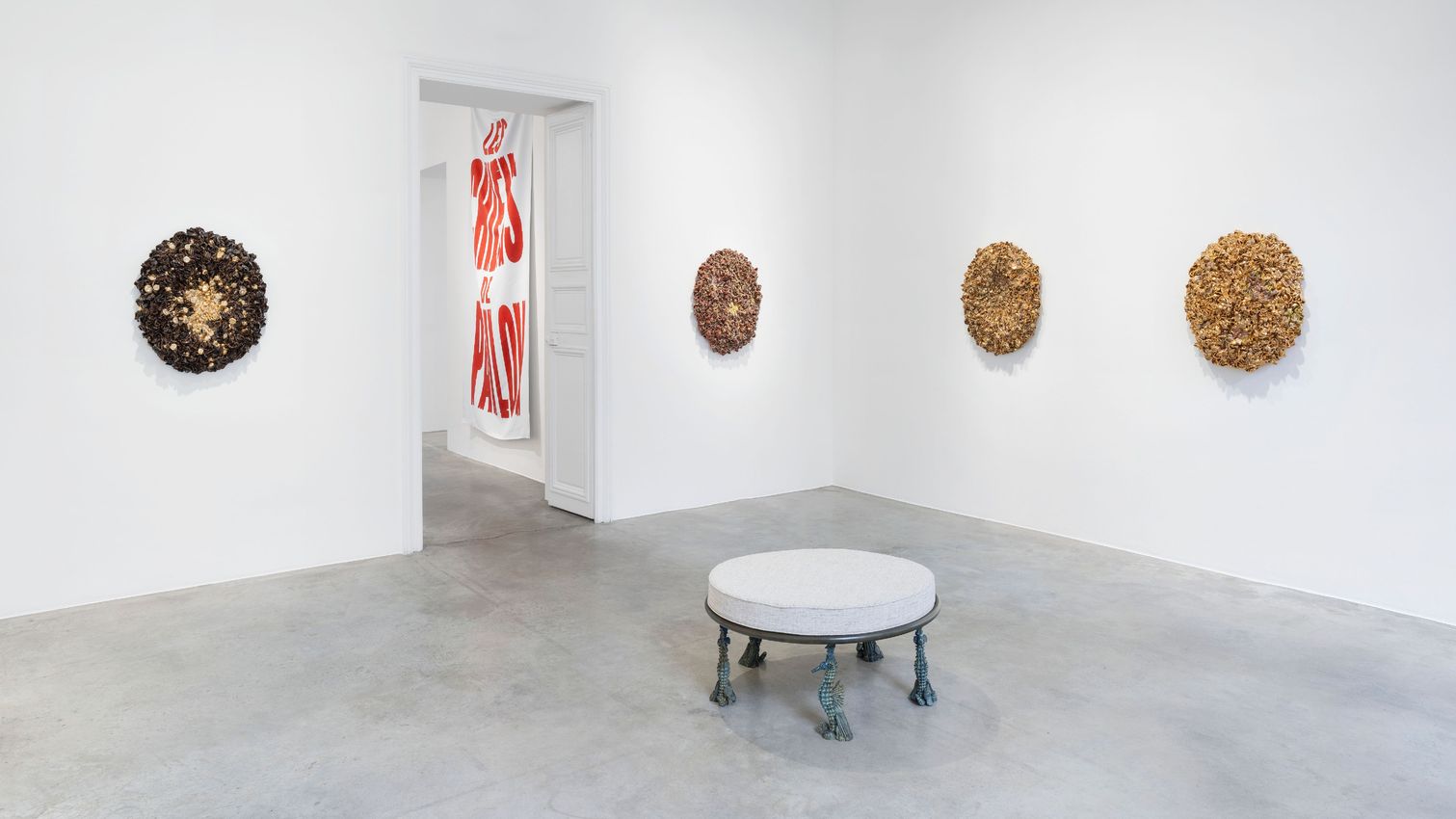
Perrotin is pleased to present Les Chiens de Pavlov, the tenth solo exhibition by Belgian artist Johan Creten, with the gallery. At once deeply personal and strikingly universal, the exhibition unfolds as an immersive journey through technological archaeology, political allegory, and mythological imagination—revealing how the dreams of yesterday continue to shape the realities of today.
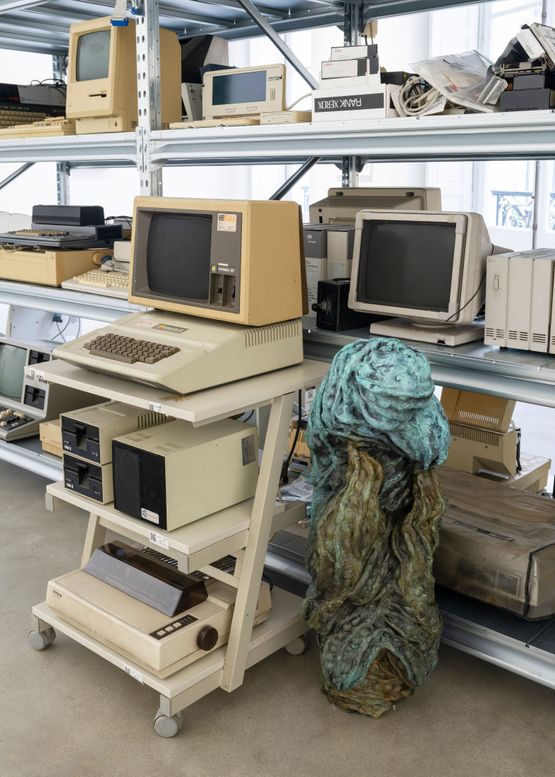
Johan Creten’s father had a particular obsession. Fascinated by the emerging technologies of the 1980s, he amassed, over more than four decades, a vast collection of early computers that, as the artist recalls, “occupied not only dedicated storage spaces but every available corner: stacked upon furniture, hidden behind curtains, piled one upon another in an almost archaeological density.” After his father’s death three years ago, the family inherited the machines and transformed them into a large wall, presented at the centre of this exhibition. It is an intensely personal gesture—an act of mourning made public—but what was ultimately passed on was not the computers themselves, but the impulse to question. That notion of obsession lies as much at the heart of this exhibition as it does of Creten’s entire practice.
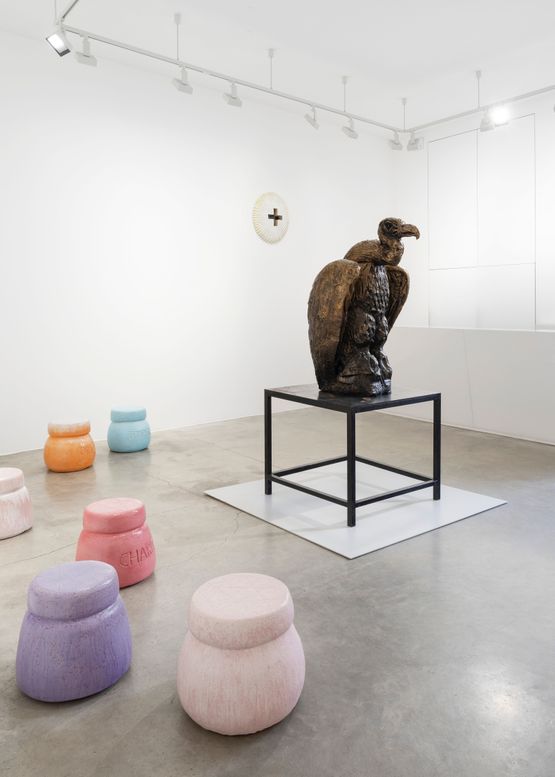
Roughly around the time his father began assembling his private collection, Creten started building his own artistic vocabulary, one he has continued to expand, revisit and transform ever since. Flowers take shape of feminine body, ancient myths become commentaries on the present, and words turn into wordplay, while familiar works—such as Miami Eagle / Le Con-dort (2002-2026), a bronze sculpture first conceived in glazed stoneware in Florida twenty-four years ago—reappear in new contexts.
Echoing Umberto Eco’s observation in The Open Work (1962) that “what we find in art is less the expression of new scientific concepts than the negation of old assumptions,” Creten persistently questions his own practice, and his refusal of easy solutions is remarkably consistent. Alongside producing new works, returning to older ones may appear less demanding. Yet, it means exposing them to constant re-evaluation, always at the risk of repetition, redundancy, or even self-devaluation. Pavlovian conditioning depends on automatic, unreflective responses to familiar stimuli, reinforcing repetitive and predetermined patterns of behaviour. The mechanism was identified in the late 19th century through a simple experiment: Russian physiologist Ivan Petrovich Pavlov repeatedly rang a bell before feeding his dogs. Eventually, the dogs began to salivate at the sound of the bell alone, regardless of whether food was present. By contrast, every reconfiguration of Creten’s works—each acting as a new stimulus—alters the dynamics between them, generating an ever-expanding multitude of readings. As Eco reminds us once again, “a work of art is a field of open possibilities.”
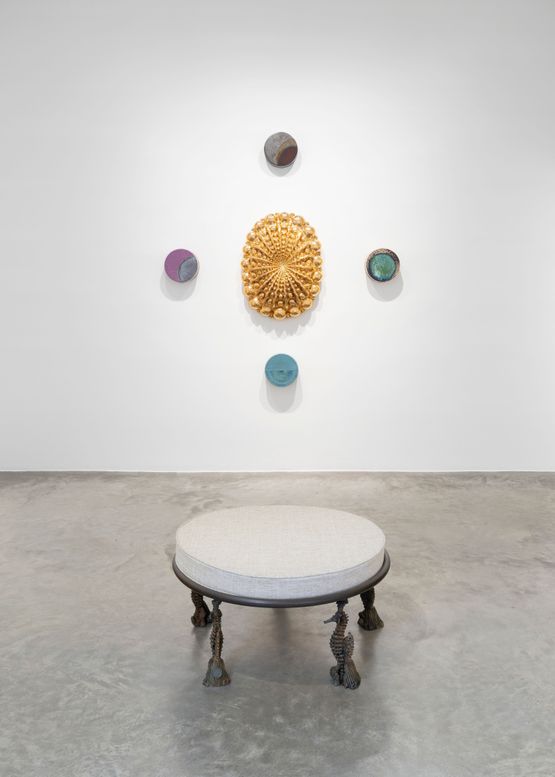
In challenging himself, Creten challenges the viewer as well. As in many of his exhibitions, seating elements—this time dedicated to the seven virtues—appear in the rooms. He creates the conditions for contemplation, and in itself that is already a generous gesture. But there is more to this invitation to slow down than simply adopting a new perspective or creating a moment of exchange with others. Taking a position is not just about occupying a place in the gallery space delineated by the ceramic boulders: one does not acquire virtue simply by sitting on a seat dedicated to it. Nor is it enough to watch works addressing greed, corruption, power, fate or misfortune from the presumed safety of aesthetic distance, believing oneself untouched by them. As much as Creten asks us to recognise the power of others, he also makes us acknowledge the vulnerability of the self.
The final room presents a group of abstract works, creating an atmosphere detached from personal memory and the turbulence of the contemporary world. The divine and the spiritual might appear to offer a moment of respite, but even when accompanied by the hope for a better future, they also carry a question mark. The most important lesson Creten leaves us with is to distrust automatic responses. Thankfully so, because blind obedience—regardless of how noble or glorious the authority being followed may seem—remains one of the greatest dangers of all.
Direct references to politics, such as the title in the already mentioned Miami Eagle / Le Con-dort (2002-2026), where the symbol of American strength and independence is given a second, far less celebratory name (le con-dort—a wordplay suggesting a “sleeping fool” in French), have always been integral to Creten’s practice. Yet it is through his continuous resistance to predetermined assumptions—to passive acceptance, but more broadly to unquestioned ways of existing—that his work acquires its most political dimension. Creten refuses one-sided narratives and categorical answers. By introducing double meanings, he extends this possibility of resistance to the viewer: once we recognise these layers, we learn to double-check our own assumptions. We are no longer Pavlov’s dogs. By dismantling linear notions of time through the intertwining of old and new works, he presents it as a continuous process of return and transformation rather than forward progression. History may have a tendency to repeat itself, yet the future remains forever unknown: there are no definitive endings. If there is no end, there is no death. Even in the drawing-collage Dessin 23 (1988), where a skull—the ultimate symbol of mortality—appears, it seems animated by a vital, generative energy. And as long as we are alive, there remains the possibility of trying again, differently.
— Marzena Jarczak, art critic.
Courtesy Perrotin


Frontrunner in the revival of ceramics in contemporary art, the Paris based artist Johan Creten has been working on the move for almost forty years, from Mexico to Rome, from Miami to The Hague.


Emmanuel Perrotin founded his first gallery in 1989 at the age of 21. He has opened since then over 17 different spaces, with the aim of continuing to offer increasingly vibrant and creative environments to experience artists work. He has worked closely with his roster of artists, some since more than 25 years, to help fulfil their ambitious dreams and projects.

A respected voice in contemporary art discourse.
Focusing on ambitious storytelling and insightful art-world commentary. Ocula Magazine publishes in-depth interviews, critical essays and timely analysis on the artists, exhibitions and ideas driving the global art world.
Learn more about Ocula Magazine
Showcasing the best of the art world.
Ocula partners with galleries from around the world to highlight their artists, artworks and exhibitions. Gallery membership is by application and invitation, with each member vetted by an independent panel.
Learn more about Ocula Membership

Specialises in the sale of major artworks.
Led by a team with deep ties to the world’s leading auction houses, galleries and collectors. Ocula’s advisory team offers bespoke services to high-net-worth clients from around the world who are looking to acquire the best of contemporary and modern art.
Learn more about our team and services