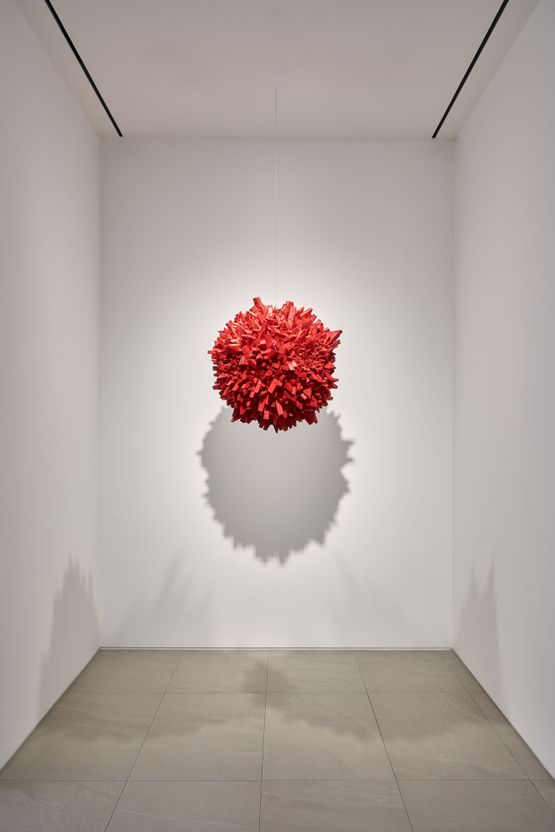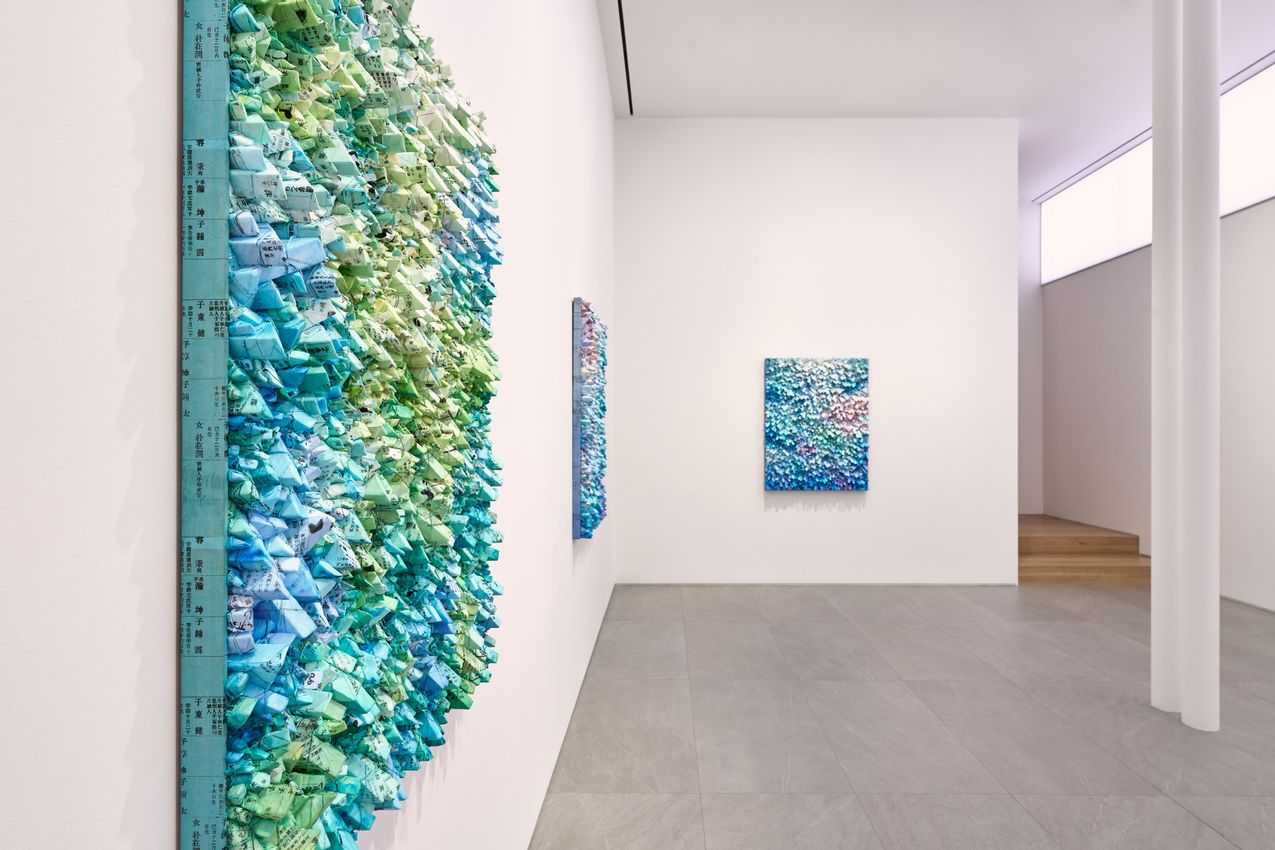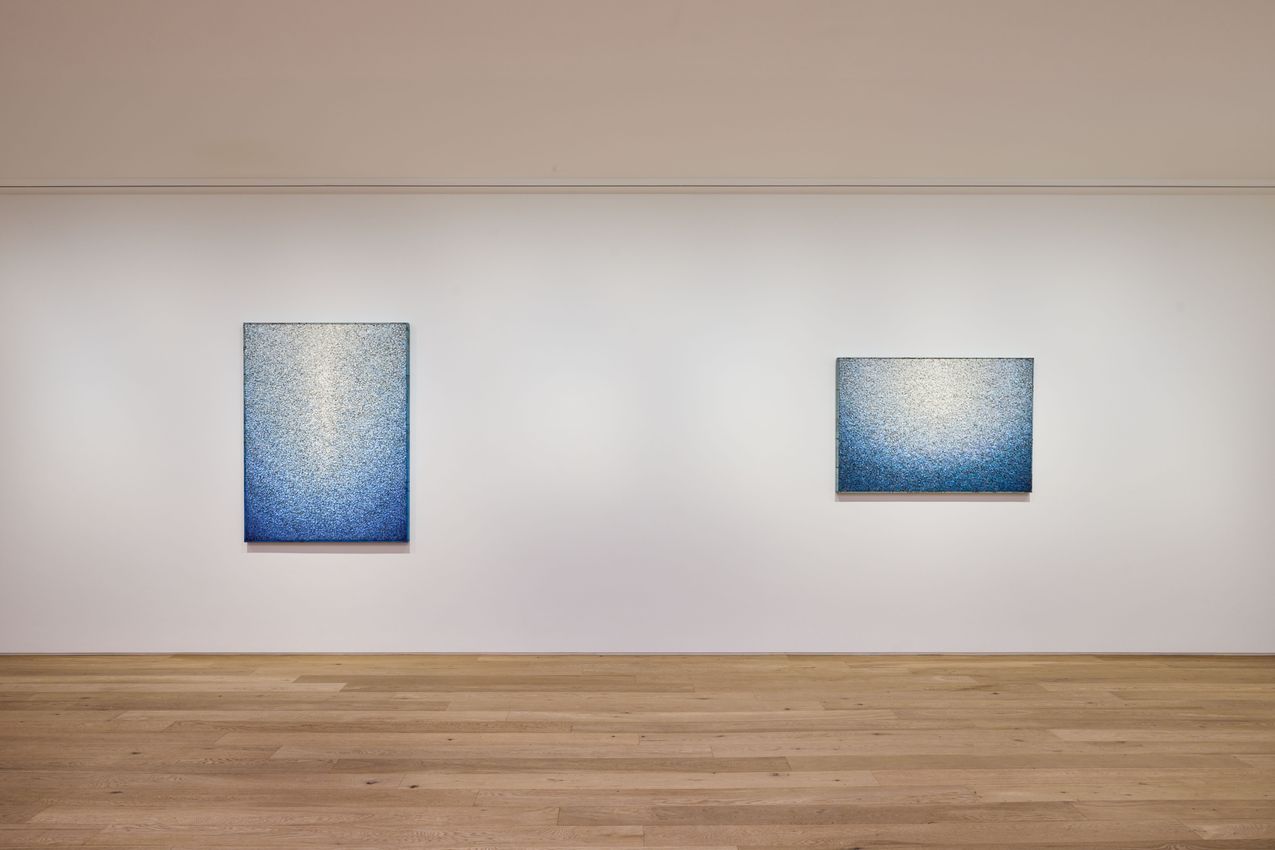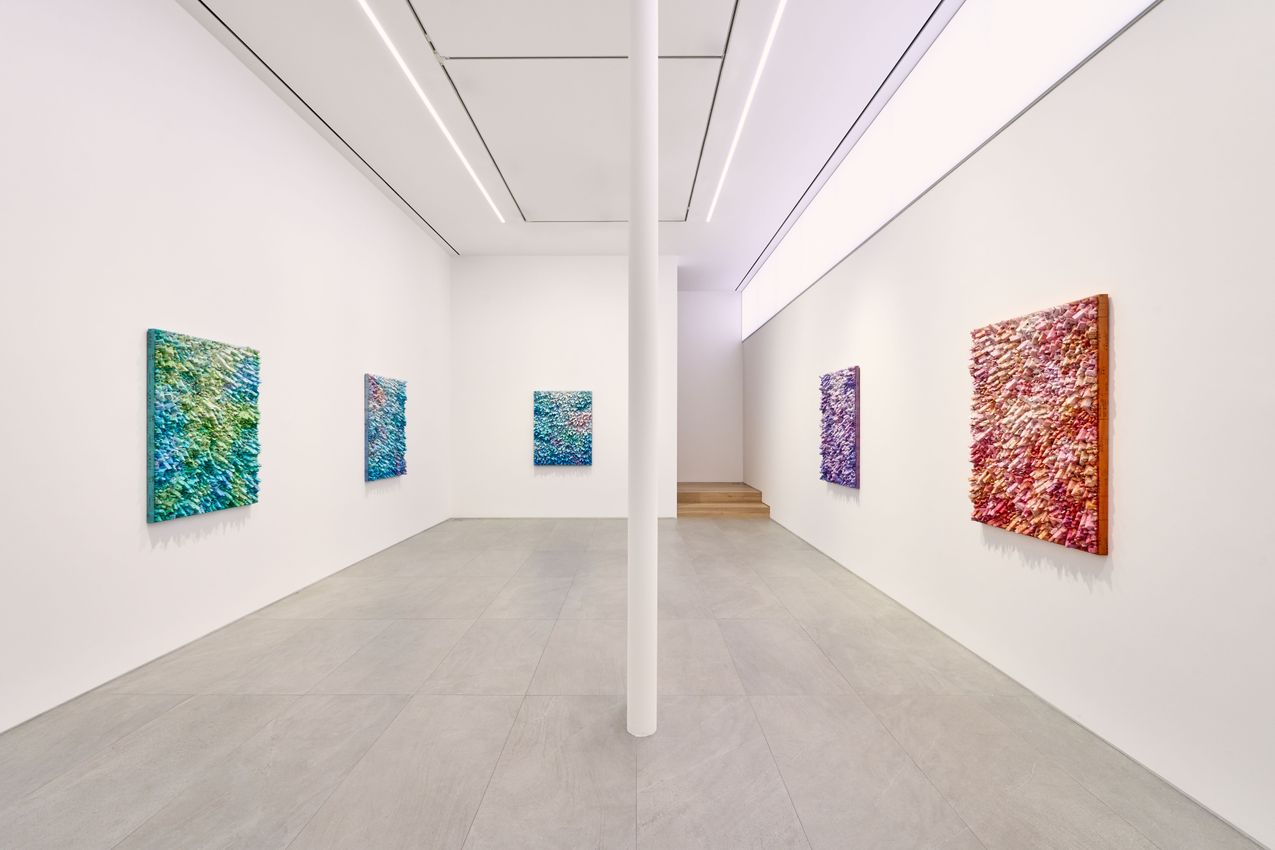
Perrotin Seoul is pleased to present Time Blossom, a solo exhibition by Kwang Young Chun. Chun has developed a distinctive visual language that bridges tradition and modernity, East and West, through his sculptural exploration of hanji, traditional Korean paper. Expanding beyond ink on paper, he has continually pushed the boundaries between painting and sculpture with his Aggregation series—compositions of tightly clustered, triangular forms wrapped in hanji.
This exhibition centers on Chun’s iconic Aggregation series alongside his new body of work, Poom, offering insight into the philosophical and aesthetic inquiries that have shaped his practice. Comprising dozens, sometimes hundreds of triangular pieces, Chun’s works metaphorically explore the relationships between the individual and the collective, tradition and modernity, chaos and order. Inspired by the colors of our daily life, the pieces are naturally dyed using a range of organic materials, resulting in a palette that is both vibrant and understated.
Reinterpreting natural materials within a contemporary context, Chun’s work offers a deep reflection on memory, history, and human existence. This exhibition not only provides a focused look at the evolution of his artistic language but also marks a new chapter in the continued expansion of his vision on the global stage.
“Time blooms.”
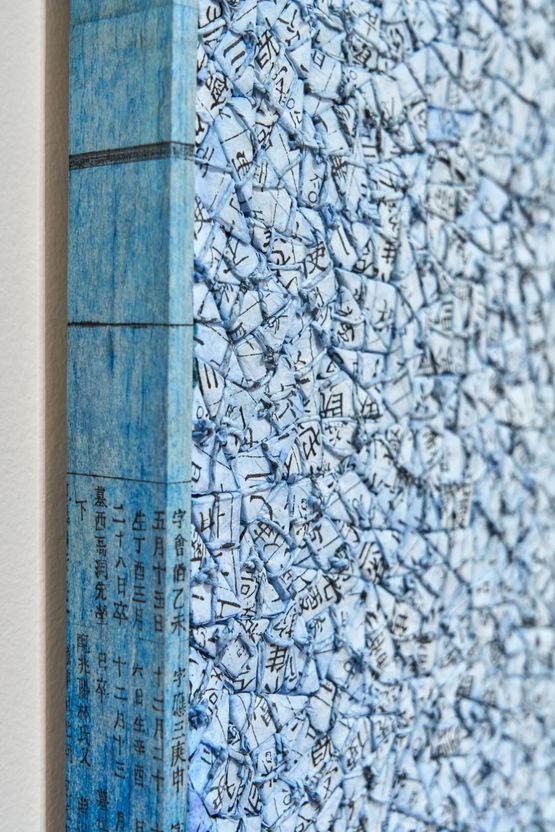
For decades, Kwang Young Chun has built a unique visual language rooted in Korean materials and memory. Since his early years abroad, when he was drawn to Abstract Expressionism, he has continuously experimented—eventually turning to hanji (traditional Korean paper) and antique books as vessels for exploring time and identity. The triangular forms wrapped in fragments of old texts go beyond visual structure, embodying accumulated memory and traces of existence.
His latest exhibition, Time Blossom, at Perrotin Seoul builds on his long artistic journey. Through more delicate and expansive colors, Chun evokes the image of time subtly unfurling like a flower. Moving beyond the earthy browns of his earlier works, he now embraces a spectrum ranging from soft pastels to vivid, saturated tones; each color representing a different emotional passage of time.
Natural dyes extracted from persimmons, ink, ochre, mugwort, indigo, safflower, turmeric, pomegranate skin, and rouge combine with the textures of hanji and antique paper. The colors go beyond their hue, becoming material expressions of memory and temporality. Each palette unfolds a different rhythm of time on the surface: while the pastels reveal a more accessible tenderness, the moodier shades recall the dense folds of memory and deep-seated emotions.
Placing each triangle by hand, the artist’s process is less about painting and more about sculpting time itself. Layer by layer, an archive of feeling accumulates through pigment and tactile textures, ultimately forming the symbolic image of a “blooming moment.”
During this exhibition, Chun debuts a new work titled Poom, which signifies “embrace.” Departing from the denser compositions of his past, this piece proposes a new flow: softer, more refined, and rhythmically organic. Countless triangles are gently layered without collision, like a space where time itself has quietly settled. In this way, Poom is not just an art object, but a visual refuge and resting place.
His work aligns with late-20th-century conceptual approaches in contemporary art, which often focused on durational practices and existential themes. Chun’s method—marked by repetition, accumula- tion, and meditative labor—visualizes the flow of time and collects the essence of emotion.
Yet the materials he uses, such as hanji, antique books, and natural dyes, are deeply rooted in East Asian heritage. This gives his practice a distinct position outside Western-centric art histories, highlighting a different sensibility in his treatment of time and form.
Chun’s art offers a new visual expression at the intersection of Eastern philosophy and contemporary sculpture. Time Blossom invites us to quietly revisit his oeuvre, where layers of paper, pigment, memory, and feeling converge. Within these calm yet complex surfaces, the viewer experiences the delicate unfolding of time.
About the artist
Kwang Young Chun, acclaimed for his sculptural assemblages of hanji bundles, mediates between Korean tradition and contemporary abstraction.
Born in 1944 in Hongcheon, South Korea, Chun earned his BFA from Hongik University in Seoul (1968) and his MFA from the Philadelphia College of Art (1971), during which he was deeply influenced by American Abstract Expressionism. However, he later sought to reconnect with his cultural roots, developing his signature Aggregation series in 1995. Drawing inspiration from childhood memories of hanji-wrapped herbal medicine packets in his great-uncle’s apothecary, Chun meticulously wraps countless triangular forms in hanji, creating a distinctive artistic language. The hanji he uses is often sourced from old books and documents—some over a century old—and retains traces of Korean characters. Dyed natural pigments, the paper carries the patina of nature and time. Through these humble materials, Chun transforms his works into monumental wall installations and sculptural forms that evoke both the shapes of nature and the vestiges of history.
With a career spanning over five decades, Chun has exhibited at major institutions worldwide, including the Brooklyn Museum (New York), Mori Arts Center Gallery (Tokyo), National Museum of Contemporary Art (Seoul & Gwacheon), and Moscow Museum of Modern Art. His works are held in esteemed collections such as the Victoria & Albert Museum (UK), M+ (Hong Kong), and the National Gallery of Australia. Recognized for his contributions to contemporary art, he was named Artist of the Year by the National Museum of Contemporary Art, Seoul (2001) and received the Presidential Prize at the 41st Korean Culture and Arts Awards (2009).
Chun Kwang Young is a contemporary South Korean artist recognised for his ‘Aggregations’ (1995–ongoing) series of tactile sculptural compositions that are made of multiple minute triangular forms wrapped in mulberry paper. The richly textured surfaces of these ‘Aggregations’ are reminiscent of the stalactites of caves or the moon with its crater-like hollows.


A respected voice in contemporary art discourse.
Focusing on ambitious storytelling and insightful art-world commentary. Ocula Magazine publishes in-depth interviews, critical essays and timely analysis on the artists, exhibitions and ideas driving the global art world.
Learn more about Ocula Magazine
Showcasing the best of the art world.
Ocula partners with galleries from around the world to highlight their artists, artworks and exhibitions. Gallery membership is by application and invitation, with each member vetted by an independent panel.
Learn more about Ocula Membership

Specialises in the sale of major artworks.
Led by a team with deep ties to the world’s leading auction houses, galleries and collectors. Ocula’s advisory team offers bespoke services to high-net-worth clients from around the world who are looking to acquire the best of contemporary and modern art.
Learn more about our team and services