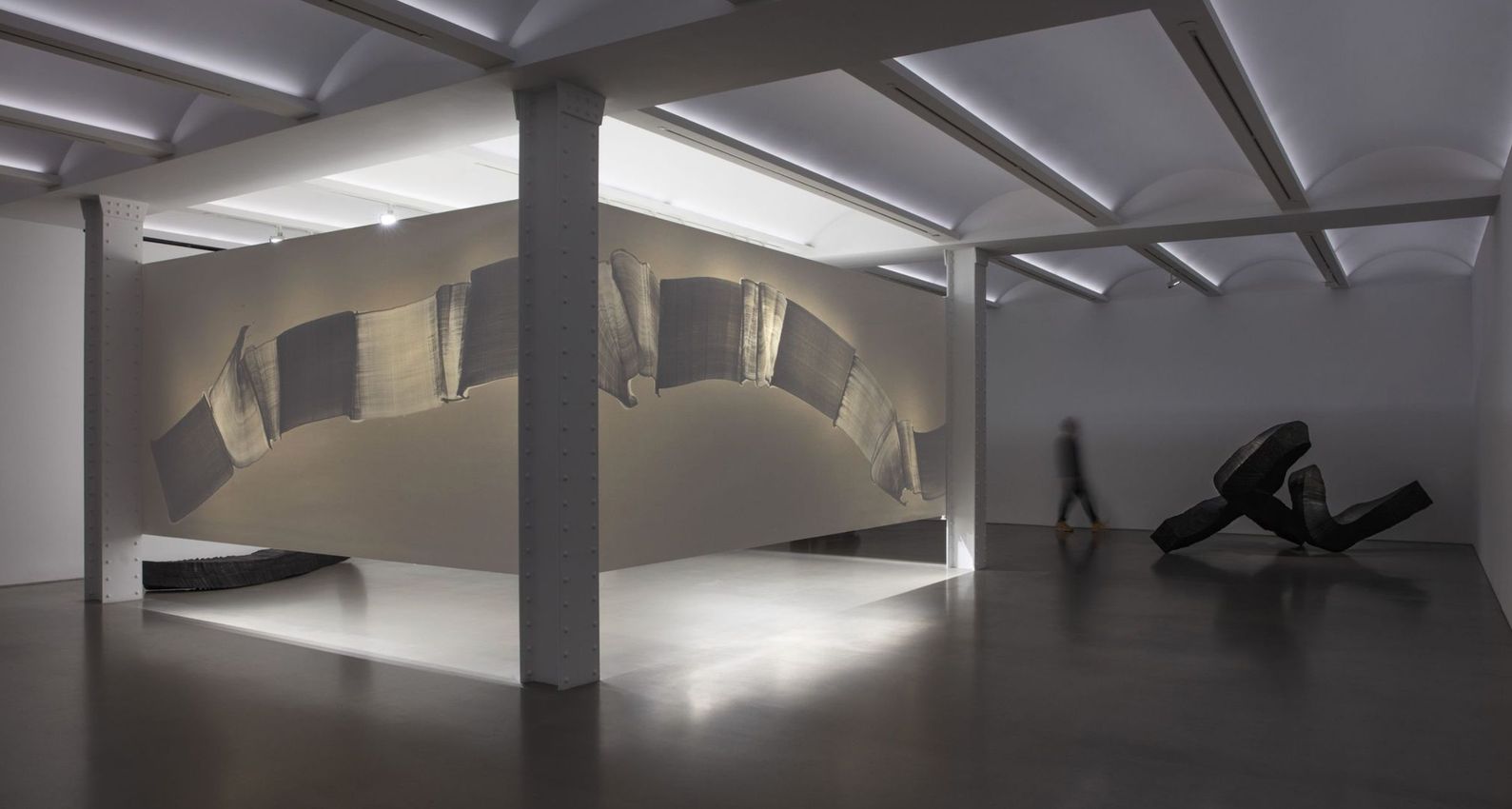
Perrotin New York is pleased to present Between, an immersive exhibition of new work by artist Lee Bae (b. 1956 in Cheongdo, South Korea). The exhibition follows two major installations by the artist: in 2023, Lee Bae was the first Korean artist to be commissioned for a colossal project at Rockefeller Center in New York, and currently, his work is the subject of a solo exhibition at the Wilmotte Foundation as part of the official collateral program of the 60th Venice Biennale. Building on these recent presentations, at Perrotin, the artist unveils a site-specific paper installation painted with charcoal ink alongside several bronze sculptures. These bodies of work explore the liminal space between cultural past and contemporary moment by using minimalist forms to capture lost fragments of time.
As a leading Korean minimalist artist, Lee Bae pursues a pure expression of form. The core of his practice is a formal study on the colour black and materiality. Over the last four decades, he has mastered the use of charcoal as a medium for his work. In his practice, charcoal acts as a physical representation of the cycle of life, renewal, and personal histories. Until the early 2000s, Lee Bae worked exclusively with raw charcoal to create minimal, mosaic-like assemblages of charred wooden shards and sculptural arrangements of carbonised trunks. In the last five years, he has experimented with charcoal ink painting as well as the material possibilities of bronze.
Since 2019, the artist has been experimenting with simple actions in his Brushstroke paintings, executed with singular continuous black gestures on paper. The paper itself was adapted for various uses in ancient Korea, the inner bark of the mulberry tree combined with Hibiscus meniot crucial in everyday objects and living spaces. In these paintings, shades of ink create depth on a flat surface, conjuring three-dimensional space through swooping translucent strokes. In grand motions, one trace is followed by another, each building off the previous, creating an archive of condensed energy.
Central to the exhibition is a paper-based installation to which the artist meticulously applied a large brushstroke, informed by ink wash painting and calligraphy. In East Asia, calligraphy is a rigorous artistic practice that is deeply connected to the author. Similarly, in the tradition of Korean monochrome painting, the creation process involves intense physicality where mind, body, and material become one. Lee Bae reworks traditional calligraphy’s legibility to something intangible, allowing for the viewer to adjust their perceptions of what was once familiar. Wielding the brush is of utmost importance, as he listens to the tools as much as himself. Once started, he cannot hesitate as each stroke records his movement over time on the paper. In this way, the performance-based gestures of Between are a visual concretisation of the fleeting temporal experience.
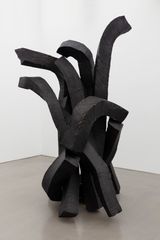
Building upon the artist’s Brushstroke series are new bronze sculptures that punctuate the gallery space and extend the dimensionality of his paintings by occupying physical space. The organic forms of bronze, recalling charcoal in both colour and texture, stand in repose on the gallery’s first floor, contrasting against the white walls and leaving room for contemplation within the intermittent empty space. One sculpture, Brushstroke (2024), an intertwining mass of black appendages, casts heavy shadows while simultaneously reflecting the light against its textured surface. By utilising the resistant material of bronze, his sculptures become artefacts that withstand the passage of time.
Lee Bae’s Between invites viewers to live in the now, to reconsider our relationship with past, present, and future. By creating physical space for reflection, his work materialises the immaterial, preserving time through gesture and form.
Lee Bae’s monochromatic practice is a formal and immersive quest into the abysses of blackness. Subtly blurring the lines between drawing, painting, sculpture and installation, he has shaped his abstract aesthetics across categories to grant the non-colour tangible depth and intensity. Until the mid-2000s, he worked exclusively with raw charcoal to create minimal and refined, mosaic-like assemblages of charred wooden shards or chunks on canvases, as well as larger sculptural arrangements of carbonised trunks. Obtained by burning wood and used to revive fire, charcoal offers a powerful metaphor for the cycle of life that has further inspired him to open his exploration onto the fourth dimension of time. While he has moved on to solely working with carbon black, a substance close to soot, Lee Bae’s latest series of pictorial works crystallises random elemental gestures, which he practices beforehand with Indian ink on paper, into thick layers of translucent acrylic medium resembling wax.


A respected voice in contemporary art discourse.
Focusing on ambitious storytelling and insightful art-world commentary. Ocula Magazine publishes in-depth interviews, critical essays and timely analysis on the artists, exhibitions and ideas driving the global art world.
Learn more about Ocula Magazine
Showcasing the best of the art world.
Ocula partners with galleries from around the world to highlight their artists, artworks and exhibitions. Gallery membership is by application and invitation, with each member vetted by an independent panel.
Learn more about Ocula Membership

Specialises in the sale of major artworks.
Led by a team with deep ties to the world’s leading auction houses, galleries and collectors. Ocula’s advisory team offers bespoke services to high-net-worth clients from around the world who are looking to acquire the best of contemporary and modern art.
Learn more about our team and services