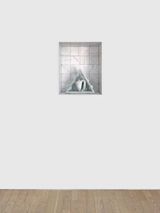
Perrotin Los Angeles is pleased to announce artist Leslie Hewitt’s solo presentation New Waves, opening on Saturday, November 16, 2024, and remaining on view through January 25, 2025. New Waves is the artist’s fifth solo exhibition with Perrotin and her first at the gallery’s Los Angeles location.
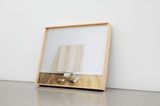
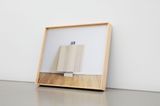
Leslie Hewitt’s photographs turn our perceptual assumptions about viewing upside down—or perhaps more accurately, they quite literally ground perception with the force of gravity. In her self-described still life photographs, a series Hewitt has been making since 2004, chromogenic prints rest inside of custom-made frames, which are placed on the floor and leaned against a wall. Encountering these works requires a full body act of looking, a physical experience that slows down perception.
Gravity, and a slowing of perception, also come into play within the depicted space of Hewitt’s photographs. If concepts like floor, and lean, are central to the artworks as physical objects, they also figure
prominently within the still life scenes Hewitt presents us with. In Untitled (Maddened by Love), 2019, for example, a neatly stacked pile of five books rests on the floor, pushed up against a wall. On top of this stack of books is placed a rectangular—just slightly wide of square—plank of elm wood, its flat surface facing us as it leans against the wall of the space within the photograph. The gravity and lean that govern Hewitt’s artwork-as-object are repeated by the gravity and lean of the wooden plank—a subtle play on the visual and literary device of mise-en-abyme (literal translation: “placed into the abyss”), of an image within an image. In Untitled (Maddened by Love) there is yet another image within an image, a photo placed carefully at the top of the wood plank and stacked books arrangement. One can just make out what appears to be three figures set against an expanse of sky and sea, an anonymous snapshot marking a moment in place and time.
What should we make of the unadorned surface of the not-quite-blank wood plane (the striations of wood grain becoming their own surface feature), the representation of books in a kind of stasis, their printed spines both turned and at times rendered legible, and the suggestive unknowability of other elements that appear in Hewitt’s still lifes? As the artist herself has cogently described, her spare still life arrangements are in conceptual dialogue with the fraught legacy of 17th-century Dutch still life painting, where abundance was deliberately put on view. Hewitt’s compositions, so beautifully spare in composition, remove the conspicuous spoils of colonial trade (rare flowers, exotic foods, precious materials) and replace them with a different kind of abundance—a generosity of critical and emotional space for interpretation; an abundance of possibility to create new meaning.
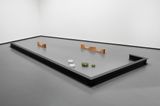
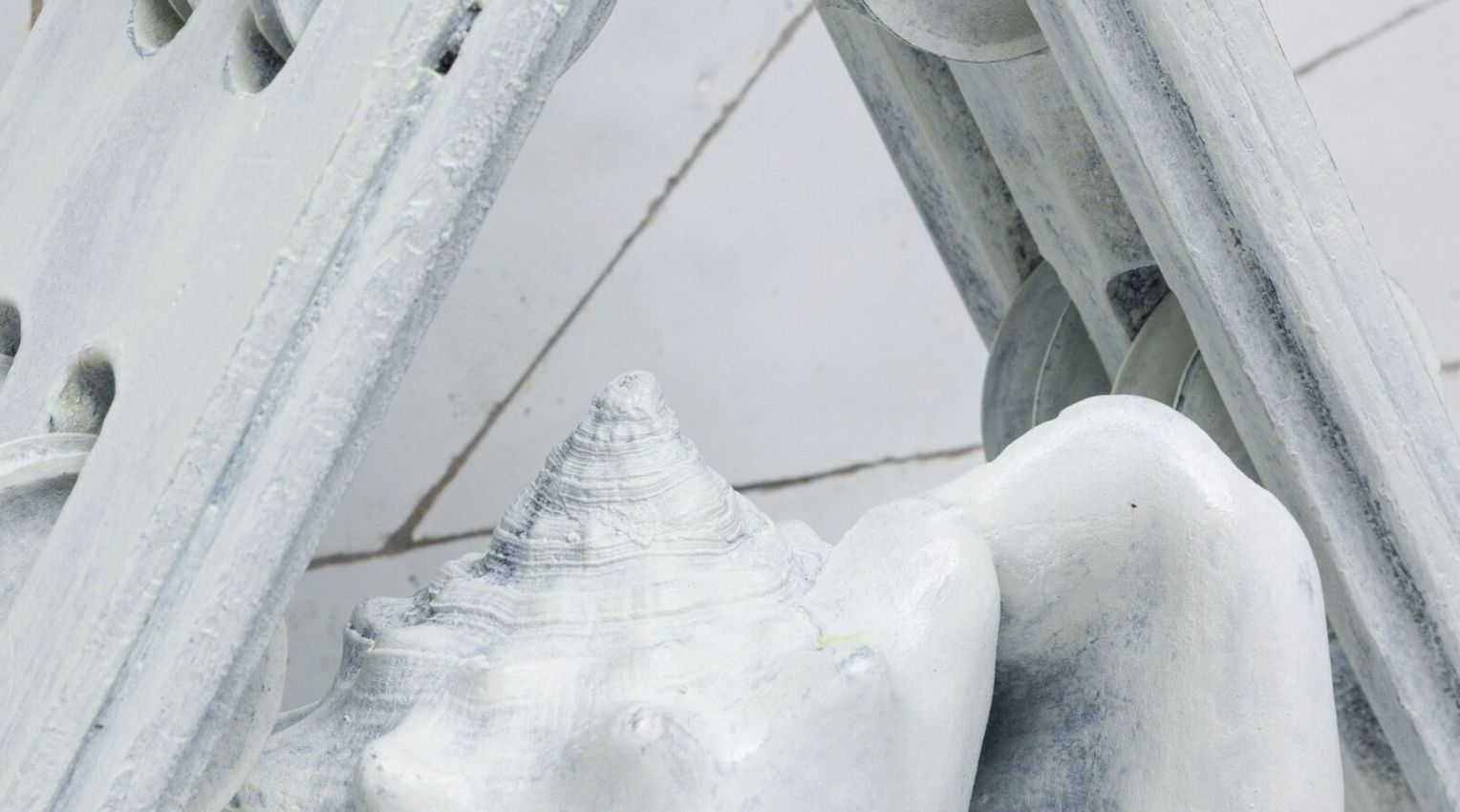
This possibility of new meanings underlies the title of Hewitt’s exhibition, New Waves. For her presentation at Perrotin Los Angeles, Hewitt presents her still life photographs alongside two additional works: a floor sculpture, Untitled (Imperceptible, Slow Drag, Barely Moving), 2022, and a work made in collaboration with Jamal Cyrus that nods to the Fluxus legacy of Benjamin Patterson, a sculpture whose title functions as an event score: For Solo Hammond B3 Organ, Double Contrabass Flute, or Tambourine (This Score May Be Realized in Any Imaginative
Way, or in conjunction with or in response to the recording of the song Rock Steady 00:03:15 on the album Young Gifted and Black, Atlantic Records (1972) with Aretha Franklin on lead vocals and piano, Donny Hathaway on electric piano and organ, Bernard Purdie on drums, Cornell Dupree on guitar, Richard Tee on organ, Chuck Rainey on bass guitar, The Sweethearts of Soul (Brenda Bryand, Margaret Branch, Pat Smith) as backing vocals, Robert Popwell as percussionist, Dr. John as percussionist, and the Memphis Horns (Wayne Jackson on Trumpet, Andrew Love on Tenor Saxophone), 2024. Like Hewitt’s still life photographs, both works incorporate an open-endedness that relies upon the viewer to complete a circuit of interpretation. In the former, we see the partial outline of a domestic space, based on blueprints, that pays homage to the lost outlines of everyday spaces and ancestral sites submerged by systematic oppression, eminent domain, and other forces often collapsing within anti-blackness. In the score, the perceptual associations of the work’s title, and the cast bronze seashell and tambourine, rely on the synaesthetic powers of its viewers to intermingle linguistic, visual, and aural registers—to call to mind sounds based on what they read and see.
Coming back to Hewitt’s title, New Waves, I take my cue from the artist to suggest that there is a conceptual physics at play in the convergence of these multiple bodies of work. Much like the reaction that occurs when atoms crash into each other, Hewitt’s colliding bodies of work generate their own transfer of energy: waves that reverberate through space and time, and into the future.
Hewitt studied at the Cooper Union for the Advancement of Science and Art, the Yale University School of Art, and at New York University, where she was a Clark Fellow in the Africana and Visual Culture Studies programs. Among her many accolades, she was a recipient of The John Simon Guggenheim Memorial Foundation fellowship in 2020 and the Anonymous Was A Woman award in 2022. Recent exhibitions include the Dia Art Foundation, the Museum of Modern Art in New York; the Studio Museum in Harlem; Solomon R. Guggenheim Museum in New York; The Walker Art Center in Minneapolis; Project Row Houses in Houston; and LA><ART in Los Angeles.

Working with photography, sculpture, and site-specific installations, Leslie Hewitt addresses fluid notions of time. Her work oscillates between the illusionary potential of photography and the physical weight of sculpture. In her photographed arrangements, she isolates personal effects and the residue of material culture to consider the fragile nature of everyday life. Her approach to photography and sculpture revisits the still life genre from a post-minimalist/civil-rights perspective. Her geometric compositions, which she frames and crystallizes through the spare assemblage of ordinary things, suggests the porosity between intimate and sociopolitical lives. Whether discreetly arranged in conceptually entangled layers or presented plainly, Hewitt often includes or is inspired by mementos such as family pictures, as well as books and vintage magazines that reference the Black literary and popular-cultures of her upbringing. Her practice as an artist points to the mechanisms of the construction of meaning and memory through decisively challenging both by unfolding formal, rather than didactic, connections in her contrapuntal compositions and distinctive take on spatiality.

A respected voice in contemporary art discourse.
Focusing on ambitious storytelling and insightful art-world commentary. Ocula Magazine publishes in-depth interviews, critical essays and timely analysis on the artists, exhibitions and ideas driving the global art world.
Learn more about Ocula Magazine
Showcasing the best of the art world.
Ocula partners with galleries from around the world to highlight their artists, artworks and exhibitions. Gallery membership is by application and invitation, with each member vetted by an independent panel.
Learn more about Ocula Membership

Specialises in the sale of major artworks.
Led by a team with deep ties to the world’s leading auction houses, galleries and collectors. Ocula’s advisory team offers bespoke services to high-net-worth clients from around the world who are looking to acquire the best of contemporary and modern art.
Learn more about our team and services