Press Release

Meditation on the finality of things and the beauty of nature, evocation of the fleeing of time and a tool of revelation of the world, the haiku offers in a few words a melancholic and concise image, both sweet and bitter, whose fall invites an unexpected humour. While poetic references regularly inhabit Nikki Maloof’s painting – such as to Robert Lowell’s poem Skunk Hour, where one of her previous paintings borrows the title – her recent works have something of this Japanese art of the ellipse. In her painting Flounder (2024), the fish are placed one on top of the other, immobilized in the derision of suspended time, eyes open in astonishment at being there and yet no longer being there, bringing to mind the verses of Matsuo Bashō, grand master of the haiku: In the spring that goes away/The birds scream/The eyes of the fish in tears. Each of Nikki Maloof’s paintings is a renewed opportunity to access matter, to explore beyond the pictorial surface, to experiment with the contrasts of textures and the transparency of the glaze – in the style of the Flemish masters of painting – in order to give this subtle work a chromatic nuance (for Flounder, an aubergine shade with multiple brown hues). Less exuberant than in her previous series, her palette seems to find here an aesthetic of purity, which echoes the change of scale she experiences and confronts the themes in her work, to reinvent them with a new freedom. The mathematical perspective of the Renaissance gives way to an internalized space – “contracted”, she says –, more felt than constructed, and whose complexity has something of the oriental perception of time and the world.

Her latest paintings have the disturbing strangeness of silence, suspended in the moment of an imminent tilt. Thus her Sardines (2025), almost abstract they are so pared back, illustrate the Japanese term for the genre of still life, 暟歗, literally ‘painting a silent object’. The allusion to Lucian Freud’s works of the 1950s – which appear more as “psychological portraits of objects” than as “still lifes” – infuses her painting, like that of Domenico Gnoli, Italian painter and illustrator, a virtuoso of the metamorphosis of everyday objects into abstract masterpieces, whose discovery in 2012 enables her not only to find her subject, but also to question oil painting as the experience of an invitation to “touch the pictorial surface with your eyes”. Maloof does not know whether her paintings begin with the image or with painting and matter; her pictorial stance is an alchemy of the unpredictable, magic of the moment of creation when the work happens, regardless of any calculation or anticipation. In it there is the echo of balance and tilting, of symmetry broken here by the sliding of the plate, clearly offcentre to the left of the canvas, or the contrast between the silvery delicacy of the fish scales and the thin scarlet line that opens their belly.

Although the artist introduced food to her pictorial universe at an early age, the recurrent presence of fish and crustaceans is, in this series, an obvious nod to Japan. However, much more than a theme, they seem to be the object of an exploration – an inventory almost – of the elements of painting, its texture, its colour, its composition, its architecture. For example Fish Heads (2025), is a clever harmony of the five elementary geometric shapes – the triangles of the heads, the oval of the eyes and the plate, the concentric circles drawn by the flesh or by the severed backbone, the square patterns of the tablecloth, the rectangle of the table – that reminds us that painting is a mental thing, an abstract construction rather than a depiction of the world or an evocation of reality. The artist creates, through a trivial subject – fish heads and tails - a universal metaphysics, which summons space and time, the beginning and the end.

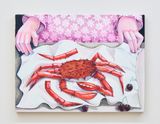
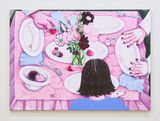
In Nikki Maloof’s painting there is something demiurgic, the evocation of a force orchestrating the universe, a theatrical representation of the world or the staging of small dramas of everyday life, which is reflected in the presence of hands at the edge of the canvas. Hands that are sometimes childish, static or active, a presence that is both graphic and yet alive, interrupting the repetitive continuity of a motif, like the cherry blossom of the dress in Crab and Cherries (2025). Metaphor of the sweet violence of life, this work plays on the contrast between the broken legs of the crab and the almost naive tenderness of the flowers, between the scarlet red of the crustacean and the immaculate whiteness of the tablecloth, between the angular folds of the tablecloth and the roundness of the fingers. The detail of the shell – its material, its relief, its roughness – evokes a landscape, like a microcosm that seems to contain the whole universe, like the Japanese pictorial technique of Gyotaku, where you keep the imprint of a fish by covering the surface with ink. Here as in many of her works, the framing contributes to the narrative, adds to the dynamics of the scene and injects a dramatic tension. In Pink Table (2025), the entire composition revolves around the bouquet posed in majesty in the centre of the table. The flowers – a sumptuous parrot tulip or crimson poppies – that seem to have emerged directly from a Dutch still life, contrast with the remains of a frugal family meal. The play of hands, the unusual twist of the forks, generate the tension of awaiting a tragedy, which is up to everyone to imagine. The artist enjoys muddying the waters, distilling clues from everyday life – a trace of lipstick on a glass, varnish on the child’s nails... – while associating them with elements of a timeless hieraticism. The shadow of Dieric Bouts seems to loom here, and the way in which the Flemish painter – often cited by Nikki Maloof – uses religious scenes as a pretext to paint precise arrangements of objects that, although not really still lifes, bear the characteristics of them. A work such as Christ in the House of Simon the Pharisee (1440) is similar to the composition of Pink Table: the secret choreography of the hands placed on the edges of the table, the fish dishes, the perspective combining a frontal view from above. In both Bouts’ and Maloof’s works, still lifes are used to explore matter – from the transparency of glass to reflection on the metal surfaces, the fold of a tablecloth or the texture of the flesh of a fruit or fish.

In a conjunction between subject and pattern, the flowers in a vase in the centre of Night Bouquet (2025) have the same presence as the tablecloth design – with no hierarchy or difference in treatment. Moreover, this conjunction, far from being merely formal, appears in the amazing brownish colour that spreads across the tablecloth, as if the passage of time, sensitive in the withered petals that litter the table, has also affected the design of the fabric flowers and has “wilted” them like those of the bouquet. The insects settling on flowers – a grasshopper, a caterpillar that is feasting on a leaf, two beetles – or the one approaching olives and grapes gathered on a plate, place this work in the classic tradition of the Vanitas. Describing Flemish still lifes as being in permanent imbalance, Paul Claudel defines them, in his Introduction to Dutch Painting (1935), as “an arrangement which is being disintegrated, something in the throes of time”. Assembling suspended objects, as in the moment before the fall, these paintings offer the experience of a time not stopped, but on the threshold of a tilt, in the imminence of the event. The poet’s description of the Dutch still life as an experience of the ephemeral and a ‘kind of dedication to the future”, seems also tinged with the meditative and contemplative dimension of Japanese aesthetics – which Claudel knows intimately from having spent six years in the Land of the Rising Sun. For him, the still life of the Dutch Golden Age is a retreat to intimacy. Sensitive in Night Bouquet, this idea of intimacy is underlined by the indiscreet rectangle of a lighted window that cuts out into the darkness of the night, and suggests the naked figure of a woman. A picture within a picture, a domestic scene, a modest and distant apparition, this window establishes a new relationship with the viewer, while evoking the projection of a space more interior than real. In this sense, it appears as the metaphor of a painting which, whatever the subject, is nothing but a mental space. A small theatre of intimacy, the bed is also a recurring theme in Maloof’s painting. Sleep (2024), whose subject, framing, and the importance of the repetitive pattern owe a great deal to Domenico Gnoli, evokes a place of solitude and crystalization of nocturnal fears – such as the fear of a threatening presence, suggested by a female shoe that pokes out from under the bed. Every detail of the domestic universe can thus become the starting point of a narrative, allowing part of the strangeness to intrude imperceptibly in everyday life, and suggesting one beyond the visible.

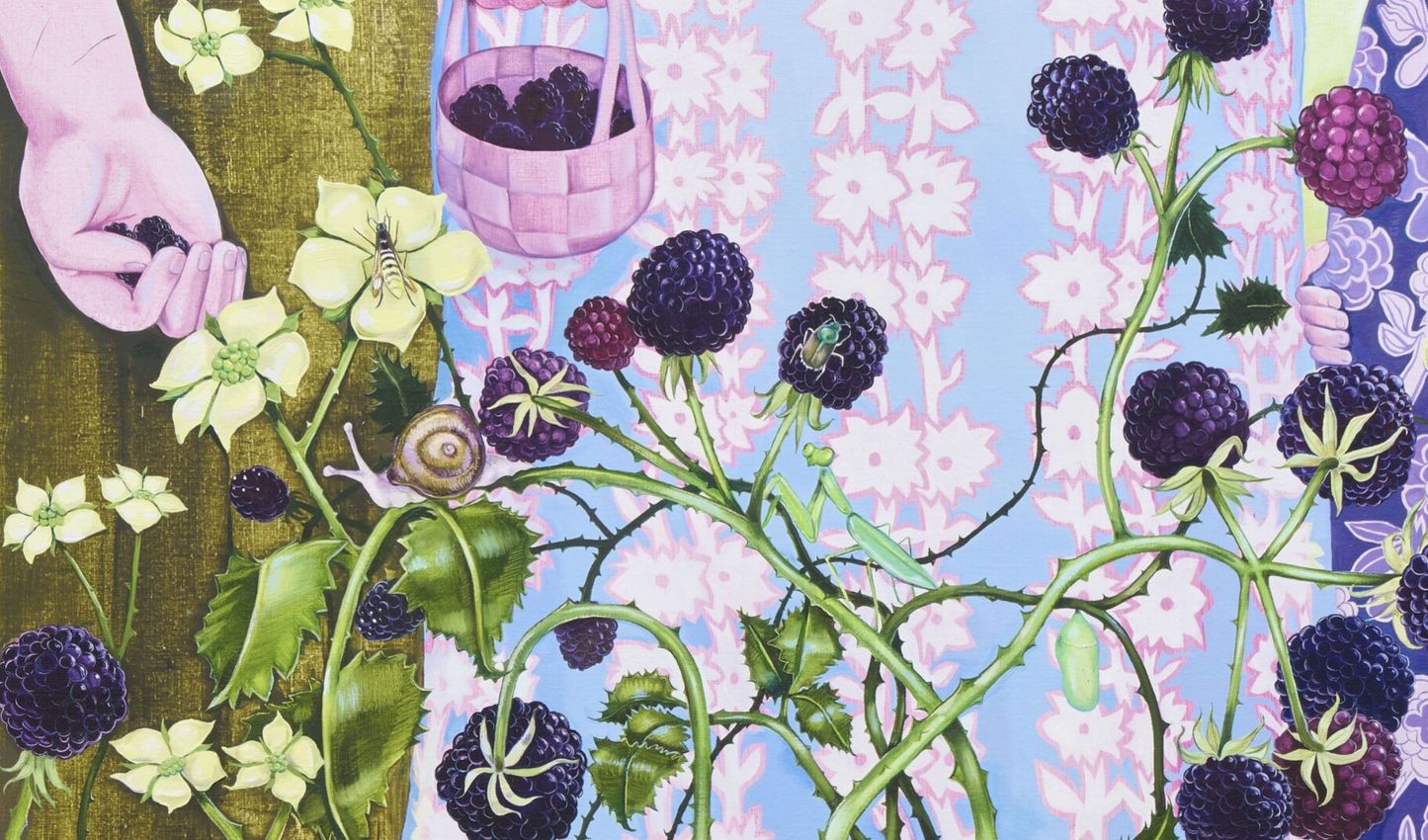
While she has always been interested in the home space and the psychological dimension that it bestows on the painting, the artist sometimes escapes, to make the garden and nature another expression of her mental space. Growing up in a rural environment in the Midwest, she now lives in rural Massachusetts. And she cultivates a garden, a transitional space between her home and her studio, which she crosses to “enter” painting. Marking the passage of time, of an eternal cycle of death and rebirth, the garden is the demanding place of nature that can be hostile or generous, as emphasized In the Brambles (2022). The blackberry stalks create complex arabesques against a background of flowery prints of summer dresses, while their thorns irritate the legs and brand them with scarlet scratches, in a metaphor of painting that, as the artist herself points out, is located in between, both a source of pleasure and sometimes as painful as the brambles. As spatial experience, the framing establishes a relationship with the viewer, invites a look, proximity or on the contrary, distance. The point of view seems to alternate between that of a child or of an adult – the mother, perhaps – in this coming and going that adds an additional temporal dimension, that of the cycle of life, superimposed on that of nature.

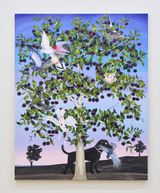
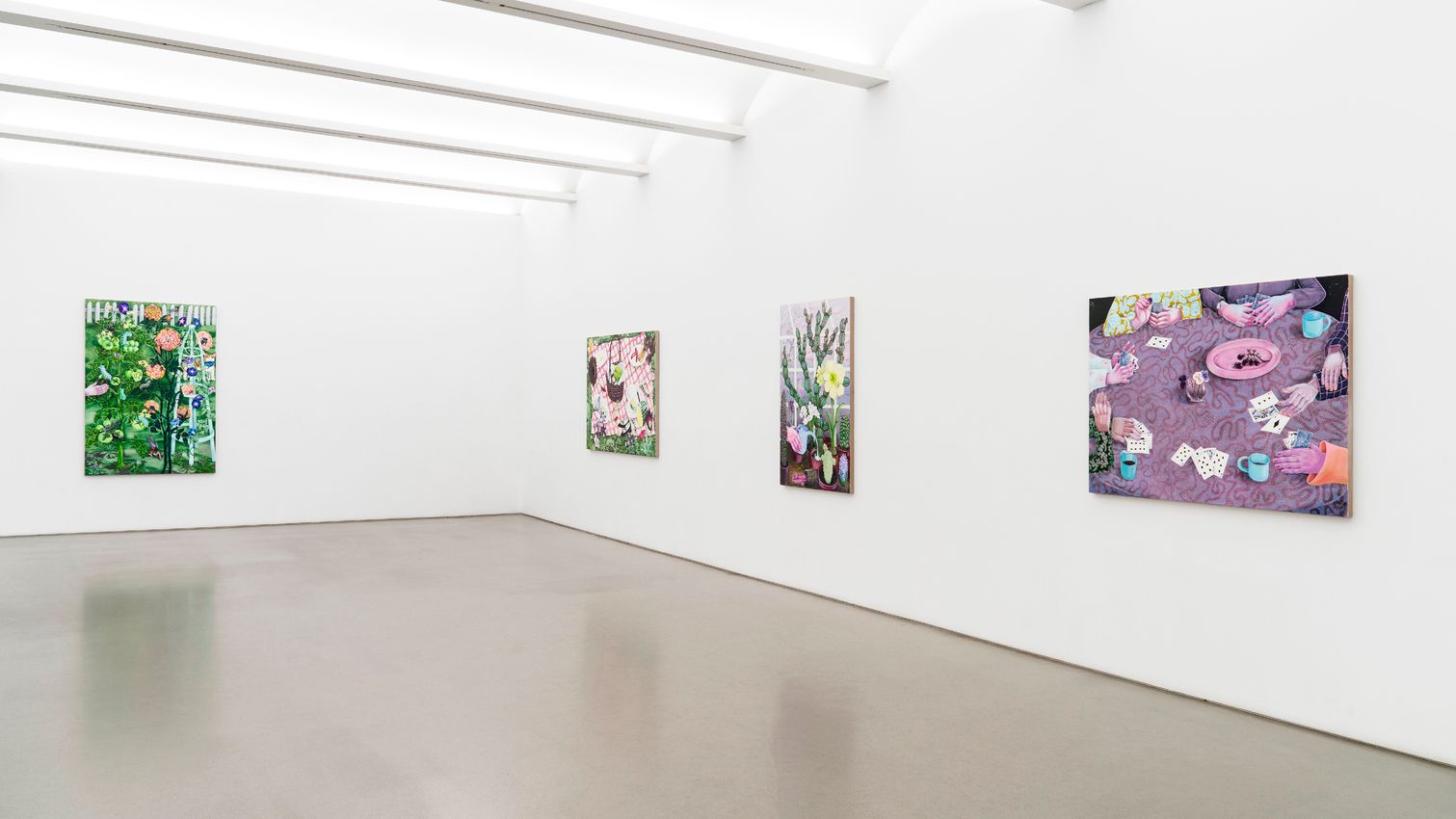
The painting of time, allegorical and internalized, in Nikki Maloof’s work does not lean towards realism. Although surrounded by nature, she does not seek to represent it. Nature is her subject, but not her model. Paradoxically, the more she paints trees or flowers, the closer she gets to a mental image, making painting itself the meaning of her research, with all the historical baggage she bears. Far from botanical accuracy, closer to the aesthetics of illustration or children’s books, her trees have a more sensitive than academic accuracy. Small theatres of life, they reveal the cycle of time and the seasons, in a colourful jubilation whose intensity organizes the balance of the composition. Whether in Spring (2025) or Summer (2025), the tree – whose monumental and frontal silhouette dominates a stylized landscape – houses a series of scenes symbolizing alternately birth, the reproduction of life, and death. From young birds cheeping in their nests, a flight of birds with scarlet plumage or captured in the instant they fall, their bodies bloodied, dropping past a pair of frolicking squirrels, these trees are where the cycle of life is happening. Borrowed from both a universal and oriental spirituality, evoking the Shinto tree of life, home to the Kami, they seem to weave a link between heaven and earth.

As one season follows another, each painting by Nikki Maloof invites a new one, in this continuum as dizzy and as infinite as time. Responding to a true and vital need, painting to her is a source of almost childish pleasure. Exploring beyond the visible, her work takes us to an inner world, which has its own logic. The sensitivity in her freedom of expression to explore matter, colour and pattern, or in her unique way of giving life to objects and transforming everyday life into something extraordinary, her desire to paint seems to be the real subject of her work. A visual oxymoron, combining joyful melancholy and the silent drama of existence, the beauty of the ephemeral and the attempt to slow down the passage of time, her painting is a celebration of life. And of the joy of painting.

Text by Hélène Kelmachter

Courtesy Perrotin.

Read More
About the Artist

Nikki Maloof is an American artist known for her still life paintings that depict animals in brightly coloured and highly patterned settings. Her drawings and oil paintings portray anthropomorphised creatures that oscillate between being humorous and unnerving.

View Artist Profile

Also Exhibiting at Perrotin

About the Gallery
Emmanuel Perrotin founded his first gallery in 1989 at the age of 21. He has opened since then over 17 different spaces, with the aim of continuing to offer increasingly vibrant and creative environments to experience artists work. He has worked closely with his roster of artists, some since more than 25 years, to help fulfill their ambitious dreams and projects. The gallery is now based in New York, Paris, Hong Kong, Seoul, Tokyo, and participates in all the significant worldwide art fairs each year (Art Basel (Hong Kong, Miami, Basel), Frieze (London, New York), FIAC (Paris), Dallas Art Fair, Art Cologne, Art Stage Jakarta, Expo Chicago, Art021 & West Bund Art & Design, Shanghai, Zona Maco Mexico, amongst others).
View Gallery Profile
Address
Piramide Building 1F
6-6-9 Roppongi
Minato-Ku
Tokyo
Japan
Opening Hours
Tuesday – Saturday
11am – 7pm
(1)
Tokyo Piramide Building 1F, 6-6-9 Roppongi
Perrotin
Piramide Building 1F, 6-6-9 Roppongi, Minato-Ku, Tokyo, Japan
+81 367 210 687
http://www.perrotin.com

Opening hours
Tuesday – Saturday
11am – 7pm
The art world in focus