


MOHAMMED Z. RAHMAN
b. 1997, United KingdomMohammed Z. Rahman (b. 1997) Mohammed Z. Rahman is a Bengali British visual artist and writer based in London whose practice weaves together personal narratives, socio-political histories, and the poetic potential of the domestic. Through painting, sculpture, zine-making, and installation, Rahman crafts what they describe as ‘dream aesthetics’—layered visual narratives that invite viewers into intimate worlds of memory, migration, labour, and community.
Practice and Approach
With a background in social anthropology from the School of Oriental and African Studies (SOAS), Rahman’s artistic methodology is distinctly informed by ethnographic thinking and lived experience. Their work transcends traditional disciplinary boundaries, merging self-taught portraiture and sculptural practice with rigorous conceptual frameworks that interrogate whose stories are told, whose lives are considered memorable, and what it means to mark unsung histories.
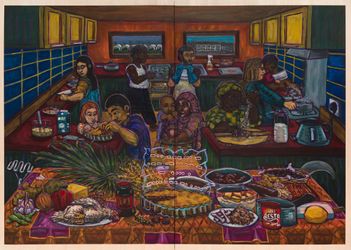
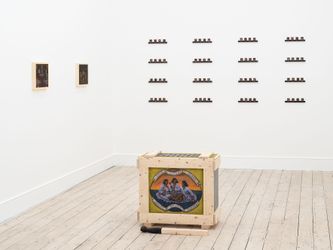
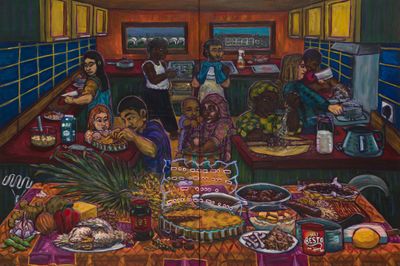
Rahman’s visual vocabulary draws from their family’s diasporic journey—a Bengali British household in East London navigating inherited Sylheti cuisine, working-class labour, and the kaleidoscopic migrant communities that constitute contemporary London. This intimate geography grounds their practice, where the kitchen table becomes a site of solidarity, the dinner becomes a platform for collective memory, and the ordinary objects of daily life—matchboxes, wooden crates, familiar foods—transform into vehicles for exploring connection and kinship.
The artist’s self-taught painting practice shares its DNA with their teens spent cooking as part of a working-class Bengali family. Their culinary vocabulary consists of diasporic interpretations of ancestral Sylheti cuisine, English classics, and their enmeshment in London’s ever-creolising migrant foodways. This convergence of culinary and artistic knowledge informs their “elevation of the ordinary”—a deliberate methodology to make accessible and dignify the spaces and practices often deemed invisible or undervalued.
Key Themes and Motifs
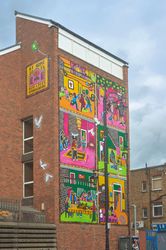
Rahman’s work consistently straddled themes of interspecies, internationalist, and intergenerational kinship, queerness, labour, and subculture. Their paintings frequently employ a visual language of concealment and revelation, where repeated symbols and forms migrate across works in different scales and contexts—a skateboard reappearing as a marker of sibling memory, a painted house containing multitudes, a fork-as-streetlamp suspending spaghetti into the urban landscape.
The artist’s engagement with food as subject matter extends beyond representation to a broader meditation on embodied knowledge, supply chains, ecosystems, and the emotional power of shared meals to foster solidarities. In their practice, food becomes a philosophical and political framework, connecting personal biography to collective histories of migration, labour, and desire.
Dreams and memory function as governing aesthetic principles. Rather than literal representation, Rahman develops what they term ‘dreamscapes’—collaborative works begun through conversations with subjects whose lived experiences become the foundation for painted explorations of interiority, fantasy, and historical consciousness. This approach is evident in their ongoing research into dreams and memories from the many communities that constitute their relationship to London.
Mohammed Z. Rahman Exhibition History
Rahman’s emergence as a significant contemporary voice has been marked by recent institutional recognition and solo presentations. City of Burrows (2023), their debut solo exhibition at Phillida Reid gallery, introduced their distinctive approach to painting as historical intervention. This was followed by A Flame is a Petal (2024), also at Phillida Reid, which was presented as part of London Gallery Weekend.
Their first major public gallery solo exhibition, Remember to Live (February–May 2025) at Peer in London, demonstrated the breadth and ambition of their practice. Comprising new paintings on canvas, boards, and found crates, the exhibition foregrounded themes of unsung histories and dreams, including a dreamscape developed in collaboration with Ballroom house mother Bambi Laveaux, and painted wooden crates commemorating workers, carers, and activists of the early AIDS crisis in the UK.
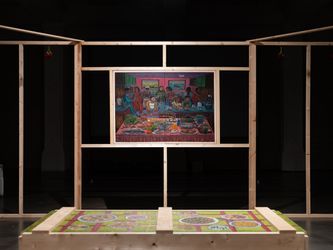
Most recently, Rahman presented Hearthside (2025) at Whitechapel Gallery in collaboration with Oitij-jo, a multi-day installation meditating on hospitality, food knowledge, and the dinner table as a site of community. This work exemplifies their commitment to exploring how embodied culinary knowledge and alchemical gastronomical practices can communicate solidarity and connection.
Institutional Engagement and Collaborations
Beyond gallery exhibitions, Rahman has developed substantial relationships with major institutions and grassroots organisations. They have worked with the Whitechapel Gallery, Brent Biennial, Tate Modern, the Smithsonian Institution in Washington DC, and V&A East, among others. Simultaneously, they have maintained consistent engagement with community-oriented organizations including Oitij-jo, gal-dem, Writing Our Legacy, Wasafiri Magazine, Skin Deep Magazine, and The Willowherb Review, reflecting their commitment to making art accessible and politically accountable to the communities their work represents.
In 2021, Rahman undertook an artist’s residency at the Apocalypse Reading Room in London, curated by Ama Josephine Budge and supported by Artsadmin, where they developed their research into dream aesthetics and collaborative practice.
Recognition and Acquisitions
Rahman’s work has entered significant public collections. In 2024, their painting Divali was acquired by the UK Government Art Collection, a significant endorsement of their practice. That same year, they received the prestigious Frieze Tate Fund award, resulting in the acquisition of two works—The Lovers and The Spaghetti House—by Tate Modern. These institutional endorsements recognize both the formal sophistication and political urgency of Rahman’s artistic vision.
Their work has also been supported through the Government Art Collection London Gallery Weekend Fund, further solidifying their position within contemporary British art discourse.
Artistic Vision and Future Directions
What distinguishes Rahman’s practice among their generation is their capacity to hold multiple registers simultaneously—the intimate and the political, the fantastical and the ethnographic, the personal and the collective. Their paintings operate on several levels, rewarding sustained looking and demanding active participation from viewers. Objects and symbols recur across works in titillating variation, inviting interpretation while resisting singular meaning-making.
The artist’s recent work demonstrates an expanding exploration of form and scale, from intimate matchbox paintings that require viewers to ‘come close and listen with their eyes’, to large-scale installations that transform architectural spaces into dreamscapes of community and care. Their commitment to the elevation of the ordinary—to making legible and dignifying the practices and people rendered invisible by dominant narratives—positions their practice as vital contribution to contemporary art’s ongoing reckoning with whose histories matter and how we memorialize and imagine futures together.
Mohammed Z. Rahman FAQs
Who is Mohammed Z. Rahman?
Mohammed Z. Rahman (he/they) is a British Bengali visual artist and writer based in London, working primarily in painting, illustration, sculpture and zine-making. His practice places socio-political and personal histories in conversation through scenes of domestic life, food, family and community.
What themes does Mohammed Z. Rahman’s work explore?
Mohammed Z. Rahman’s work explores how migration, labour, queerness and faith shape everyday life, often using domestic interiors and shared meals as sites of both care and conflict. Drawing on dreamscapes and what they describe as ‘dream aesthetics’, his paintings move between comfort and crisis, revealing and concealing layers of family and folk history.
Is Mohammed Z. Rahman self-taught?
Mohammed Z. Rahman is a self-taught painter with a degree in social anthropology from SOAS, University of London. This background informs his approach to art as an intimate and political form of oral history, attentive to material culture and the stories embedded in everyday objects.
Where has Mohammed Z. Rahman exhibited recently?
Mohammed Z. Rahman’s recent solo projects include Remember to Live at Peer, London, and Hearthside at Whitechapel Gallery, which together foregrounded domestic space, hospitality and Bangladeshi diasporic histories in London’s East End. Rahman is represented by Phillida Reid in London, where he presented his debut solo show of paintings in 2023.
Are Mohammed Z. Rahman’s works in public collections?
Mohammed Z. Rahman’s paintings have entered major public collections, including works acquired by Tate through the Frieze Fund and by the UK Government Art Collection. These acquisitions recognise the significance of his contribution to contemporary British painting and to narratives of British-Bengali experience.
Ocula | 2026

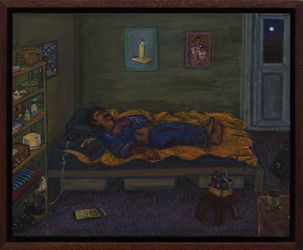
Representative Artworks
View story
View story
View story
View story
View story

Explore and Follow Artists Shaping Contemporary Art
A respected voice in contemporary art discourse.
Focusing on ambitious storytelling and insightful art-world commentary. Ocula Magazine publishes in-depth interviews, critical essays and timely analysis on the artists, exhibitions and ideas driving the global art world.
Learn more about Ocula Magazine
Showcasing the best of the art world.
Ocula partners with galleries from around the world to highlight their artists, artworks and exhibitions. Gallery membership is by application and invitation, with each member vetted by an independent panel.
Learn more about Ocula Membership
Specialises in the sale of major artworks.
Led by a team with deep ties to the world’s leading auction houses, galleries and collectors. Ocula’s advisory team offers bespoke services to high-net-worth clients from around the world who are looking to acquire the best of contemporary and modern art.
Learn more about our team and services