In his second solo exhibition at Sadie Coles HQ, Alex Da Corte presents a series of nine drawings and a new large-scale sculpture, each based on the image of the canopy structure of a movie-theatre marquee. The exhibition’s title, American Speech, is the name of an ongoing series of work confronting the messages we make, what we hope for, and what remains.
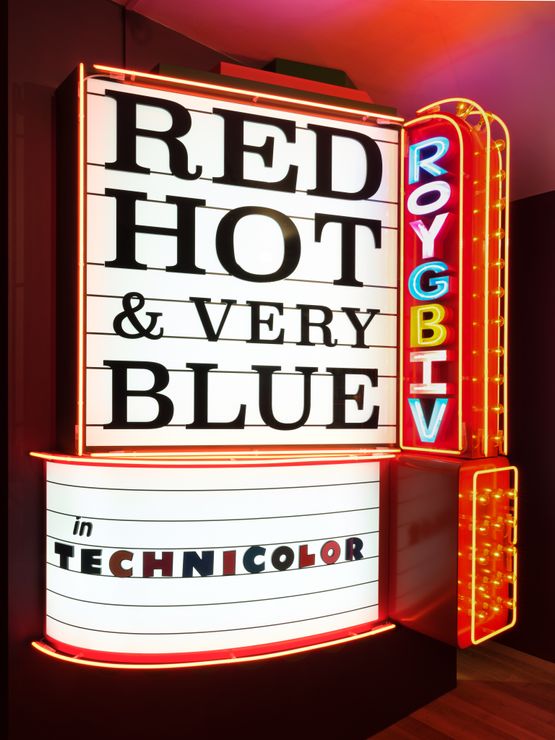
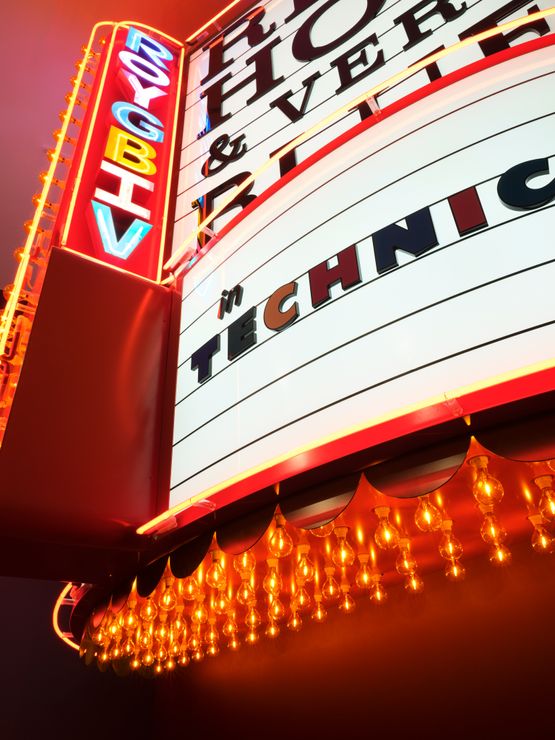
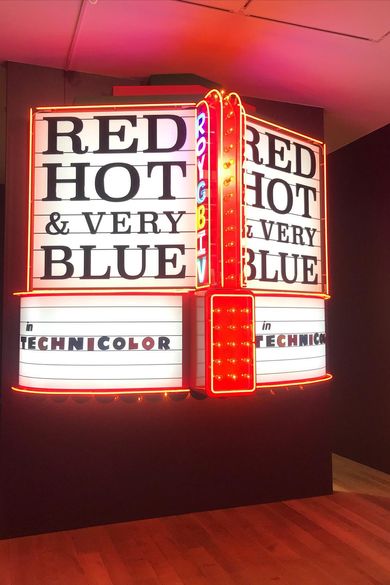
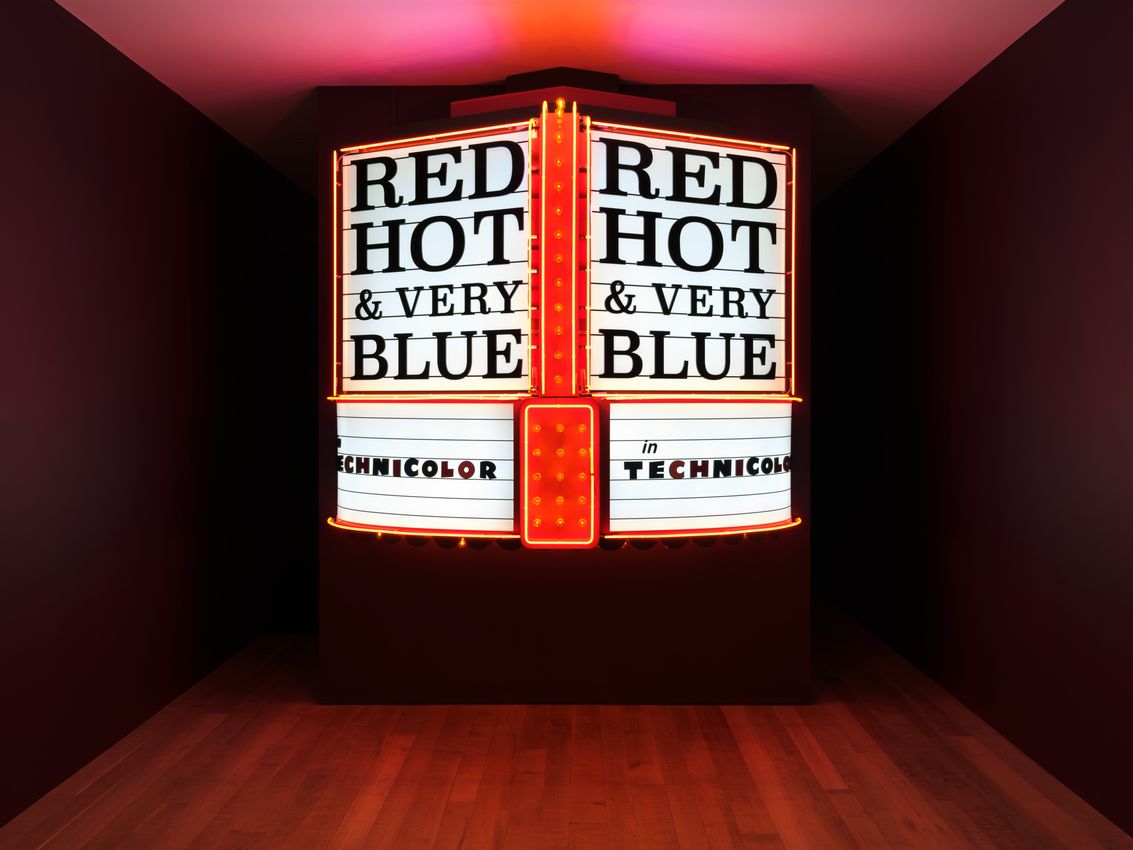
The sculpture consists of an illuminated model of a marquee, both palpably shrunken to domestic scale and uncomfortably large, in which text is stacked vertically and horizontally. The vertical letters, fringed by a line of lightbulbs, spell out the acronym for the colours of the rainbow, ROYGBIV. Alongside and below reads: Red Hot & Very Blue, In Technicolor. The first half of this title is lifted directly from an old marquee at an adult theatre showing ‘blue’ films, while In T__echnicolor smothers it in the gloss of mid-century family entertainment. This naughty collision creates a whole. In this title is the complete stage of experience, just as full and just as wonky as the enigmatic distillation of the colour spectrum in the neon ROYGBIV, its letters gleaming in confident colours that actually don’t correspond. It is a “collage of mistakes,” Da Corte explains, just like the built American environment from which its volumes are drawn. The artist celebrates the estrangement of form and content, the live negotiation of culture—per Robert Venturi and Denise Scott Brown’s 1972 touchstone Learning from Las Vegas—that constructs faith, fear, nonsense and progress in our world, all at the same time.
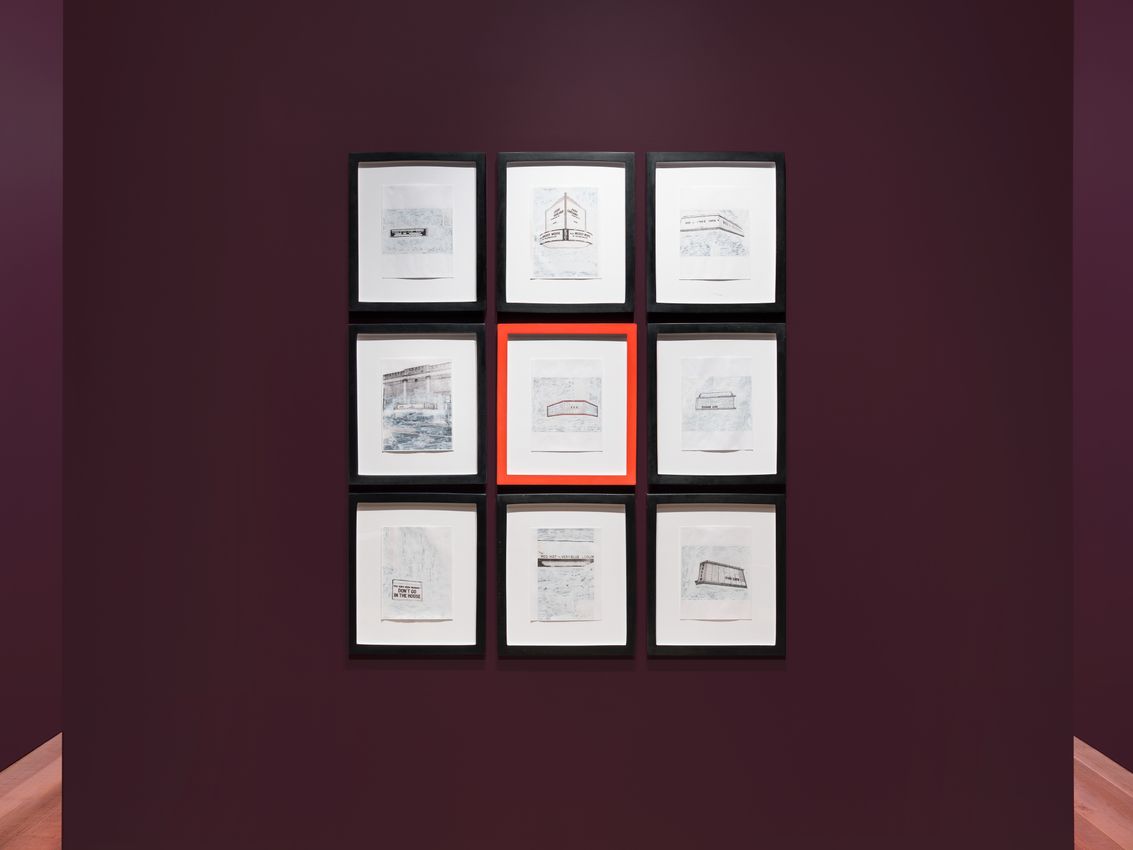
Just as the sculpture touts an unachievable totality, each of Da Corte’s drawings is simultaneously archival documentation, comprising a monochrome print of an old movie theatre, and an elegiac, slipping symbol. The artist has whited-out certain architectural details or words from the theatres’ facades, leaving a fragmentary image—in some cases, a near-blank interrupted by small vestiges of text, or an architectural shape evacuated of detail.
Echoing conceptual experiments in deletion such as Robert Rauschenberg’s Erased de Kooning Drawing, 1953, Da Corte’s drawings are enactments of memory and forgetting. Words become metonymic, parts standing for absent wholes. Built structures become ghostly silhouettes. The act of deletion renders the images and their component words more open-ended or, at times, more concentrated and emotive: the name of Judy Garland eclipses those of her co-stars or the movie itself, just as Garland’s iconicity has blazed through the obscuring effects of time. In XXX, all identifying details have been removed apart from the angular outline of the marquee itself—highlighted in red—and the triple X warning of hard erotic content. Meanings, in this way, are isolated or transformed rather than simply erased.
The words American Speech are freighted with political rhetoric; they serve as naked acknowledgement of the artist’s broadcast of his own voice, the language he inherits and continues, the responsibilities he bears. American Speech is also the name of the academic journal where, in 1926, the word ‘marquee’ was first recorded. The American speech of a marquee is a place of expectation and promise. Words, like colours, change as they mix. ‘It’s not necessarily to cancel out whatever mysteries and meanings these pre-existing icons have,’ Da Corte has explained of his work, ‘but to make them my own, to embrace them and add on to them. It’s about mutating more than erasing.’

Alex Da Corte (b. 1980, Camden (NJ)) obtained a MFA in Sculpture from Yale University, New Haven (CT) (2010) and a BFA in Printmaking and Fine Arts from The University of the Arts, Philadelphia (PA) (2004). Da Corte is a conceptual artist, working across a range of different media including video, performance, installation, painting and sculpture. Often he unites these elements to create fantastical and vividly-coloured immersive environments that amount to Gesamtkunstwerks. His work is informed by Pop Art and Surrealism, regularly combining high- and low-brow American cultural references–from branded items found in domestic life to figures from popular culture–in order to explore and interrogate personal and cultural politics, alienation and the psychological parameters of the human experience.


A respected voice in contemporary art discourse.
Focusing on ambitious storytelling and insightful art-world commentary. Ocula Magazine publishes in-depth interviews, critical essays and timely analysis on the artists, exhibitions and ideas driving the global art world.
Learn more about Ocula Magazine
Showcasing the best of the art world.
Ocula partners with galleries from around the world to highlight their artists, artworks and exhibitions. Gallery membership is by application and invitation, with each member vetted by an independent panel.
Learn more about Ocula Membership

Specialises in the sale of major artworks.
Led by a team with deep ties to the world’s leading auction houses, galleries and collectors. Ocula’s advisory team offers bespoke services to high-net-worth clients from around the world who are looking to acquire the best of contemporary and modern art.
Learn more about our team and services