



Press Release

We are pleased to announce the opening of SCAI PIRAMIDE (Roppongi), our third exhibition venue following SCAI THE BATHHOUSE (Yanaka) and SCAI PARK (Tennozu). SCAI PIRAMIDE seeks to foster thoughtful exchanges and further advance the contemporary art scene in Tokyo. Going beyond the existing gallery framework, it aims to propose renewed perspectives on art and update our contextual understanding in response to changing times.

The inaugural exhibition will feature the early works of Shusaku Arakawa, whose renewed attention and reevaluation of his oeuvre follows the 10th anniversary of his death. While the system of values and our understanding of the past is being called into question, we are asked what kind of training is necessary to “think through” the present, using all the cognitive means allowed to us. Arakawa’s paintings respond to this proposition by becoming a gathering place of images, shifting perceptions, thoughts, and exercises of the natural sciences and philosophy. In the fog of “not-quite-knowing”, the paintings act as a compass pointing towards an unseen horizon in a moment of awakening that binds all dimensions of cognition together. Arakawa’s endeavor will be brought to a new light, and the exhibition aims to generate renewed interpretations by referencing today’s reality.

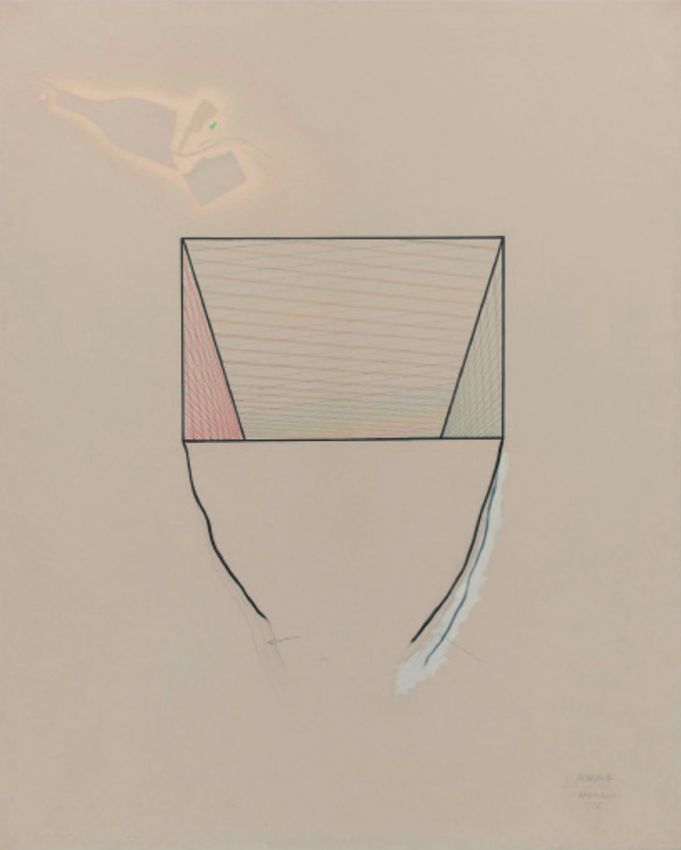
In the two-dimensional work BOTTOMLESS No. 1 (1965) depicts a cube stretched vertically and open at the bottom. The freehand dawning resembles a huge, unidentifiable apparatus—believed to be a presentation of a body flowing out blood with the spirit inside. Many of these works, often described as diagrammatic paintings, are made on human-scale canvases intended to alter physical percepts and thoughts, and consist of arrows, mechanical diagrams, everyday images and typography to guide the viewer. Oscillating between serious rigor and strange gimmicks, the viewer is encouraged to incite a new cognitive dimension.

Adding a temporal dimension to the intellectual quest in flat planes, the two experimental films—in collaboration with Madeline Gins—are considered an emotive and affectionate form of this expression. In Why Not (A Serenade of Eschatological Ecology) (1969, 110 minutes), a nude woman wrestles with a door and a table in a room questioning the nature of existence—a physical performance in an enclosed space. This subject is further explored in For Example (A Critique of Never) (1971, 95 minutes), which documents a homeless boy wandering the streets of New York, tracing changes of his body and surrounding environment repeatedly shifting and overlapping Arakawa + Gins’s texts on screen.

Semiotic ideas flash across the canvas and on screen. The questions posed by the young artist—who at the time was about 30 years old—were directed with the motive to shake the viewer’s perception and bring forth new means of comprehension. They seek to grasp the totality of the phenomenon of meaning, skirting the most jargoned procedures of literature. Arakawa’s remarks are ever more poignant during a time of confusion, witnessing the world increasingly divided and polarized, with conventional systems seized in their functionality.

Read More
About the Artist

enowned for his paintings, drawings, and prints, as well as his innovative architectural constructions, Arakawa was one of the earliest practitioners of the international Conceptual art movement of the 1960s. After moving to New York from Japan in 1961, Arakawa produced diagrammatic paintings, drawings, and other conceptual works that employed systems of words and signs to both highlight and investigate the mechanics of human perception and knowledge. In 1962, Arakawa met American poet Madeline Gins, with whom he developed a personal and creative partnership. Together they expanded Arakawa’s painting practice into an important series entitled The Mechanism of Meaning, a suite of eighty canvases that explored the workings of human consciousness. The Mechanism of Meaning exists in two versions that were exhibited in their entirety by the Sezon Museum of Modern Art, Karuizawa in 1988 and the Solomon R. Guggenheim Museum, New York in 1997. In the 1990s, Arakawa and Gins developed the theory of “procedural architecture” to further impact on human lives. Through architecture specifically, they endeavored to “learn how not to die.” Terming this concept “reversible destiny,” they believed firmly in the capacity of their architectural works to positively influence the personal well-being and longevity of those who lived within them. Arakawa and Gins dedicated the remainder of their lives to seeing these ideas integrated into architectural theory and contemporary building methods.

View Artist Profile Arakawa contemporary artist
About the Gallery
SCAI PIRAMIDE seeks to foster thoughtful exchanges and further advance the contemporary art scene in Tokyo. Going beyond the existing gallery framework, it aims to propose renewed perspectives on art and update our contextual understanding in response to changing times.
View Gallery Profile
Address
3F, 6-6-9 Roppongi
Minato-ku
Tokyo
Japan
Opening Hours
Tuesday – Saturday
12pm – 6pm
(1)
Tokyo 3F, 6-6-9 Roppongi, Minato-ku
SCAI PIRAMIDE
3F, 6-6-9 Roppongi, Minato-ku, Tokyo, Japan

Opening hours
Tuesday – Saturday
12pm – 6pm
The art world in focus
