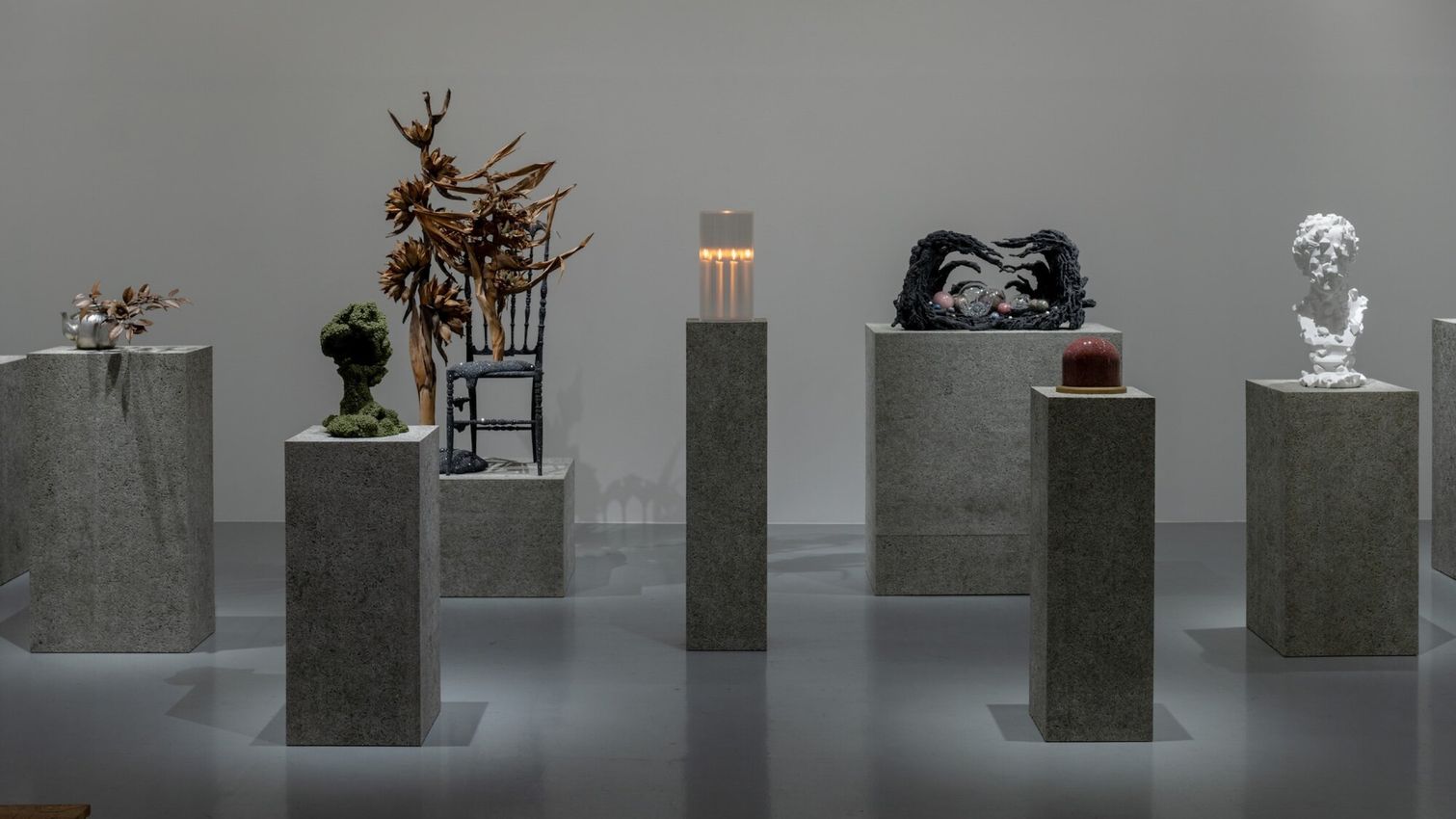
Over the past two decades, Kohei Nawa’s mixed-media practice has explored the reciprocal interplay between materiality, perception, and codification in an era of accelerated technological and ecological transformation. Series such as PixCell have emerged through his sustained engagement with materials that alter the surface of found objects, highlighting recursive exchanges between engineered substances and encoded signifiers, as well as between digital data and sculptural form. Sentient—Nawa’s sixth solo exhibition with the gallery and his first in three years—extends this inquiry, challenging conventional ontologies of objecthood through a diverse array of artistic interventions.
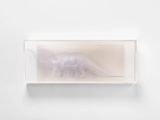
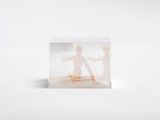
The exhibition comprises approximately twenty sculptural works, each placed on an individual pedestal and collectively weaving a multilayered dialogue. From a 1970s cathode-ray tube television and a kazariuma doll used in seasonal festivals, to a plaster cast of a Greek sculpture once employed in drawing classes, the featured objects have been gathered through varied channels of circulation—such as online auctions and local flea markets. They appear as if they have been “caught by the mesh in the shifting currents of time” (as Nawa puts it), each embodying distinct aesthetics from disparate eras and regions. The range of materials extends beyond still objects to include elements such as a perpetually burning candle and a weekly refreshed ikebana arrangement—spanning from mass-produced icons of an era to handcrafted formal expressions.Techniques drawn from Nawa’s ongoing series—including Velvet, which coats surfaces with villosity resembling moss or fungal mycelium, and Trans, which sculpts forms based on 3D-scanned digital data—are applied to these objects, rendering their meanings unstable and unsettling their semiotic legibility.
Based on a prototype conceived during his university years, Meat in a Cell (2025) reveals the early emergence of Nawa’s long-standing themes: the interplay between organic and synthetic matter, as well as the conceptual framework of the cell. What appears at first glance to be a polished mineral is, in fact, a mass of meat enclosed within a glass case. Its deceptive form inscribes itself in the viewer’s memory through a stark disjunction between visual recognition and material reality, reminiscent of the Surrealist effect of ‘defamiliarisation’. Works such as Traveller’s Tree (2025)—composed of a wooden chair coated in silicon carbide and dried plants—and Cockscomb (2025), in which a cockscomb flower, preserved through plastination like an anatomical specimen, is pinned inside a glass jar, further amplify the uncanny dimensions of the exhibition’s imagery—placing organic and biological matter into a state of suspended stillness, as if frozen in another realm.
Among the exhibited works, Cells in the Grotto (2025) stands out for its interpretive fluidity. Resembling a cave overgrown with rhizomes, the structure is coated in dried and pulverised clay, with glass spheres of varying sizes placed within, each containing natural or synthetic material. Mica flakes, crystallised minerals, film-coated turnip seeds, Himalayan rock salt, and mugwort—elements diverse in colour and form— are encapsulated, suggesting a fragile ecosystem intricately entangled with the earth’s ongoing environmental crises. At the same time, the seemingly discordant arrangement of these objects evokes mythological and symbolic associations, foregrounding the logic of assemblage as one governed by uncontrollable external forces.
At Nawa’s studio, objects stripped of their original function arrive one after another, accumulating in a state of deliberate disorder that echoes what Walter Benjamin described as “the scatter of allegorical properties (the patchwork)”*—a mode of collecting that rejects linear narrative and fixed categorisation. As these objects undergo transformation through the layering of diverse materials and techniques, their legibility as signs is gradually dismantled. Within this combinatory assemblage, objects drift between material properties and encoded meaning, unsettling existing systems of value. In Sentient, the spatial constellation of these sculptures opens a field of relational encounters—one in which meaning remains fluid, continuously unravelling into unforeseen perspectives.
Kohei Nawa (b. 1975, Osaka) lives and works in Kyoto, Japan. After a semester abroad at the Royal College of Art, London, he received a Ph.D. in Fine Art Sculpture from the Kyoto City University of Arts (2003). Between 2005–2006, he stayed in New York through the support of the Asian Cultural Council, and Berlin through Daimler Chrysler. In 2009, he founded the creative platform SANDWICH (Kyoto), thereafter serving as its director. Notable solo exhibitions include: L_B_S at Ginza Maison Hermes, Tokyo (2009); Synthesis at the Museum of Contemporary Art, Tokyo (2011); and SCULPTURE GARDEN at Kirishima Open-air Art Museum, Kagoshima (2013). He has participated in the 6th Asia Pacific Triennial in Brisbane, Australia (2009); the 14th Asian Art Biennale Bangladesh in Dhaka, Bangladesh (2010) (Grand Prize winner); Aichi Triennale in Nagoya, Japan (2013), amongst others. Nawa is currently an Associate Professor at the Kyoto University of Art and Design.
SCAI The Bathhouse is a contemporary art gallery located in Yanaka, with a town ambience reminiscent of Old Tokyo. In walking proximity to Ueno, an area dense with museums and art schools, the gallery was converted from a venerable 200-year-old public bathhouse. Take a step inside, and you will find a white cube with soft natural light descending from the high ceiling.

A respected voice in contemporary art discourse.
Focusing on ambitious storytelling and insightful art-world commentary. Ocula Magazine publishes in-depth interviews, critical essays and timely analysis on the artists, exhibitions and ideas driving the global art world.
Learn more about Ocula Magazine
Showcasing the best of the art world.
Ocula partners with galleries from around the world to highlight their artists, artworks and exhibitions. Gallery membership is by application and invitation, with each member vetted by an independent panel.
Learn more about Ocula Membership

Specialises in the sale of major artworks.
Led by a team with deep ties to the world’s leading auction houses, galleries and collectors. Ocula’s advisory team offers bespoke services to high-net-worth clients from around the world who are looking to acquire the best of contemporary and modern art.
Learn more about our team and services