Press Release

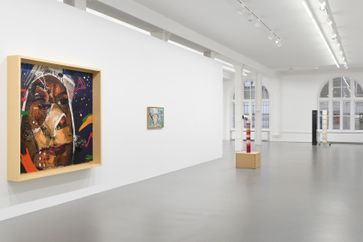
Skarstedt is pleased to present Martin Kippenberger: The Late Paintings –– an exhibition dedicated to the wildly heterogeneous production of Kippenberger’s final years. Covering the period 1994-1997, the exhibition brings together paintings from important bodies of work such as: Egg Paintings; Jacqueline: The Paintings Pablo Couldn’t Paint Anymore; The Raft of Medusa; and Window Shopping Until 2 a.m.

Picasso looms large throughout Kippenberger’s life. Almost always described in mystical terms as a sorcerer or magician, Picasso is the paradigm of the unimpeded genius, the epitome of the modernist painter-hero who never ceased to reinvent himself, even in his old age. As his biographer, John Richardson, recounts, Picasso was highly conscious of the importance of a “Great Late Phase” in solidifying his place in the art historical pantheon. Like Picasso before him, by the mid-1990s, after years of hard living, Kippenberger was increasingly aware that he too was entering his Late Period. However, instead of Picasso’s virile musketeers, with his Egg Paintings, Kippenberger cast himself as the Eggman as he deployed the egg, in its various guises, to perform an incisive critique of the cultural status quo. An equally ironic and iconoclastic act, the invocation of the egg marks a refusal of the heroic self-fashioning that dominates Picasso’s late work.

In 1996, Kippenberger explicitly resumed his identification with Picasso for the series, Jacqueline: The Paintings Pablo Couldn’t Paint Anymore, but this time, he set out to achieve what even the master of modernism could not: to paint his grieving widow, Jacqueline. Yet Kippenberger’s triumph over Picasso is undermined by the signature stamped on the canvas: ‘J.P.’ (Jacqueline Picasso). It is as if, when applying the final stroke which would cement his triumph, Kippenberger’s identity disappeared into the surface of the painting only to be replaced by the spectral presence of the model whom he had been painting.

Although the Jacqueline paintings do mourn Picasso’s death, more fundamentally, they mourn the death of the modernist author par excellence. By specifically identifying with a post-mortem Picasso, Kippenberger laments the impossibility of a certain model of authorship that died with Picasso. As Ann Temkin writes, “Through no fault of his own, [Kippenberger] was late to the party of modernism [...] It was no longer credible to relate oneself to prior work in terms of progress–one could only portray the reality of one’s own belatedness.” Particularly in the late paintings, with their echoes of color field painting, passages of gestural abstraction, overlaid grids, and Barnett Newman-esque zips, Kippenberger trudges through the marshlands of modernist aesthetics unable and unwilling to lay claim to a style that would be distinctly his own. Through his various performances, appropriations, and parodic identifications, Kippenberger revels in unoriginality; he disperses his authorial voice in a style-less style, weaving together diverse cultural and art historical fragments to form authorless assemblages.

Even in The Raft of Medusa, where he most explicitly engages with the prospect of his own death through a theatrical deconstruction of Géricault’s masterpiece, Kippenberger never veered into self-pity or a desperate attempt to assert his immortality as a painter. In Untitled (from the series The Raft of Medusa), Kippenberger anticipates his own death through an unidealized depiction of his sagging head, which already shows the onset of rigor mortis. However, Kippenberger stages the existential drama of the human body against a parodically Rothko-esque background. In contrast to Rothko’s desire to provoke intense emotions like tragedy or despair through his work, Kippenberger’s candy-colored compositions in The Raft of Medusa series undercut the mounting pathos through an ironic détournement. As Untitled oscillates between the tragic and the parodic, the heroic and the anti-heroic, Kippenberger ultimately refuses the seduction of painterly apotheosis –– even as the cancer spread throughout his dying body.

In this way, we begin to question if we can really identify a so-called Late Period in Kippenberger’s oeuvre at all. These paintings, in their radical heterogeneity, seem to prohibit any chronological periodization whatsoever. And they can furthermore only be considered ‘late’ according to the mythologized biography of the painter whose early death lends them an air of tragedy. However, the paintings gathered here seem to undermine the very authority of the modernist painter-hero who could ensure the validity of such a periodization. Once liberated from a heroic chronology, Kippenberger’s late paintings no longer seem to represent a coda, a grand finale, or some neat conclusion to his career; rather they seem to represent an opening –– the latest evolution of a body of work which thwarts reductive interpretations and continues to generate proliferating meanings.

Read More
About the Artist

A provocateur, satirist and virtuoso across mediums, Martin Kippenberger was a prolific contemporary artist whose irreverent approach to artmaking challenged the conventions of the post-war European avant-garde.

View Artist Profile Martin Kippenberger contemporary artist
About the Gallery

Skarstedt was founded in 1994 by Per Skarstedt to present a program of museum-level exhibitions by contemporary European and American artists. Recognized for its critically acclaimed historical exhibitions, Skarstedt works closely with artists and estates to re-unite seminal bodies of work and offer focused surveys of pivotal moments in the history of twentieth-century art.

View Gallery Profile
Address
20 East 79th Street
Upper East Side
New York
United States
Opening Hours
Tuesday – Friday, 9:30am – 6pm
Saturday, 10am – 5pm
(1)
New York 20 East 79th Street, Upper East Side
Skarstedt
20 East 79th Street, Upper East Side, New York, United States
+1 212 737 2060
http://www.skarstedt.com

Opening hours
Tuesday – Friday, 9:30am – 6pm
Saturday, 10am – 5pm
The art world in focus