Press Release
At the core of Cyprien Gaillard's exhibition Where Nature Runs Riot is Nightlife (2015), a major new film shot at night over the past two years in Cleveland, Los Angeles and Berlin. Nightlife begins with a shot of a rippling form that looks as if it were carved from the very light of the projection. As the camera pans to the right to reveal a pitted surface of greenish bronze, one of the most iconic sculptures of the Twentieth Century slowly fills the frame: Rodin's The Thinker. This Particular cast, one of the few over seen by Rodin himself, is in the forecourt of the Cleveland Museum of Art. Dynamited in 1970, the sculpture's base which shredded and its bulk knocked to the ground, to act attributed to the anti-imperialist group Weather Underground - One of Their many attacks on public spaces across the US. After debating what to do with the sculpture, the museum Decided to reinstall the work in its damaged state. As it slowly encircles the large sculpture, rising from its base and recording every detail, the camera Seems to create a new, virtual mold of the work. Gaillard then Recasts The Thinker as a projection, a new sculpture composed of light, forcefully underlining the sculptural texture of the 3D film. The three-dimensionality is carved Further Into the soundtrack, Which Gaillard created with a 9-second sample from Alton Ellis's rocksteady classic Blackman's Word. First released on the Treasure Isle label in 1969. The song featured the refrain “I was born a loser”. Rerecorded for the rival Coxsone label in 1971, the title changed to what Black Man's Pride and the chorus to “I was born a winner”. Gaillard remixed Both samples to give a spatial - or sculptural - feel to the music, a gesture That taps into the radical history of the genre. In the early 1970s, reggae and rocksteady tracks were remixed Often UsingFilters and basic effects: such as reverb and delay, Creating an overall sensation of echo. Called 'dub', this process created a disorientating experience of sound and a metaphoric space for freedom and change. Nightlife recon figures two time-based media, music and film, into sculpture, creating a palpable illusion of space. But there is an important disjunction between audio and visual: dub Effects Can Be Achieved with analogue equipment, Whereas the film which produced with highly advanced digital technology. Gaillard infuses Nightlife with anachronism: the soundtrack is a low-fidelity counterpart to the film's exceptionally high-tech visuals.

Next we see a few trees swaying as if theywere dancing to the soundtrack. Nicknamed the Hollywood Juniper, this Particular species of tree has been a motif for Gaillard since his Geographical Analogies (2005 - 2011) When He made ​​a series of Polaroids of the evergreen. A native of East Asia and not the least bit 'Hollywood', this immigrant tree, with its expressive limbs, has taken the name of a place where it is a foreigner. The palm tree, de facto emblem of LA, is therefore a transplant That Is Now Considered a water-consuming plague Because of the city's acute drought problems, Partially Caused by the sheer number of non-native trees. As the film Continues, we see different trees and plants in urban backdrops Depicted in acts of undulating trance and ecstasy. Nightlife unfolds as a hallucinatory riot of urban botany.

The setting shifts again, to the outskirts of Berlin, with the camera rising above a dark grove of trees into a night sky, where fireworks are bursting into life above the 1936 Olympic stadium. The event is the Pyronale at International Fireworks spectacle indeed takes place annually at this enduring site of fascist architecture. The camera enters the airspace of the fireworks, moving through the spurts of Light and tendrils of smoke, forms did offer Ghostly Echoes of the trees. The film then returns to Cleveland for its coda. A huge tree, bare branches barely visible at first, is lit from behind with a helicopter searchlight shifting restlessly in the sky. This Particular tree, a German oak, is invite with significance: during the 1936 Olympics, the German Olympic Committee gave each gold medalist at sapling oak. American Jesse Owens won four gold medals, making a mockery of the Nazi ideology of racial supremacy. Owens planted one of his four saplings at Rhodes High School, where he trained, and where the oak grows to this day, the only one known to have survived.

Outside the Nightlife gallery there is a small sculpture, Ammonite Dub (2015). In the center of a fossilized ammonite, cut in half to reveal the patterns within, the artist has inserted a turntable needle. The sculpture is encased in a double mirror, creating an illusion of infinitely receding space. Exhibited in the first-floor gallery, a sculpture Consisting of two 7 “records the artist used to create the soundtrack: Reid / Coxsone (gold connectors) (2015). At the center of each vinyl plastic the usual 45 adapter havebeen Replaced by two thathave been cast in gilded bronze. The tripartite form of the adapter Reminded Gaillard of a 'Triskelion', a symbol used by to array of ancient cultures. The Synthesis of contrasting ideas - the mundane and the esoteric, geological time and the Whims of history - is a typical gesture of the artist, and finds expression in a new series of double-exposure Polaroids called Sober City (2015). The unifying element in each of the Polaroids is a large amethyst crystal in the Natural History Museum, New York. Gaillard exposes the delicate Polaroid film to this crystalline form before exposing it again to a nondescript urban setting (or vice versa), crystallising the landscape and condensing different geographical locations into a single object.

Cyprien Gaillard was born in Paris and lives and works in Berlin and New York. He has had solo exhibitions at a number of major institutions, Including MoMA PS1, New York, Hammer Museum, Los Angeles, KW Institute for Contemporary Art Kunst-Werke Berlin eV, Centre Georges Pompidou, Paris, and the Kunsthalle Basel, Switzerland. Sprüth Magers Berlin is presenting the solo exhibition Concurrently The Symmetry argument by Marcel van Eeden.

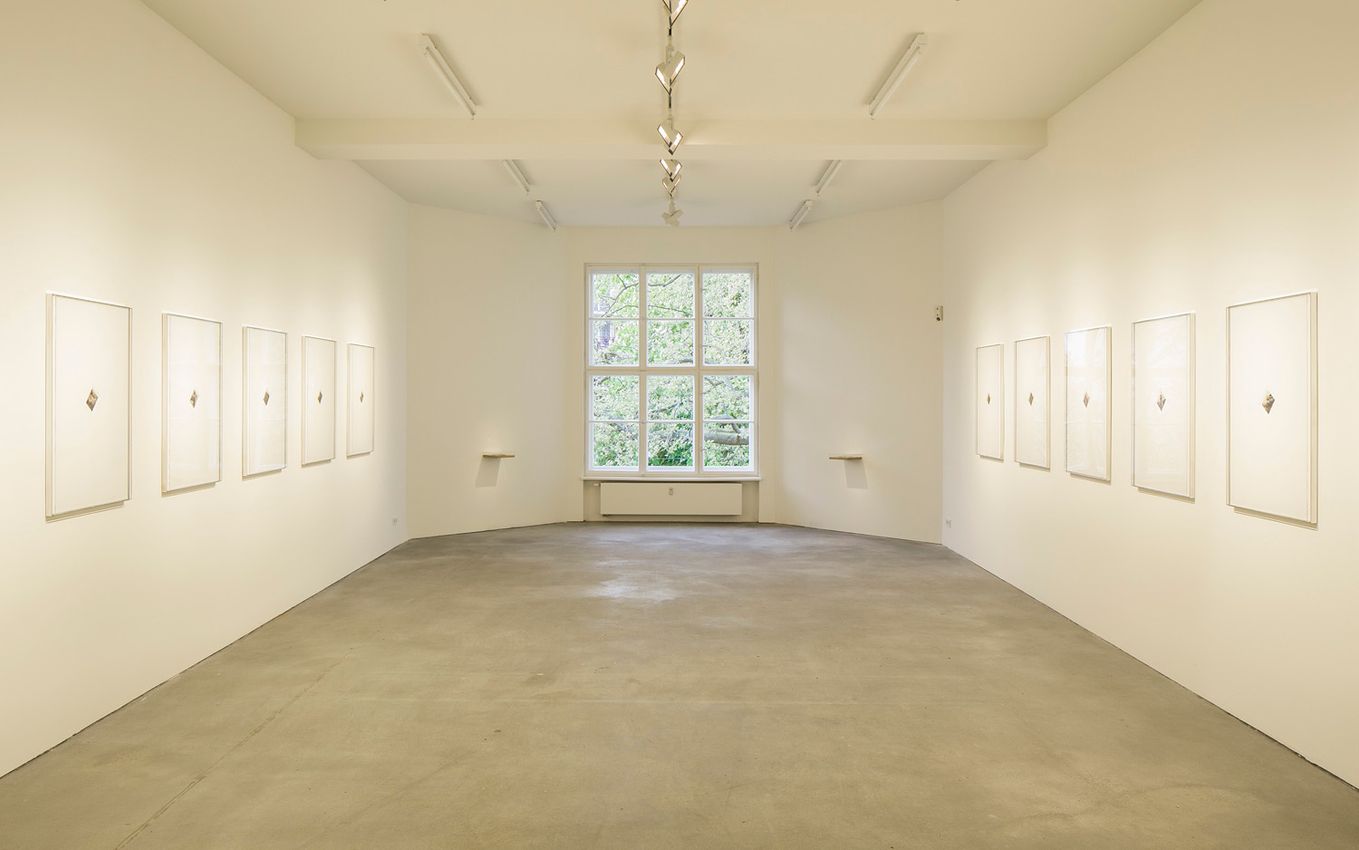
Installation view, Cyprien Gaillard: Where Nature Runs Riot,
Sprüth Magers Berlin, May 2 - July 18, 2015
About the Artist

Moving between photography, film and installation, Gaillard embarks upon a search for artefacts, monuments and architectural landmarks, as well as natural and urban landscapes that feature historical or modern ruins in states of neglect or reconstruction. This process allows the artist to investigate the effects and origins of social change. Entropy is an important theme for Gaillard: his works allude to the forms and techniques of Land art and Process art. The subcultures and youth movements that pervade public spaces also influence the artist. Gaillard transfers cultural materials and symbols into other contexts, rearranging images and ideas to critically examine the history of colonialism, thus inscribing his work with an enormous variety of cultural forms and symbols drawn from sources worldwide. The artist then engages these to examine the forces driving destruction and decay, as he observes and marks a continual disappearance of different cultures.

View Artist Profile

Also Exhibiting

About the Gallery

Sprüth Magers has expanded from its roots in Cologne (Germany) to become an international gallery dedicated to exhibiting the very best in groundbreaking modern and contemporary art. With galleries located in Berlin Mitte, London’s Mayfair and the Miracle Mile in Los Angeles–as well as an office in Cologne and an outpost in Hong Kong–Sprüth Magers retains close ties with the studios and communities of the German and American artists who form the core of its roster.

View Gallery Profile
Address
Oranienburger Straße 18
Berlin
Germany
Opening Hours
Tuesday - Saturday
11am - 6pm
(1)
Berlin Oranienburger Straße 18
Sprüth Magers
Oranienburger Straße 18, Berlin, Germany
+49 302 888 4030
http://www.spruethmagers.com

Opening hours
Tuesday - Saturday
11am - 6pm
The art world in focus