



Press Release

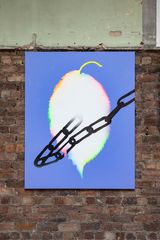
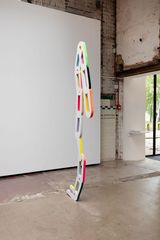
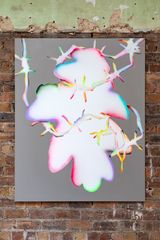
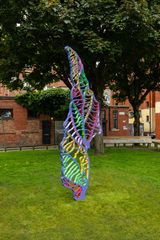
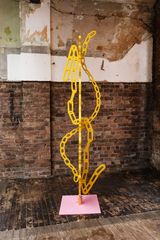
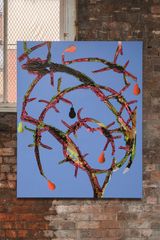
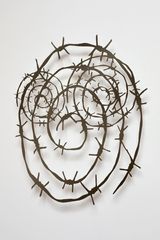
Motifs of leaves, barbed wire and chains thread their way through Simon Periton’s National Geographic, drawing into alignment notions of the natural, the decorative and the securitized – a set of themes that have preoccupied the artist across his career. While embracing a wide range of approaches and mediums, the works share a graphic appearance, one which both articulates the intricacy of the natural world and also the threatening appearance of the fences and boundaries which often curtail and order it. The positive and negative spaces in the works draw attention to their edges, which serve a key metaphorical role in the exhibition.

Periton’s leaves could in turn be understood as a kind of barrier, mimicking the hedgerows which bound agricultural land and the countryside. In this sense, questions of ownership, or how power is inscribed in space, are at the heart of the installation. Periton’s titles – National Geographic, Manifest Destiny, Peartree Farm, International Anthem – refer to politics, anthropology and settler colonialism. Visually, Manifest Destiny refers obliquely to John Gast’s painting American Progress (1872). This depicts Columbia, a figure representing ‘progress’, guiding settlers across America as indigenous people flee, laying a telegraph wire as she goes. In Periton’s work, the line becomes a crown of barbed wire. In contrast, International Anthem, with its symbolically broken chain, references The Internationale, a song adopted by the socialist movement in the late nineteenth century, and also artist Gee Vaucher’s DIY publication, issues of which were distributed at the concerts of activist punk band Crass (1977–1984) that Periton attended as a teenager.

Periton mixes utopianism with historical realities. The stencilled countercultural visual language of his paintings recall the visual language of punk and protest banners, suggesting a negative view of efforts to contain and fence, particularly in a political moment when questions around migration, freedom of movement and hydrocarbon exploration are at the forefront of political debates across the globe. Representative of these concerns is Silver Jack, 2025. In this a kind of Green Man figure – commonly found carved into medieval churches across Britain – is inverted, becoming a carceral mask representing enclosure rather growth and rebirth.

Simon Periton (b. 1964, Kent) lives and works in Bath. He has exhibited internationally and completed numerous prestigious public art projects in the United Kingdom. Recent public commissions include: Farringdon Station for The Elizabeth Line, London (2022); ‘Hyperaccumulator’, Osiers Road Quarter, London (2022); ‘Pollinator’, Radcliffe Observatory Quarter, University of Oxford (2015); ‘Resistance is Fertile’, Waddesdon Manor, Aylesbury, (2015); ‘Shed’, Brentford Connection, Brentford (2014). Selected solo exhibitions include: ‘Your War, My Love’, GS Artists, Swansea (2018); ‘Celestial Agriculture’, New Art Centre Sculpture Park & Gallery, Salisbury (2015); ‘The Asbo Mystery Play and other public works’ / ‘The Gild The Lily Files’ (with Alan Kane), Sadie Coles HQ, London (2012); ‘Spirits of Salt’, Sadie Coles HQ, London (2009); ‘A Rabble of Butterflies’, The Galerist, Istanbul (2008); ‘Simon Periton’, The Modern Institute, Glasgow (2007); ‘Flag’, Henry Moore Gallery, Leeds (2004); ‘Mint Poisioner’, Inverleith House, Edinburgh (2003). Selected group exhibitions include: ‘Frieze Sculpture 2018’, Regent’s Park, London (2018); ‘Regenerate Art’, Kunstverein Munchen, Germany, (with Alan Kane) (2014); ‘The Hepworth Wakefield: A Celebration Backbone: Modern British Sculptors’, NewArtCentre, Roche Court, Salisbury (2011); ‘Undone: Making and Unmaking in Contemporary Sculpture’, Henry Moore Institute, Leeds (2010); ‘The Dark Monarch: Magic and Modernity in British Art’, Tate St. Ives (2009) (touring to the Towner Gallery, Eastbourne); ‘Wunschwelten’, Schrin Kunsthalle, Frankfurt (2007).

Read More

Also Exhibiting at The Modern Institute

About the Gallery

The Modern Institute was founded in Glasgow in 1997. The gallery works with 45 internationally established and emerging artists including Martin Boyce, Jim Lambie, Richard Wright, Anne Collier, Cathy Wilkes, Simon Starling, Urs Fischer, Luke Fowler and Nicolas Party.

View Gallery Profile
Address
3 Aird's Lane
Glasgow
United Kingdom
Opening Hours
Mon - Fri, 11am - 5pm
Sat, 12pm - 5pm
(1)
Glasgow 3 Aird's Lane
The Modern Institute
3 Aird's Lane, Glasgow, United Kingdom

Opening hours
Mon - Fri, 11am - 5pm
Sat, 12pm - 5pm
The art world in focus