Press Release

Following the critical acclaim of its curated presentation at Art Basel in Basel 2025—which featured its main booth conceptually integrated with the Kabinett sector, alongside Su Meng-Hung’s monumental screen installation Desolate Landscape on the Golden Screens celebrated in the Unlimited sector as one of the “eight must-see masterpieces”—Tina Keng Gallery is pleased to announce its return to the fair’s 2026 edition.

Exhibiting in the primary Galleries sector, the gallery will present “Trace: The Orbits of East Asian Aesthetics.” This institutional-grade showcase marks the international debut of Taiwanese modernist master Wang Pan-Youn, whose profound oeuvre offers a timeless geopolitical narrative. Concurrently, the gallery’s curated project “A Grammar of the Strait: Fables and Fragments,” focusing on pioneering Taiwanese artists, has been selected for the Kabinett sector, a platform renowned for its rigorous dialogue between historical and contemporary art. Together, these dual presentations offer global collectors and institutions a rare, historically significant trajectory of East Asian aesthetics that deeply resonates with today’s international contemporary art discourse.

Tina Keng Gallery in Galleries | Trace: The Orbits of East Asian Aesthetics

Deepening its long-term engagement with the historical dimensions of East Asian modern and contemporary art, Tina Keng Gallery will present a trans-century Asian narrative at Art Basel in Basel 2026, seamlessly merging historical memory with contemporary transformation. Centered on the theme “Trace: The Orbits of East Asian Aesthetics,” the exhibition brings together seven seminal artists whose practices deeply intertwine Asian roots with a global vision.

The curated roster features Wu Dayu (1903–1988), a pioneering figure of Chinese abstract painting; Wang Pan-Youn (1908–2017), a master who synthesised Eastern literati sensibilities with modernism; and Wang Huaiqing, a titan whose practice bridges the modern and contemporary eras. Echoing the zeitgeist of today’s global art landscape, the presentation also highlights contemporary master Su Xiaobai, currently featured in an official collateral event at the Venice Biennale; Sawangwongse Yawnghwe, recently invited to the 61st Venice Biennale; Su Meng-Hung, whose monumental installation captivated audiences in last year’s Art Basel Unlimited sector; and Sopheap Pich, a leading figure in Cambodian contemporary sculpture.

Here, Eastern philosophy serves as a profound conceptual locus, guiding these artists to challenge established forms and expand their creative vocabularies. While anchored by their cultural roots, the expansion and convergence of their artistic visions cohere into a powerful internal momentum that radiates outward. In doing so, they offer a nuanced response to trans-century historical memories and contemporary conditions, charting a persistently evolving aesthetic trajectory propelled by deep Asian cultural legacy.

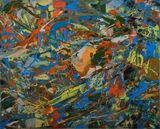
In the early 20th century, Wu Dayu (1903–1988) travelled to Paris, absorbing the essence of modernist paradigms such as Post-Impressionism, Fauvism, and Expressionism amidst a turbulent artistic ferment. Driven by a resolute pursuit of modernised expression, his quest for pure artistic freedom and the liberation of somatic perception marked the foundational inception of Chinese abstract painting. Within the framework of Western colour theory and formal expression, Wu fused the fluid linear energy of Chinese calligraphy with the expressive brushwork of literati ink traditions, developing his distinctive philosophy of “Dynamic Expressionism” (Shixiang). In this synthesis, dynamic form, light, and rhythm resonate in harmony, deeply internalizing the essence of Western colour to cultivate an abstract realm suffused with Eastern philosophical thought. This established the bedrock of Chinese Abstract Expressionism, earning him the mentorship and reverence of internationally renowned masters such as Zao Wou-Ki, Chu Teh-Chun, and Wu Guanzhong. Wu’s profound explouration into the essence of Eastern painting marked a return to origins, carving out a novel path for an Eastern aesthetic paradigm within the post-war wave of Western abstraction.

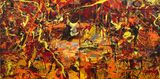
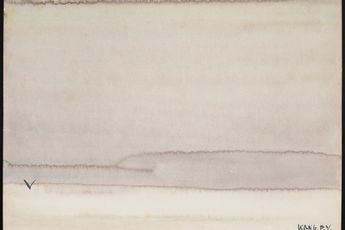
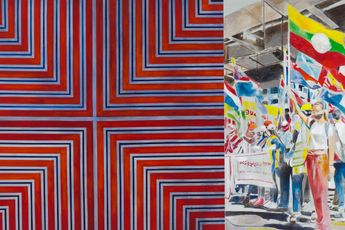
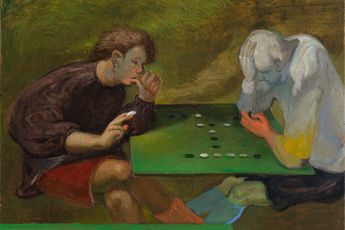
At the intersection of Eastern art and Western thought, Wang Pan-Youn’s (1908–2017) paintings superimpose a cinematic framing of modern Taiwanese history onto the trajectory of Eastern abstraction. Having endured the displacement and turmoil of East Asia during and after World War II, Wang utilised a unique palette and minimalist composition to merge the wash diffusion of Eastern ink with symbolic techniques. Navigating the threshold between figuration and abstraction amidst a turbulent life, his work illuminates a profound inner clarity. The subjects within his paintings are occasionally squeezed and compressed, intuitively reflecting his psyche when confronting destiny, while the vast colour fields left on the canvas become a sanctuary for literati melancholy. This intensely personal life-gaze ultimately struck a silent yet monumental resonance within the torrent of the era, deeply echoing the collective emotional memory born of East Asian geopolitical upheavals.

Wang Huaiqing continues this cross-generational artistic inquiry, having studied under the master Wu Guanzhong. Enduring the social upheavals of the 1970s and the influx of Western contemporary art concepts, he profoundly inherited the deep brush-and-ink spirit and philosophy of Chinese heritage, embarking on a rigorous interrogation of its cultural essence. From Bole to Jiangnan vernacular dwellings, Ming-style furniture, and onto the grand narratives of Night Revels and the Chinese Emperor series, his expansive vision is manifested through the structural reshaping of form. Wang condenses form into a geometric order characterised by a contrapuntal interplay of presence and absence, focusing on the abstract relationship between planar composition and chromatic space. This imbues material structures with a profound historical weight and cultural memory, successfully translating traditional historical codes into a contemporary discourse. Suspended within the gravitational pull of both Eastern and Western traditions, Wang precisely grasps his cultural core and subjective identity, deconstructing and absorbing them to forge an artistic ethos that is both introspective and unyielding, thereby vastly broadening the macroscopic horizon of Eastern aesthetics.

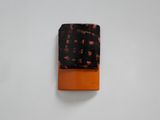
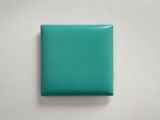
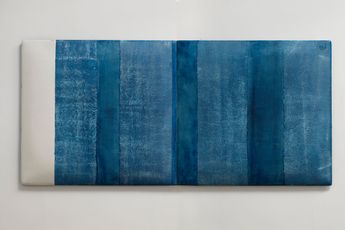
Contemporary master Su Xiaobai, whose current major exhibition as an official collateral event at the Venice Biennale has garnered significant international academic acclaim, overlays the material weight and temporal thickness of oil, lacquer, and linen, allowing them to settle into a minimalist, refined pictorial lexicon. Countless iterations of polishing yield the warm, mellow luster of the lacquer, while the delicate textures of wear and cracking serve as spiritual traces of Su’s contemplation on impermanence and mutation. This repetitive, ritualistic action enacts a contemporary manifestation of the Eastern spirit, ultimately achieving a cross-cultural classic of our time within the tension between heaviness and lightness, roughness and refinement.

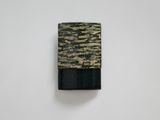
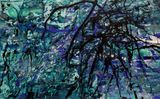
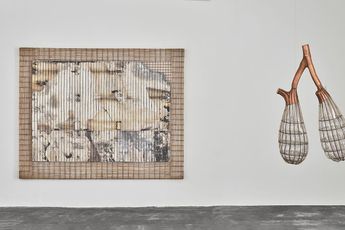
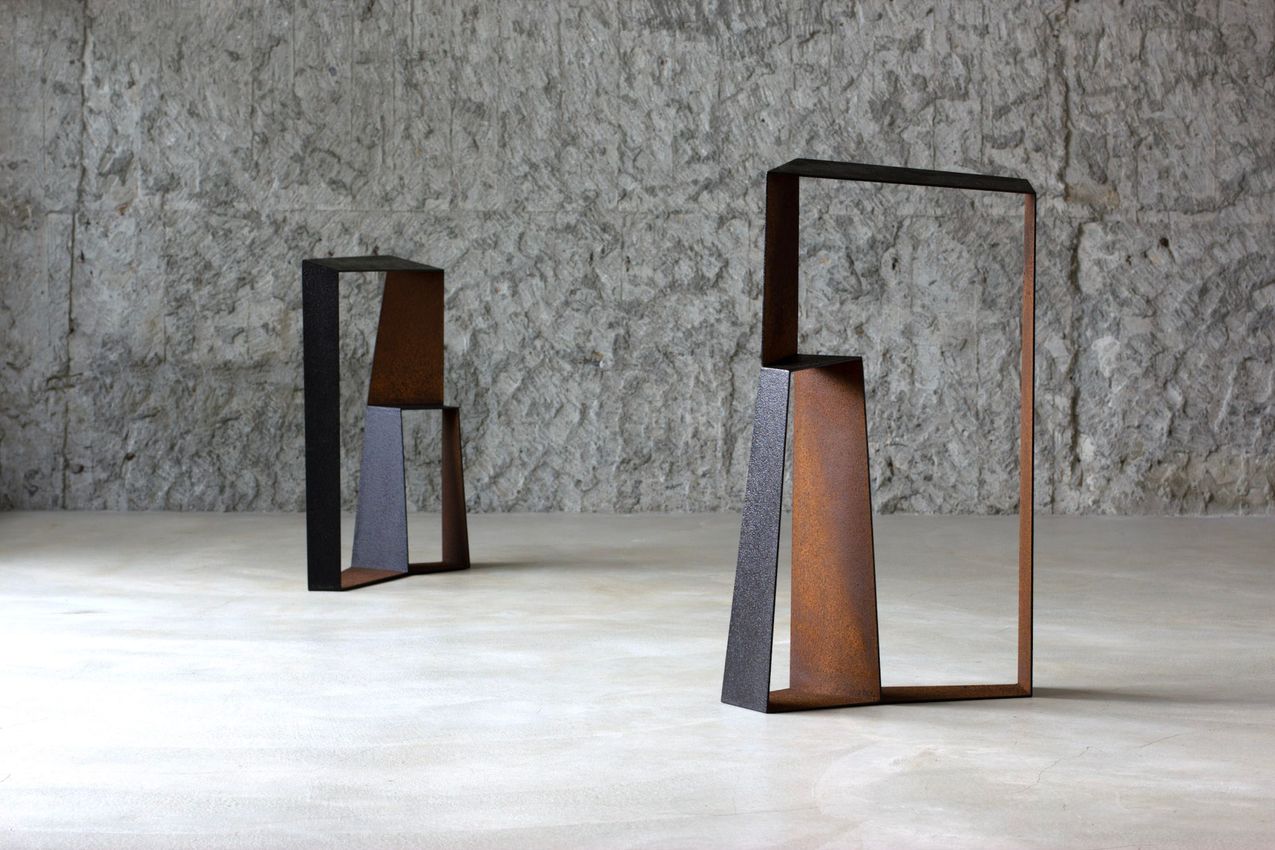
Nature and memory remain the inspirational loci for Sopheap Pich to excavate the self and connect with traditional Khmer culture. His long-celebrated practice includes sculptures and wall reliefs fashioned from locally gathered bamboo and rattan, alongside works composed of hand-forged copper and recycled aluminum. In his latest creations, weathered, corrugated, and richly layered scraps of industrial metal are deconstructed and stratified, transforming into dynamic, three-dimensional abstract landscapes. Rather than imposing a predetermined form onto his materials, Pich allows structures to organically shape themselves through repetition, tension, and accumulation. These works precisely elucidate the dialectical relationship between matter, form, and space; while highlighting an evolutionary process of resilience, regeneration, and continuity, they deeply bear Southeast Asia’s distinct cultural and historical resonances.

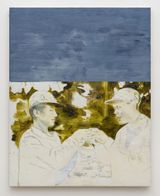
What guides Sawangwongse Yawnghwe into divergent trajectories of critical inquiry is a profound interrogation of the authority to interpret historical discourse situated between memory and national narrative. As a descendant of the Shan royal family of Yawnghwe in Myanmar, he utilises archival documents as the foundation for contemplation and tracing origins. Navigating the layered intersections of past and present, truth and fiction, contingency, and necessity in Burmese history, he meticulously combs through historical facts to reclaim human conscience beneath the torrent of the times. Within his two-dimensional paintings, Yawnghwe juxtaposes historical photographs with flat, monochromatic colour fields, merging figurative history and abstract codes into a singular image. The artificial ruptures and natural fractures within the composition echo the force majeure and forced migration experienced by individuals in volatile epochs. This critical re-examination and discovery of Asian geopolitics extends into his global perspective at the 61st Venice Biennale, quietly anchoring the gaze onto lost historical trajectories of Asia within the context of international contemporary art.

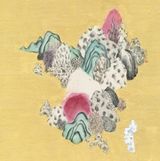
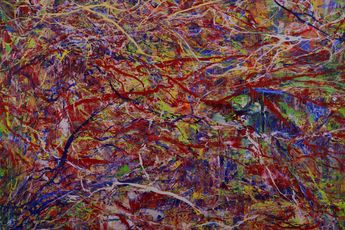
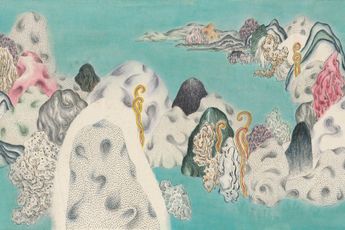
At this year’s booth, Su Meng-Hung grandly presents his latest series of works, showcased concurrently with his solo exhibition “Flowers of Coromandel” in Taipei. The new works extend his artistic trajectory of translating classical flower-and-bird and landscape motifs into contemporary cultural codes, further interlocking aesthetics, historical craftsmanship, and contemporary political economy. He explores how cultural symbols are reconstructed and endowed with entirely new, heterogeneous meanings through processes of circulation and recombination. Combining the mechanical reproduction of silkscreen appropriation with the highly complex, manual craftsmanship of biantu (varied lacquer layering and polishing), Su detaches traditional flower-and-bird, landscape, and figure drafts, steering them toward abstraction and conceptualization. Concurrently, through the meticulous layering and polishing of lacquer, the works generate a visual presence that possesses both psychedelic colouration and material tension, accentuating a purer painterly quality. Through these heterogeneous and contradictory forces, Su guides the viewer back to the present, inviting an openended perspective to recognise and redefine cultures and symbols that have undergone historical transformations.

Guided by historical lineages, the exhibition unfolds gradually along the axes of material language, geopolitical narratives, and the consciousness of looking, reflecting the deep-seated Asian cultural foundations that Tina Keng Gallery has long cultivated. This represents not only an ongoing indexing of the trajectory of Asian artistic modernity but also opens a pathway for Western audiences to perceive the spirit of Eastern aesthetics and contemporary artistic discourse. As viewers move between the works, encountering the nuances of form and material detail, they are invited to feel the underlying cultural memory and conceptual tension. Through this progressively layered visual experience, they step into the profound cultural depth and trans-regional vision that Tina Keng Gallery has meticulously built over the decades.

Tina Keng Gallery in Kabinett | A Grammar of the Strait: Fables and Fragments

Centered on contemporary Taiwanese art, Tina Keng Gallery’s Kabinett sector project, titled “A Grammar of the Strait: Fables and Fragments,” seeks to channel the dialectical energy and qualitative transformations of artistic vocabulary observed across generations in the main Galleries sector into the island’s contemporary context, anchoring this trajectory of creative transit within the Taiwan Strait. Driven by topological and geopolitical pressures, the Strait is characterised by surging waves and torrential undercurrents. It serves as a metaphor for a demarcation line, yet within its fluid state, it fosters continuous infiltration, convergence, and sedimentation; it is precisely this rupture and isolation that inversely opens a new chapter of history. The Kabinett presentation deploys the “Strait” as an allegory for the resilience of art, forging spaces of expression amid constraints and tension. The exhibition delves into how Taiwanese artists leverage a series of “fragments”—shattered evidence, residual traces, and fractured memories—to generate enduring “fables” steeped in metaphor and multiple significations. In doing so, they respond to the alienating contradictions, naturalised atmospheres of coercion, and institutional pressures born of the Strait, culminating in a decolonial reinterpretation of canonical culture.

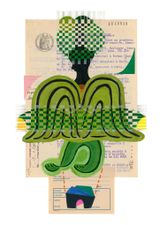
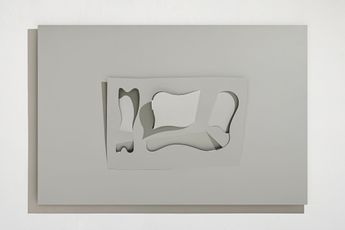
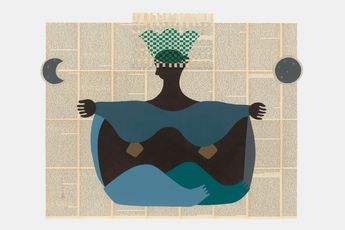
The exhibition opens with Ava Hsueh, whose work was recently acquired for the permanent collection of the British Museum. Hsueh interprets abstraction as a slow sedimentation within time, capturing transient moments. Through a precisely calibrated field and sequentially unfolding pulses, her work cushions the density of time rather than merely depicting it. Her painting establishes rules of layering and deposition, profoundly manifesting acts of accumulation, revision, and restraint—a precise response to the self that resonates with the collective tension and anxiety of a shared epochal undercurrent. With this as an anchor, the “fragments” of historical and cultural structures are transformed into tangible textures and spatial somatic experiences within the exhibition space. Jam Wu extends traditional paper-cutting into “paper weaving.” Within the intertwined warp and weft of paper strips, the cut edges become porous apertures for breath, allowing thoughts and emotions to subtly permeate. Concurrently, Yuan Hui-Li deconstructs and reconstructs classical brush-and-ink syntax from within. Fusing and appropriating the kinetic energy of calligraphic strokes, she transmutes traditional cun (texture) strokes into a sensible semiotic system, pushing the boundaries of layering and texture in ink painting.

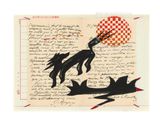
If fragments are the “lexicon” artists use for reassembly, then “fables” are the syntax that links them to interrogate the era. Accordingly, Chen Ching-Yuan constructs illusory historical scenes fraught with a sense of déjà-vu. By implanting truncated symbols and faint clues, he deliberately maintains narrative coherence in a state of perpetual deferral, reflecting how collective memory is assembled, circulated, and contested within fables of shifting semantics. Yao Jui-Chung delivers another fable by subverting historical classics. He playfully yet powerfully upends inherited cultural authority, soberly exposing how so-called “orthodoxy” is constructed, preserved, and subsequently deconstructed amid the island’s intrinsic tensions.

Echoing these conceptual frameworks, the spatial design of the Kabinett sector features a rectangular cube with dual narrow access channels. It acts as a nexus where oceanic flows of thought and imagery converge, welcoming viewers from diverse cultural contexts.

The surging ocean currents signify both geopolitical confluences and the navigational tracks of linearly advancing time. Armed with an acute perception of the tensions inherent in the convergence and dispersion of historical fragments, alongside a fluid vision that traverses boundaries and moves between the internal and external, Tina Keng Gallery contextualises masterworks of Asian modern and contemporary art. In doing so, it responds to the contemporary zeitgeist focusing on Asian discourses, continuously expanding the interpretation of the dialectical relationship that bridges 20th-century East Asian art philosophy with present-day dynamics.

Read More

Selected Works

Loading...

Artists Exhibiting

Also Exhibiting at Tina Keng Gallery

The art world in focus