



STANLEY WHITNEY
b. 1946, United StatesA key figure in contemporary abstract painting, Stanley Whitney is internationally acclaimed for his vividly coloured, grid-based compositions that test the limits of structure, rhythm, and chromatic intensity in contemporary art.
Early Years
Born in Philadelphia in 1946, Stanley Whitney grew up during the Civil Rights era, a backdrop that would later inform his meditative and improvisational approach to painting. He studied at the Kansas City Art Institute before completing his MFA at Yale School of Art in 1972. After settling in New York, Whitney’s career developed steadily, though it was not until the 2000s that broader institutional recognition caught up with his singular contribution to contemporary abstraction. He now lives and works between New York City and Parma, Italy.
Artworks
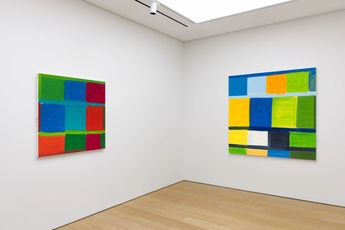
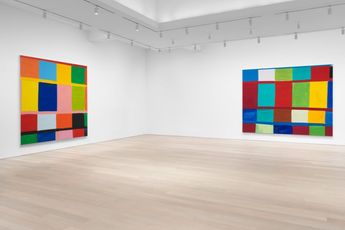
Stanley Whitney’s artworks are known for their distinctive arrangement of vibrant colour blocks, drawn within hand-drafted grids that challenge notions of order, spontaneity, and expression in contemporary abstract painting. His canvases create a unique visual rhythm, where colour is both form and meaning, articulating the artist’s deep engagement with structure, improvisation, and the history of painting.
Discovering the Grid: 1990s Breakthroughs
In the early stages of his practice, Whitney grappled with how to make space active within the canvas. It wasn’t until a formative period living and working in Italy during the 1990s that he arrived at the loosely structured grid that would come to define his signature style. Works like Untitled (1998) reveal his growing interest in dividing space into rhythmically stacked rectangles, allowing each block of colour to interact freely with its neighbours. The move marked a clear break from more formalist traditions of abstraction, favouring intuition over rigid systems.
‘Dance the Orange’ at The Studio Museum, Harlem (2013–2015)
Whitney’s 2015 solo exhibition Dance the Orange at The Studio Museum in Harlem introduced his practice to a wider public. The show featured large-scale paintings such as Dance the Orange (2013) and My Name is Peaches (2015), in which his use of colour reaches new heights of emotional and spatial complexity. The artworks vibrate with energy, as the tension between control and improvisation plays out across each canvas. Influenced by jazz improvisation and the structure of poetry, Whitney uses colour as a temporal and musical device, building harmony and dissonance across rows of painted forms.
Recent Paintings: Colour as Language
Recent works, including Stay Song (2021), Afternoon Paintings (2020), and How High the Moon (2022), continue Whitney’s lifelong investigation into colour as a visual language. The artist creates compositional balance not through symmetry, but through subtle shifts in hue, density, and spatial weight. These paintings resist narrative, instead encouraging the viewer to slow down and experience colour on its own terms—emphasising feeling over figuration, atmosphere over image.
In paintings like Light a New Fire (2022), the interplay between saturated reds, dusky mauves, and acidic yellows reveals Whitney’s nuanced command of colour mixing and emotional tone. The unruled borders between each block evoke human touch, while the visible underlayers remind us of the artist’s process and presence in each artwork.
Drawing and Works on Paper
In addition to painting, Whitney maintains a dedicated drawing practice that complements his large-scale works. His works on paper, often executed in ink, gouache, or pastel, reveal the immediacy of his thinking—miniature rehearsals for larger compositions or standalone explorations of line and palette. These artworks, though more intimate in scale, hold the same vibrancy and rhythmic power as his paintings, underscoring the continuity of his visual language across mediums.
Awards and Accolades
- Robert De Niro Sr. Prize, New York (2011)
- Art Award, American Academy of Arts and Letters, New York (2010)
- Pollock-Krasner Foundation Fellowship, New York (2002)
- John Simon Guggenheim Fellowship, John Simon Guggenheim Foundation, New York (1996)
Exhibitions
Stanley Whitney has been the subject of both solo and group exhibitions at important institutions. A selection of important exhibitions are provided below.
Solo Exhibitions
- Stanley Whitney: How High the Moon, Buffalo AKG Art Museum, Buffalo, NY. Travelled to: Walker Art Center; Institute of Contemporary Art, Boston (2025).
- Stanley Whitney: Dance with Me Henri, Baltimore Museum of Art, Maryland (2022)
- Stanley Whitney: The Italian Paintings, Palazzo Tiepolo Passi, Venice (2022)
- Focus – Stanley Whitney, Modern Art Museum, Fort Worth, Texas (2016)
- Dance the Orange, The Studio Museum in Harlem, New York (2015)
- Stanley Whitney, Palazzo Magnani, Reggio Emilia, Italy (2007)
- Stanley Whitney, Pennsylvania Academy of Fine Arts, Philadelphia (1985)
Group Exhibitions
- Sensory Poetics: Collecting Abstraction, Solomon R. Guggenheim Museum, New York (2022)
- Blue is the color of your eyes, Moderna Museet, Malmö, Sweden (2019)
- Making and Unmaking: An exhibition curated by Duro Olowu, Camden Arts Centre, London (2016)
- Outside the Lines: Black in the Abstract, Part 2. Contemporary Arts Museum Houston (2014)
- The Annual: 2012, National Academy Museum, New York (2012)
- Something About Mary, Orange County Museum of Art, Newport Beach, California (2007)
Stanley Whitney’sInstagram can be found here.
Critical Reception
Stanley Whitney’s artworks have been widely praised in leading publications, including Artnet News, The Guardian, and The New York Times. In conversation with Ocula Magazine, Whitney stated: ‘I’ll go where the work takes me. I always tell people if it goes out the window, I’ll follow it.’
Stanley Whitney FAQs
What is Stanley Whitney best known for?
Stanley Whitney is best known for his vibrant abstract grid paintings that use stacked blocks of colour to explore rhythm, space, and structure. These compositions are defined by hand-drawn lines and improvisational energy, creating a visual language that draws from jazz, poetry, and architecture. His unique approach to colour—treating it as both subject and structure—has positioned Whitney as a leading figure in contemporary art. His distinctive works challenge conventional ideas of order and remain deeply influential in abstract painting today.
What influences Stanley Whitney’s art?
Stanley Whitney’s art is shaped by a diverse array of influences, ranging from jazz music and classical architecture to the works of artists like Piet Mondrian, Giorgio Morandi, and Philip Guston. Music—especially improvisational jazz—plays a central role in his creative process, with each painting unfolding like a visual score. Additionally, Whitney’s experiences living in Italy significantly informed his sense of spatial harmony and colour relationships. These varied inspirations converge in artworks that are both structurally rigorous and emotionally resonant.
How does Whitney approach colour?
For Stanley Whitney, colour is not merely a compositional element—it is the primary language through which meaning is made. He approaches colour with a sense of musicality, layering and juxtaposing hues to create harmony, tension, and visual rhythm. Rather than adhering to premeditated plans, Whitney allows each colour to guide the next, resulting in artworks that feel spontaneous yet deeply balanced. His intuitive process transforms colour into a spatial and emotional force, making each painting an immersive experience in contemporary abstract art.
Ocula | 2025


Explore Stanley Whitney's Exhibitions











Explore and Follow Artists Shaping Contemporary Art
A respected voice in contemporary art discourse.
Focusing on ambitious storytelling and insightful art-world commentary. Ocula Magazine publishes in-depth interviews, critical essays and timely analysis on the artists, exhibitions and ideas driving the global art world.
Learn more about Ocula Magazine
Showcasing the best of the art world.
Ocula partners with galleries from around the world to highlight their artists, artworks and exhibitions. Gallery membership is by application and invitation, with each member vetted by an independent panel.
Learn more about Ocula Membership
Specialises in the sale of major artworks.
Led by a team with deep ties to the world’s leading auction houses, galleries and collectors. Ocula’s advisory team offers bespoke services to high-net-worth clients from around the world who are looking to acquire the best of contemporary and modern art.
Learn more about our team and services