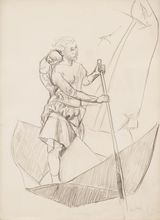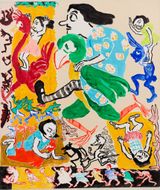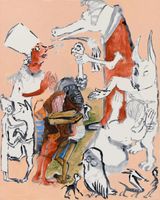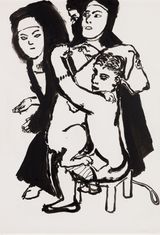
Victoria Miro is delighted to present Secrets of Faith, an exhibition in Venice by Paula Rego.Completed in 2002, the works on view depict episodes from the life of the Virgin Mary–subjects familiar in Christian art radically retold by Rego that are among the most special to the artist. ‘Of all my pictures, these were the most fun to make,’ Rego has said, and their importance can be measured by the fact that many have remained in her own collection; for years she kept one work from the cycle, Descent from the Cross, on her bedroom wall.
During his presidency of Portugal, Jorge Sampaio (1939–2021), who Rego had known as a lawyer since the 1960s and who, during the Carnation Revolution of 1974, came up with the slogan ‘Always 25 April’, invited the artist to create a series for the chapel of the Palácio de Belém, the head of state’s official residence in Lisbon. In response, Rego made Nossa Senhora, tackling Mary’s story with a curiosity and passion that resulted far in excess of the eight works which were eventually installed in the chapel.
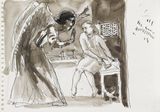
This exhibition features additional works from the cycle and a number of related watercolours that reveal Rego’s thought processes as she depicts Mary viewed from the lived experience of women–embracing the Virgin’s iconography while unseating serene and ethereal depictions from art history, finding the most pertinent parts of the story and dramatising them in ways that speak beyond the traditional narrative. Rego’s challenge in telling the story not just from the Virgin’s perspective but from the position of an embodied female figure is one that drew on her knowledge of the Old Masters, Christian art and religious texts, as well as her own experience of flesh and faith. She deals with episodes of pain and pleasure, astonishment and fear, through the prism of her own, deeply personal life experiences – pregnancy at a young age, motherhood, the burden of grief. Of her belief in God, Rego has said, ‘I think it is because I am Portuguese and because I love stories, and Christianity is a very good story.’
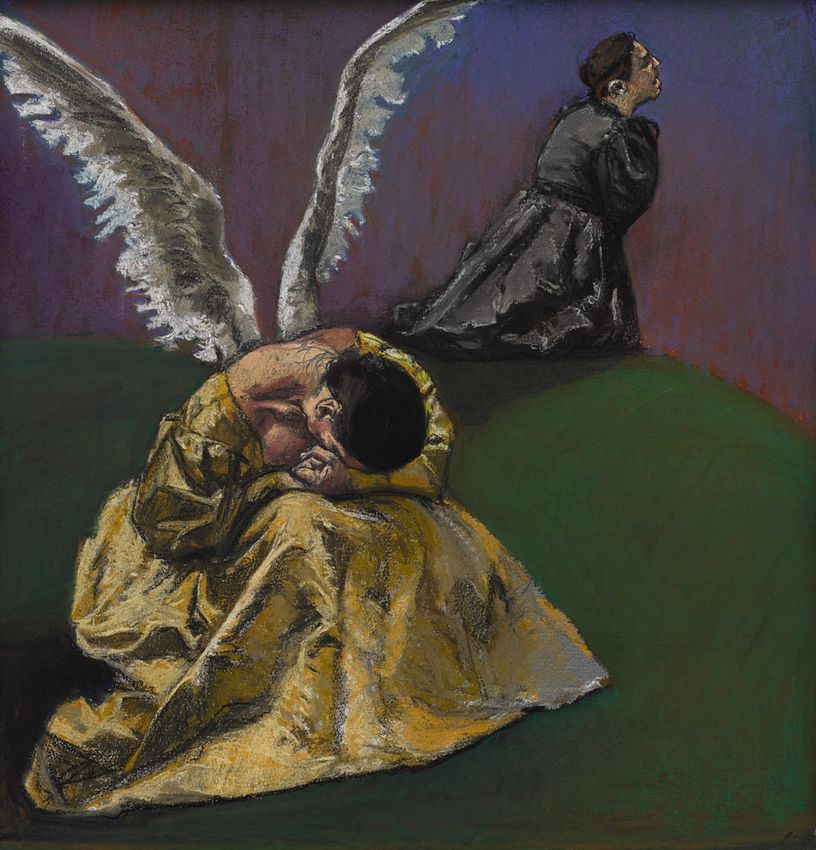
Rego’s work, always defiantly unsentimental, here places centre stage the earthly body, subjected to forces that are viscerally felt. In Annunciation we see Mary, modelled by the artist’s granddaughter, as a girl in school uniform, her head tilted back in a kind of rapture before the Angel who proffers a bunch of phallic calla lilies; an unmistakably physical interjection to the narrative of the immaculate conception. Mary remains a child, as does Christ, in a number of watercolours depicting the Pietá, their youth serving to heighten a sense of their vulnerability. In Descent from the Cross, a work that Rego connects most strongly to the death of her husband, Victor Willing, in 1988, the composition accentuates the weight of the body being taken down. In Agony in the Garden, while the angel is curled over in anguish, Mary, consumed by grief, turns away.
The feminism implicit in telling Mary’s story in ways it hadn’t been before is intertwined with Rego’s relationship with faith and her formative experiences under the Salazar dictatorship in a deeply Catholic country where the most proscriptive aspects of religion were felt most acutely by women. While the story may be thousands of years old, these scenes of Mary’s life are entirely of a piece with Rego’s work and the wider forces of suffering and survival, agency and resolve addressed consistently throughout the seven decades of her career.
Paula Rego will participate in the 59th International Art Exhibition of La Biennale di Venezia, titled The Milk of Dreams, curated by Cecilia Alemani, open to the public from 23 April–27 November 2022.
An artist of uncompromising vision and a peerless storyteller, Paula Rego has since the 1950s brought immense psychological insight and imaginative power to the genre of figurative art. Drawing upon details of her own extraordinary life, on politics and art history, on literature, folk legends, myths and fairytales, Rego’s work at its heart is an exploration of human relationships, her piercing eye trained on the established order and the codes, structures and dynamics of power that embolden or repress the characters she depicts. Often turning hierarchies on their heads, her tableaux, whether tender or tragic, consider the complexities of human experience and the experience of women in particular. She is especially celebrated for works that forcibly address aspects of female agency and resolve, suffering and survival, such as the ‘Dog Women’ series, begun in 1994, the ‘Abortion’ series, 1998–99, which is considered to have influenced Portugal’s successful second referendum on the legalisation of abortion in 2007, and the recent series ‘Female Genital Mutilation’ (2008–2009).

Since Victoria Miro founded her eponymous gallery in Cork Street, Mayfair, in 1985, the gallery has grown to represent over 40 artists and estates. With a reputation for presenting ground-breaking artworks from around the world, Victoria Miro has exhibition spaces in Mayfair and Wharf Road in London, and a further gallery space in Venice.

A respected voice in contemporary art discourse.
Focusing on ambitious storytelling and insightful art-world commentary. Ocula Magazine publishes in-depth interviews, critical essays and timely analysis on the artists, exhibitions and ideas driving the global art world.
Learn more about Ocula Magazine
Showcasing the best of the art world.
Ocula partners with galleries from around the world to highlight their artists, artworks and exhibitions. Gallery membership is by application and invitation, with each member vetted by an independent panel.
Learn more about Ocula Membership

Specialises in the sale of major artworks.
Led by a team with deep ties to the world’s leading auction houses, galleries and collectors. Ocula’s advisory team offers bespoke services to high-net-worth clients from around the world who are looking to acquire the best of contemporary and modern art.
Learn more about our team and services