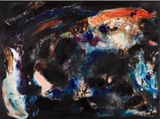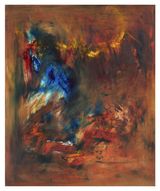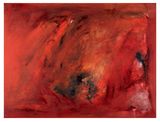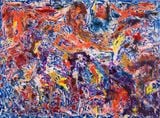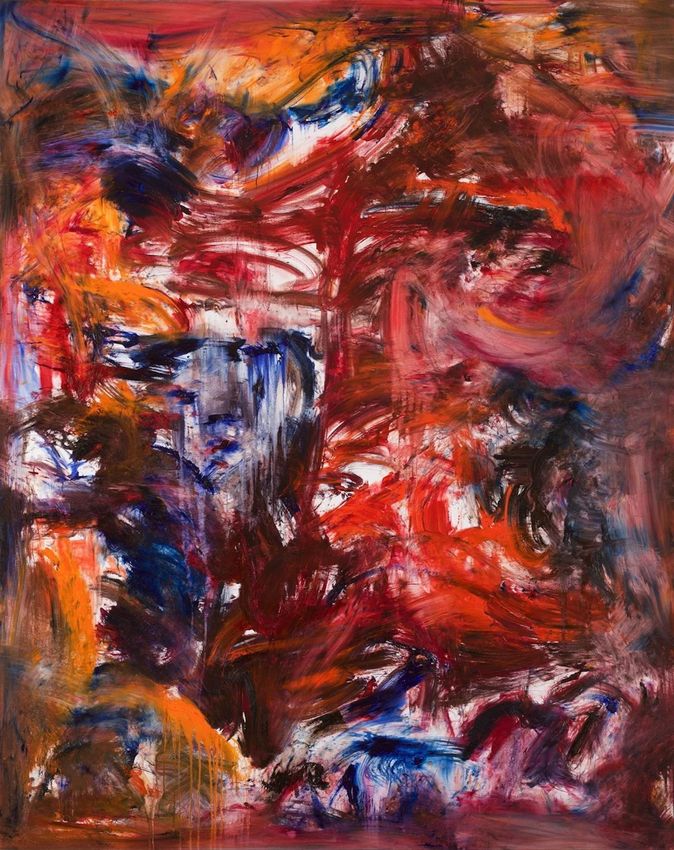
Marked by traces of what once was, Turn to Salt is a powerful new exhibition of works by Marie de Villepin. Through layered compositions and shifting textures, her paintings give form to memory - sometimes sharp, sometimes fading. Salt, with its dual power to preserve and erode, becomes a symbol of transformation. The title, drawn from a lyric of one of the artist’s songs that she composed, carries a quiet ambiguity that threads through the show.
Each painting captures a moment in which memory takes form. Tones of pink, green, red, and blue feel trapped - as if caught in quicksand or solidified in salt - evoking a tension between movement and stillness. Gesture becomes feeling, with each canvas unfolding like an emotional landscape. Forms erode and dissolve, or harden like salt crystals, echoing how we choose to hold on to, or release, our memories.
Set against the backdrop of a world once again marked by upheaval - by war, displacement, ecological fragility, and cultural fragmentation - Marie’s works speak to the quiet resilience of the human spirit. In this moment of geopolitical tension, Turn to Salt becomes not just a personal journey, but a broader meditation on how we process loss, reckon with history, and search for meaning amidst uncertainty. The salt that runs through these canvases is a metaphor - an elemental trace of survival and transformation.
Looking back becomes an act of reflection, curiosity, and defiance. The works ask whether we must make peace with the past to move forward - a question that lingers in all our lives. Marie draws from her own journey, echoing artists who have challenged convention by confronting the past to better understand the present. Salt, in these works, becomes a quiet witness. It’s what remains after time has passed—a trace of contact, a crystallised memory. In Turn to Salt, turning back is not a punishment, but a way to acknowledge what came before.
Created during different moments, each painting carries its own rhythm and story. Together, they form a quiet, cohesive narrative. With each brushstroke, Marie crystallises reality, turning lived experience into lasting form. She does not simply reflect the world; she reimagines it. And in that reimagining, she crosses into the realm of myth and legend - where memory becomes monument, and the personal becomes eternal.
Artist Statement:
Salt preserves. Salt wounds. Salt heals. In Turn to Salt, Marie de Villepin gathers a body of work suspended in contradiction, beauty and desolation, transformation and stillness, memory and myth. Drawing from the biblical image of Lot’s wife turning to salt as she looks back, an act of mourning, defiance, or reverence. These paintings linger at the edge of irreversible change.
Each canvas captures a moment when time crystallizes. Figures blur into landscapes; places decay into textures. The surfaces hold traces of tenderness and erosion as if exposed to weather, to longing, to grief. There’s a sense that looking too long, or too hard, might fix something in place forever.
Rather than warning against the gaze backward, Turn to Salt reclaims it. It’s an invitation to witness what remains when everything else dissolves. The sediment of memory, the mineral shape of regret, the slow crystallization of truth.
What do we preserve by looking back? What do we lose when we don’t?
Born in Washington, D.C., Marie de Villepin grew up in the United States and in India. Art was a constant feature in her upbringing as she began developing her musical and drawing skills throughout her frequent travels, filling dozens of notebooks, which allowed her to fix moments and emotions as a chronicle of her life. Growing up in a diplomatic household, Marie had the chance to surround herself with a prominent circle of poets, musicians, filmmakers, and painters including Zao Wou-Ki, a family friend. She was inspired by influential post-war American artists, including Willem de Kooning, Cy Twombly, Joan Mitchell, and Philip Guston. In particular, she admired the musicality, freedom, and capacity for transcendence in their works.

A respected voice in contemporary art discourse.
Focusing on ambitious storytelling and insightful art-world commentary. Ocula Magazine publishes in-depth interviews, critical essays and timely analysis on the artists, exhibitions and ideas driving the global art world.
Learn more about Ocula Magazine
Showcasing the best of the art world.
Ocula partners with galleries from around the world to highlight their artists, artworks and exhibitions. Gallery membership is by application and invitation, with each member vetted by an independent panel.
Learn more about Ocula Membership

Specialises in the sale of major artworks.
Led by a team with deep ties to the world’s leading auction houses, galleries and collectors. Ocula’s advisory team offers bespoke services to high-net-worth clients from around the world who are looking to acquire the best of contemporary and modern art.
Learn more about our team and services