



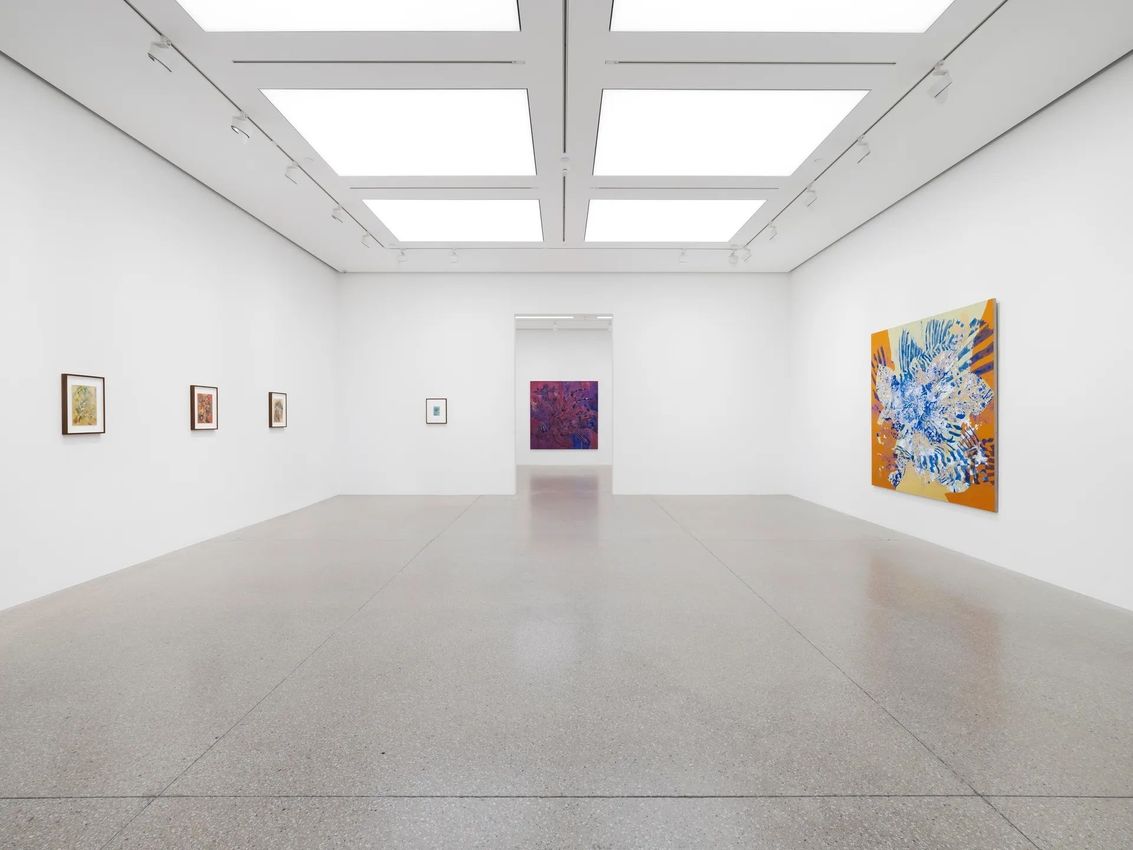
White Cube Seoul is pleased to present a solo exhibition by Mexican artist Gabriel Orozco, featuring paintings and works on paper originating from his 2021–22 series titled ‘Diario de Plantas’, a collection of notebook studies chronicling his impressions of vegetation and plant life gathered in Tokyo, Acapulco and Mexico City.
The selection of works on paper in this exhibition belong to these plant journals, begun during the Covid pandemic when the artist was living in Tokyo. The series evolved as part of a ritual whereby Orozco collected leaves from his surroundings, a practice he continued when he travelled to Mexico City to work on an ambitious public project to transform Chapultepec Park. Orozco’s process involved pressing the leaves directly into the notebooks’ pages, layering these imprints or superimposing them with his own drawings rendered in gouache, tempera, ink and graphite. The fibrous surface of the notebook paper acts as a receptive medium, allowing the pigment to seep through into the underside of the page. This page-by-page process of staining creates a dialogue that connects each of the individual works, while in the margin of each page, Orozco has systematically numbered, dated and stamped them with a traditional seal bearing his name in Japanese. This careful indexing creates both a diaristic record of the works’ making and a mark of their geographical origins.
The vegetal topographies that diffuse across the paper engage intertextually with Orozco’s freehand markings, manifesting as looping möbius strips, tangled skeins and mottled stains that trespass the leaves’ structured anatomy. This approach supports the conviction that Orozco’s diaristic studies are conceived less as an exercise in botanical classification of plant species and more as an empirical engagement with movement – both on a macro scale, reflecting the artist’s geographic travels, and on a micro scale, within the plants’ veined choreographies. The interplay between the artist’s simultaneously fluid and geometric markings and the structured organicism of the leaf-prints invites contemplation of the unique time of human-nature relations during which Orozco initiated his studies. A period now often referred to as the pandemic ‘anthropause’, it was a moment when the slowdown of human activity precipitated a concurrent rise in environmentally minded cultivation.
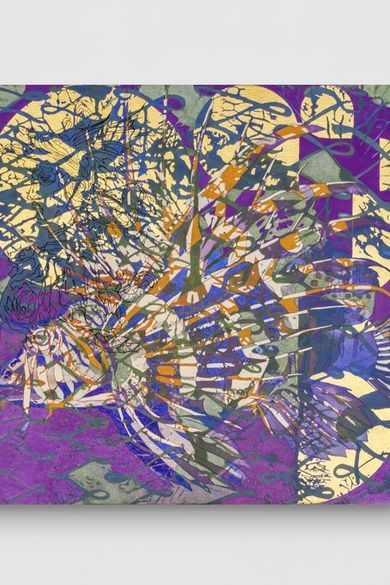
In several of the works, Orozco’s colour palette eschews organic earth tones in favour of stained reds, metastasizing blues and spectral, ‘x-rayed’ monochromatic traceries that pose a visceral quality, as seen in 21.I.22 (a) #15 and 20.I.22 (b) #10 (both 2022). In others, such as 30.I.22 (a) #17 (2022), inked lagoons of cyan immerse the vegetal life within marine terrains, creating a through-line with the aquatic imagery of his larger gold Shikishi board and linen paintings. Unlike the temporal markers that comprise the titles of the ‘Diarios’, Orozco’s paintings more explicitly gesture toward animal life as the primary subject matter, specifically the titular Lion Fish. Schematised leaf-print structures also feature in these works, though here their cooperation with the artist’s designs are increasingly complex, revealing more distinct figurative motifs. Negative spaces, accented through a range of reds, whites and gold, foreground the creature’s array of striped spines and regal, maned fins – plumage which can be interpreted as a spectrum of patterned animal life. Their structural silhouettes, meanwhile, recede into the background, yielding to large canopies of singular leaf-prints and dappled, watery surfaces created through the mix of tempera and watercolour. Painted on Shikishi, a Japanese art board traditionally used for Sumi-e (a form of Japanese painting using only black ink), calligraphy and haiku poetry, and typically bordered with gold, Orozco has applied gold leaf to the main face of several paintings. This technique serves to enhance the chameleonic properties of these compositions, as the surfaces catch and reflect the surrounding light, becoming animated by the viewer’s movement.
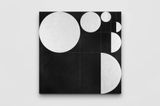
Within the works’ diagrammatic patterning, traces of the structural devices employed in Orozco’s earlier painting series are discernible. The exhibition’s largest compositions, Guapo Fish and Warrior Fish (both 2024), are animated through a centrifugal momentum and a Mondrianesque compartmentalisation of colour. Each subtly echoes the balanced correspondence found in Orozco’s ‘Suisai’ and ‘Samurai Tree’ series, where circular motifs and sequences of contrasting hues organise movement according to basic rules inspired by the principles of chess. The works in the current exhibition, however, are arguably more intricate and their structural devices appear more recessive, driven by cycles of organic states such as reproduction, growth, decomposition and fossilisation – elements which reflect not only the rhythms of nature, but the artistic process itself.
Press release courtesy White Cube


Gabriel Orozco’s diverse practice, which includes sculpture, photography, painting and video, explores philosophical conundrums through random encounters and spatial relationships. Using everyday objects in the contemporary urban environment, Orozco makes visible the poetry of chance connections, whimsy and paradox. He works with found materials or situations—a ball of clay, a deflated football, or an abandoned kite, for example—that are altered and then photographed to create surprising, often humorous scenarios from their simple, quotidian means.


A respected voice in contemporary art discourse.
Focusing on ambitious storytelling and insightful art-world commentary. Ocula Magazine publishes in-depth interviews, critical essays and timely analysis on the artists, exhibitions and ideas driving the global art world.
Learn more about Ocula Magazine
Showcasing the best of the art world.
Ocula partners with galleries from around the world to highlight their artists, artworks and exhibitions. Gallery membership is by application and invitation, with each member vetted by an independent panel.
Learn more about Ocula Membership

Specialises in the sale of major artworks.
Led by a team with deep ties to the world’s leading auction houses, galleries and collectors. Ocula’s advisory team offers bespoke services to high-net-worth clients from around the world who are looking to acquire the best of contemporary and modern art.
Learn more about our team and services