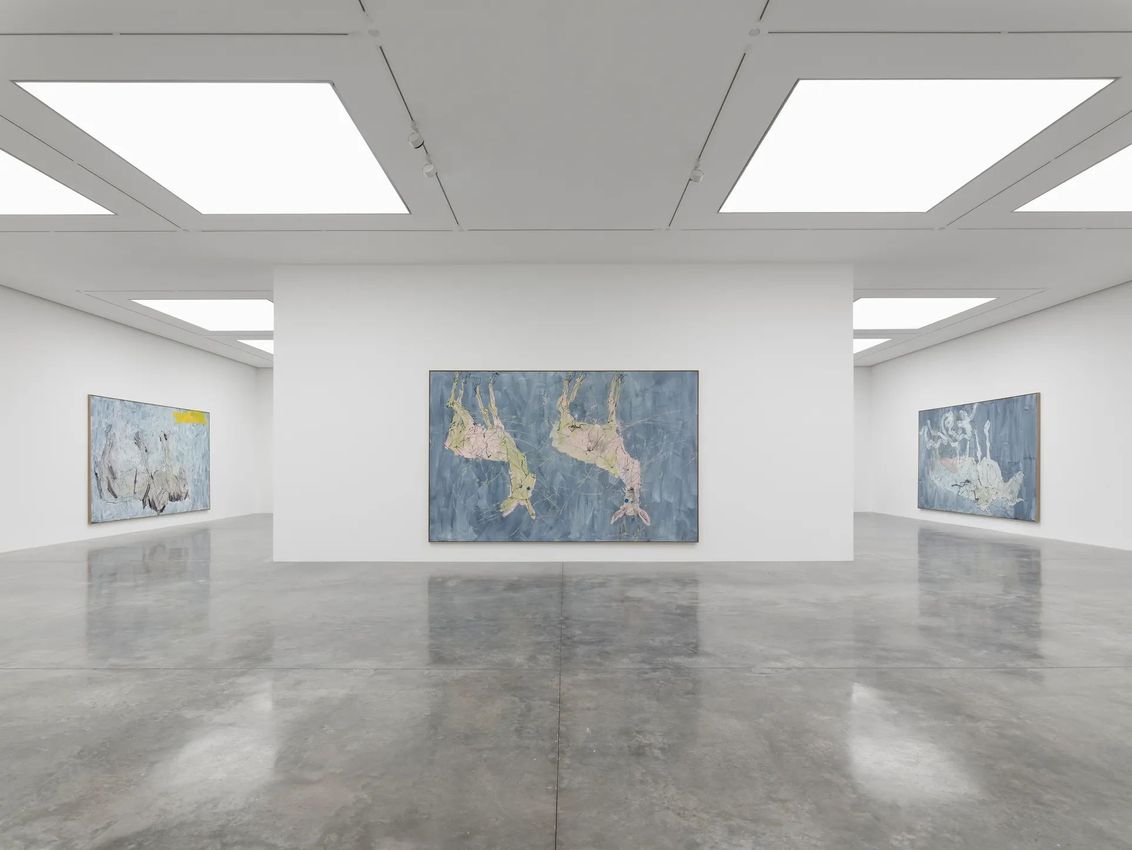
Georg Baselitz marks his return to White Cube Bermondsey for the first time in eight years with the solo exhibition ‘A Confession of My Sins’.
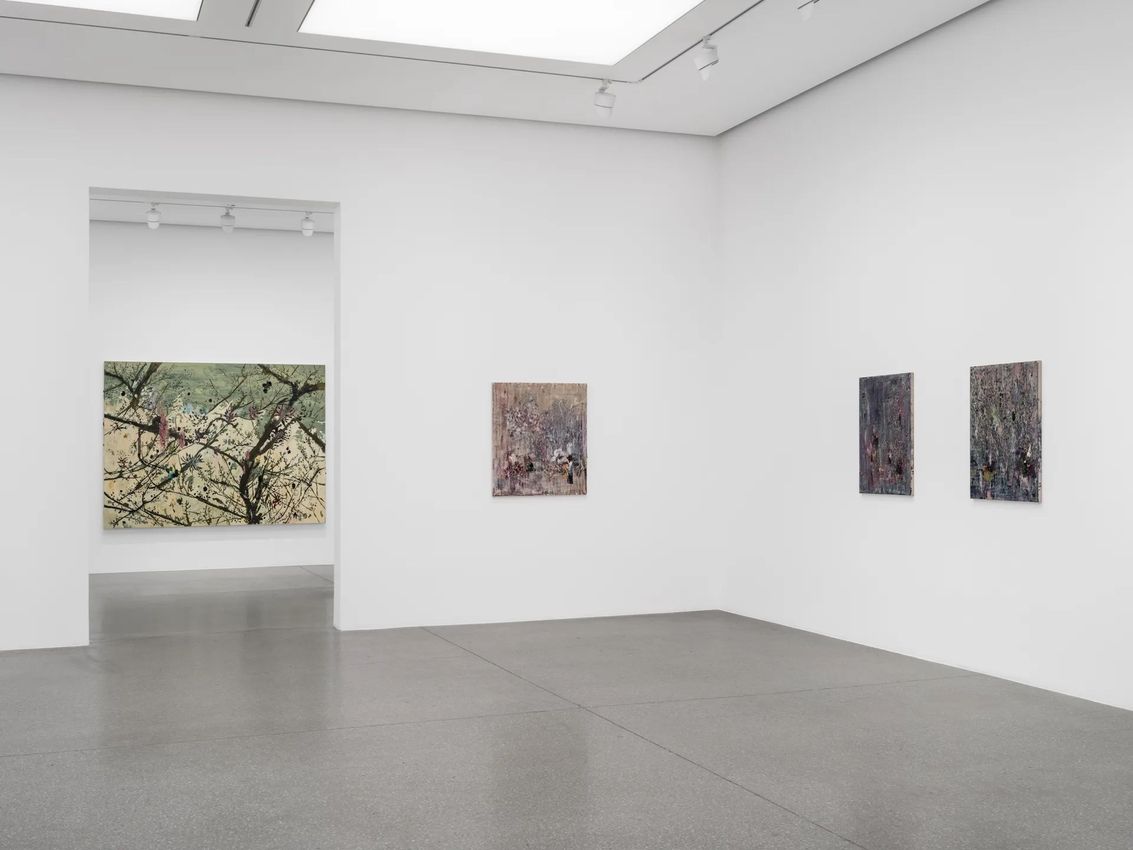
Comprising a large body of new work produced during an intensive year in the studio, the exhibition features large-scale paintings and a selection of works on paper in which the artist, now 86, surveys the past six and a half decades of his practice. From the vantage point of old age, Baselitz reflects upon a lifetime of lived experience and artistic invention, paying homage to key inspirations, motifs and subject matter, as well as unearthing pictorial references from his youth. ‘I’ve got my early childhood drawings of eagles, stags, deer, dogs and so on in folders,’ Baselitz remarks. ‘Every now and then I look at them, and I think was it a good time, was it a bad time?’
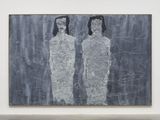
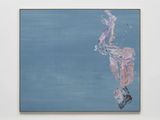
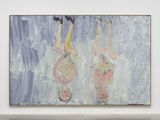
Appealing to this rich panoply of personal iconography, in several works the artist uses himself and his wife as a subject for exploration – an approach that has become focal to his recent paintings. _Der Maler in seinem Bett usw. (The Painter in His Bed, etc.) _(2023), presented in the 9x9x9 gallery alongside a selection of works on paper, depicts the painter and Elke Baselitz in a soft, spectral palette of whites. The two figures, seated and starkly rendered, are set against an enveloping darkness, recalling James McNeill Whistler’s portrait of his mother Arrangement in Grey and Black No. 1 (1871). Whistler’s portrait fascinates Baselitz because ‘it has a hardness in it’ – one brought to bear by the contrast between the figure’s sombre attire and muted background wall, as well as the compositional flattening which serves to intensify her austere profile. _Verliebtheit damals und heute (Being in Love, Then and Now) _(2023) and _James__Whistlers Mutter von James Whistler (Der Maibaum) (James Whistler’s Mother by James Whistler (The Maypole)) _(2023) re-stages her pose but replaces the background with a rich azure that brings to mind the beach scenes painted by Pablo Picasso in the late 1920s. Another of Baselitz’s paintings, _Marie-Therese in Dinard _(2023) makes direct reference to Picasso’s mistress Marie-Thérèse Walter who was often painted disguised as a multi-limbed sea creature, such that a shared interest between Baselitz and Picasso in conflating human and non-human might be inferred.
As the artist muses, the drawings that serve as a counterpart for the exhibited paintings figure like ‘a dam between two ponds’, a metaphor that evokes the landscape of his childhood around Deutschbaselitz, a village in Saxony nestled between forests and lakes. Baselitz returns to this provincial imagery, depicting animals indigenous to the area like those in _Blaue Augen Rehe (Blue Eyes Deer) _(2023), which recalls the animal studies of German Expressionist Franz Marc. Elsewhere, dogs and horses are rendered as tentative, nervous outlines. As the writer Martin Gayford observes in an essay published in the catalogue accompanying the exhibition, the distinction between humans and non-humans is almost non-existent for Baselitz. Apropos George Stubbs’s portrait of a horse, Whistlejacket (1762), Baselitz expresses his fascination with the striking individuality of the stallion. ‘I find it great,’ he says, ‘when you are in a zoo and stand in front of a cage with a chimpanzee or an ape in it and you find some similarity. But what you should really discover is an identity.’
As Gayford asserts, ‘art grows out of other art’ – a notion vividly realised through Baselitz, whose body of work forms the gestalt of a lifetime of accrued artistic influences. After witnessing the MoMA’s landmark travelling exhibition, ‘The New American Painting’, in West Berlin in 1958 – a survey which toured eight European capitals and exposed the art scene to the origins and breadth of American Abstract Expressionism – Baselitz sought to emulate Willem de Kooning’s fluid handling of paint. References to de Kooning have remained a constant in Baselitz’s practice, including his 2014 exhibition titled ‘Willem raucht nicht mehr’ (‘Farewell Bill’). As Baselitz has stated, ‘most of what you see as freedom is de Kooning.’ Paying dues to another forebear, a photograph of Edvard Munch seated in a chair with his lower legs obscured by the frame has served as a primary visual source for many of Baselitz’s works dating as far back as two decades. Merging the image of Munch with a photograph taken by Elke of Baselitz’s lower legs and feet, the painted image becomes a chimeric composite with the two artists fused as one.
One of Baselitz’s earliest, sustained preoccupations is with the French poet and playwright Antonin Artaud, who makes an appearance in two paintings presented in White Cube’s South Gallery II. _Die Maschine malt zweimal A.A. (The Machine Paints A.A. Twice) _(2023) depicts an uncanny doubling of two androgynous figures; one (or both) of whom may be the poet, their long hair resembling the style worn by Artaud in the late 1940s. The second work, _Jenseits Peddigrohrsofa in Wellenform Artauds Schlafzimmer (Beyond the Rattan Sofa in Wave Form Artaud’s Bedroom) (2023), in which Artaud is actively named, instead sees any remaining vestiges of the figure collapsing into a mass of tangled lines in ink-black paint. Baselitz’s fascination with Artaud proved to be formative. Eager to disrupt the complacency of post-war Germany, Baselitz and his comrade Eugen Schönebeck drew up the_Pandämonische Manifeste (Pandemonic Manifestoes) (1961–62) – a phantasmagorical yet polemical artists’ statement combining text and drawing, for which Artaud and his radical aesthetics of crisis served as a crucial touchstone.
A personal confrontation with crisis compels Baselitz and the work he creates, in which abstraction also serves as an abolition of the image. ‘I was born into a destroyed order, a destroyed landscape, a destroyed people, a destroyed society,’ he says, describing post-war Germany. Yet, mobilising his experiences of destruction towards continual reinvention, Baselitz has introduced new elements into this new body of work – he has begun using nylon stockings as collage material, referencing the Dadaist Hannah Höch. It requires nerve, writes Gayford, to become a collagist as an octogenarian. ‘I exclusively deal with my own past, always,’ Baselitz asserts, but ‘it was a different painter who did those earlier works. It was me, to be sure, but in a different spirit with a different intention.’
Revisiting his first encounter with Baselitz a quarter of a century ago, Gayford recalls the artist asserting, ‘In a sense, what painters really do when they paint is paint a situation that they are in: they paint actions.’ This observation proves remarkably prescient in this latest body of work, where a distinctly unifying element emerges in the angular markings embedded within many of the paintings. Baselitz, who has long painted his canvases on the floor, left behind these striations as his walking frame and the trolley holding his utensils facilitated his movements across their surfaces. These imprints now serve as a temporal record of the artist’s passage, both literally and metaphorically marking the passage of time.


Painter, sculptor, printmaker and draughtsman, Georg Baselitz is one of Germany’s most celebrated living artists, with a distinguished career spanning over fifty years.
An international art powerhouse, White Cube was established in 1993 in London by art dealer Jay Jopling. In its space on Duke Street, it served as the early exhibition venue for many now internationally acclaimed British artists, including Tracey Emin, Gilbert & George, Rachel Kneebone and Antony Gormley, who still show with the gallery today.

A respected voice in contemporary art discourse.
Focusing on ambitious storytelling and insightful art-world commentary. Ocula Magazine publishes in-depth interviews, critical essays and timely analysis on the artists, exhibitions and ideas driving the global art world.
Learn more about Ocula Magazine
Showcasing the best of the art world.
Ocula partners with galleries from around the world to highlight their artists, artworks and exhibitions. Gallery membership is by application and invitation, with each member vetted by an independent panel.
Learn more about Ocula Membership

Specialises in the sale of major artworks.
Led by a team with deep ties to the world’s leading auction houses, galleries and collectors. Ocula’s advisory team offers bespoke services to high-net-worth clients from around the world who are looking to acquire the best of contemporary and modern art.
Learn more about our team and services