Press Release

Isamu Noguchi (1904–88) was one of the most significant artists of the 20th century; his life and work still stand as a visionary example of cultural synthesis between Eastern and Western aesthetic traditions, formally elegant and strikingly modern by turns. Born to a Japanese father, who was a poet, and an American mother, who was an educator and editor, Noguchi moved between different cities, traditions and, ultimately, intellectual worlds. A restless search for his own artistic identity would bring him to Paris in 1927, as Constantin Brâncuși’s first and only assistant, before his return to New York in 1929. He would shortly thereafter spend six months in Beijing, en route to Japan, between 1930–31. It was in Beijing that Noguchi was introduced to master ink painter Qi Baishi (1864–1957), who instructed him in the essential tools of traditional East Asian arts: brush, ink, and paper. The exhibition ‘A Feeling’ offers a focused exploration of the profound impact of Qi’s teaching and lends insight into how this early encounter went on to inform Noguchi’s later sculptural practice.

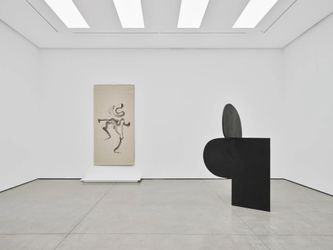
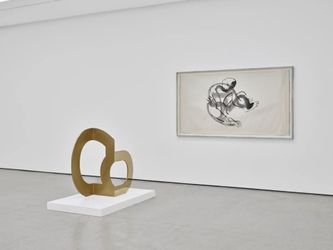
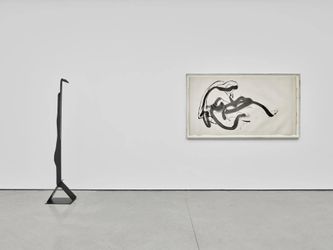
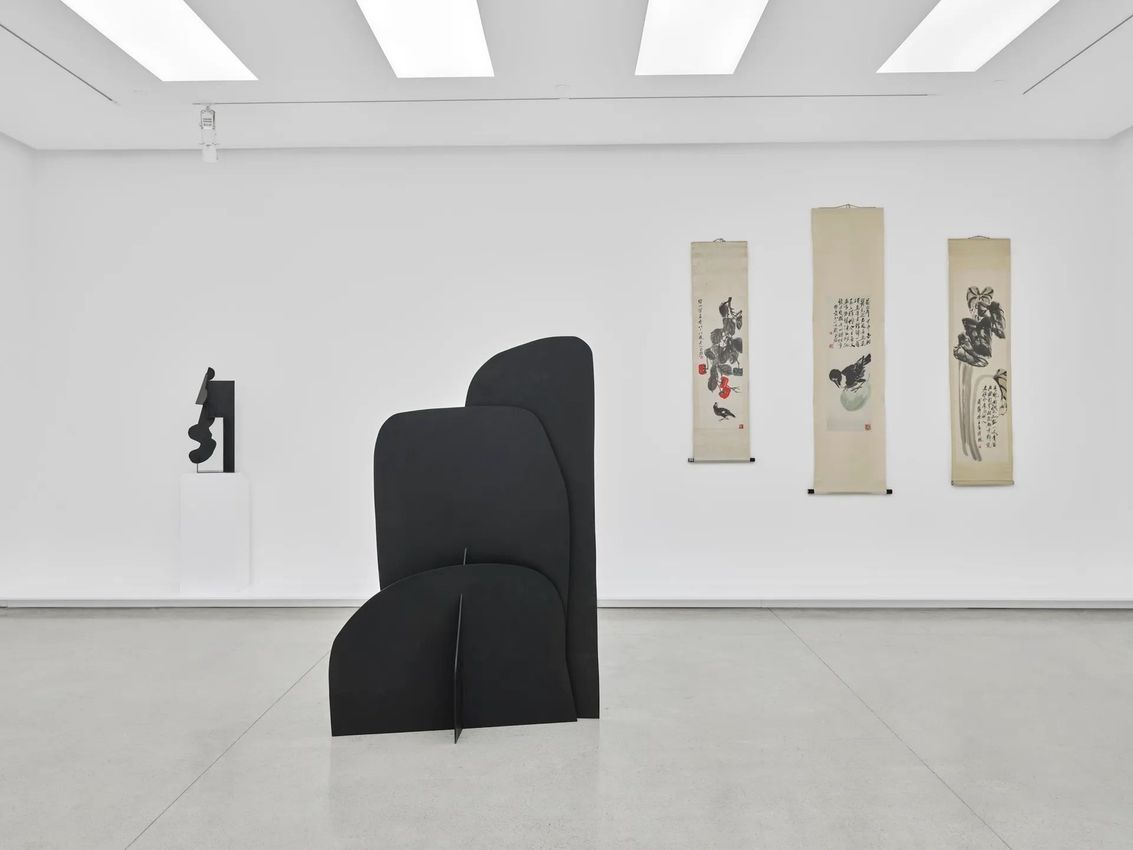
Qi was already a prominent figure in modern ink painting, and their time together led Noguchi to produce a series of works known as the ‘Peking Brush Drawings’ (all 1930). Three of these are exhibited alongside Qi’s own work. Eight of Noguchi’s formally related bronze sculptures that he created some 50 years after their meeting are also on view. By presenting works by Noguchi and Qi within the same space, the exhibition forges a temporal and spatial bridge in its continuation of an artistic dialogue between late master and student. Like Qi’s work, Noguchi’s ‘Peking Brush Drawings’ are devised as scrolls, a format that allows them to be rolled up, stowed and, traditionally, only taken out for special occasions. Scrolls were therefore occasions in and of themselves, in that their unfurling demanded slowed looking and anticipation as its contents were revealed. However, while Qi’s scrolls present East Asian motifs – foliage, flowers, birds and fruit – with hanging tendrils of Chinese script and luminous colour, Noguchi’s work departs from these subject matters and cultural convention.

The ‘Peking Brush Drawings’ profile a human form that just as easily disassembles into a tangled nest of lines. The artist deftly renders these figures by way of the two brush techniques said to underpin traditional Chinese painting: baimiao and feibai. Translating directly as ‘white drawing’ and ‘flying white’ respectively, both terms engage the tension between figure and ground – with ‘white’ referring to the negative space that comes into being through the demarcation imposed by the inscribed line. While baimiao involves the use of fine yet fluid ink strokes, feibai is the emphasis on a lightness and dynamism achieved by marks applied at differing pressures and speeds. Working in the spirit of Asian tradition, Noguchi privileges the art of the supple line above all else and leaves his markings spare, without wash or colour. Such drawings even presage the 1940s Western turn to Abstract Expressionism, a movement remembered for its ‘discovery’ of the intuitive, expressive qualities of mark-making, and its ability to register inarticulable feelings.

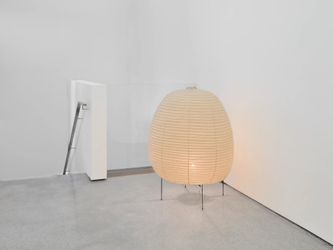
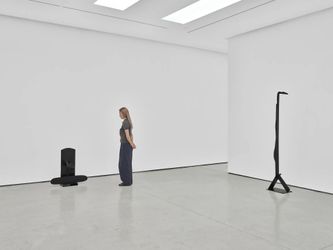
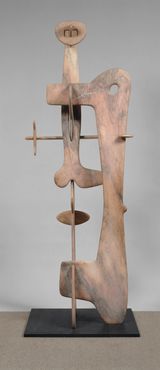
Longstanding East Asian aesthetic concepts such as these would continue to inform Noguchi’s practice, most apparent in his command of positive and negative space in works of sculpture. Presenting eight of Noguchi’s bronzes from the 1980s, ‘A Feeling’ testifies to the artist’s facility with bending the rules of working in three dimensions. Complex, puzzle-like works with interlocking planes, surprising silhouettes and irregular apertures characterise Noguchi’s late practice. The influence of Zen Buddhist thought, which he encountered during his travels in East Asia, can be felt in Noguchi’s penchant for reduction as well as his almost spiritual attunement to the interplay between form and void. That he chose to create works in bronze, however, speaks to a lifelong preoccupation with the fusing of ancient and modern ideas. ‘When the oldest alloy of the Bronze Age becomes a product of modern industry, the contradictory nature of time becomes apparent,’ the artist once said.

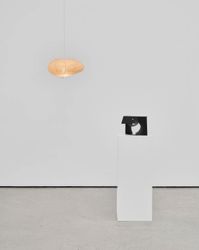
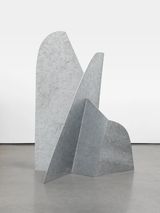
Rather than revert to traditional bronze casting, Noguchi’s bronze works are composed of metal sheets artfully cut, bent and assembled. To create these, Noguchi would often first work on compositions virtually, in calligraphy or with folded paper, before then turning to cut Styrofoam sheet models to test the sculpture’s structural basis. In the exhibition’s titular work, A Feeling (1988/2025), a figure-like form in bronze alludes to his early ‘brush drawings’ – with planes that recede into bare lines at certain viewing angles, becoming weightless leylines in ink. Giacometti’s Shadow (1982/84), Noguchi’s homage to the Swiss artist’s attenuated figures, meanwhile, affirms his visual lexicon as one equally devoted to the realm of the evanescent – be it shadow or negative space. ‘The folding creates structural strength. It also introduces three-dimensionality to appear solid,’ the artist has said, ‘or may be so without looking so, as I often prefer. A shadow.’

Other of Noguchi’s works extrapolate the classic subjects of traditional ink drawings as sculpture; Kaki-persimmons (1988/2023), for instance, appears as if to echo Qi’s Magpie and Persimmons (1948). Elsewhere, the title and topography of Cloud Mountain (1984/2025) immediately calls to mind the naturally formed protagonist gracing centuries of Chinese landscapes that Qi also sought to capture in his work Morning Glow (date unknown). With just the sparing use of three cut sheets, the sculpture successfully distils the dramatic ascent of misty peaks into a single, lyrical scene. Towering at over seven feet tall, Noguchi’s sculpture 2=1 (1988) similarly distils a concept. Here, the artist’s rendition of a duet is pared down to its essence: an embrace between two dark forms caught in the midst of their fusion as one. Produced in the final year of Noguchi’s life and the largest of the artist’s constructed bronzes, the work can be read as a monument to harmony and the reconciliation of contradiction. An assertion that two things can be true at once, 2=1 speaks to the prevailing idea Noguchi returned to throughout his life’s work – that of being an interlocutor, born of two different worlds.

Read More

Installation Views

About the Artist

One of the most significant artists of the 20th century, Isamu Noguchi (1904–1988) was a resolute modernist whose timeless work blended ancient and contemporary ideas. An itinerant, cultural polymath, he questioned defined artistic categories and the prevailing agendas of his time, embracing notions of globalism and anticipating ideas of relational aesthetics by several decades. Primarily a sculptor, Noguchi’s expansive, interdisciplinary practice included public projects, architecture, gardens, playgrounds, ceramics, furniture, lighting and set design, all formulated by a deep connection to nature and to the poetics of space.

View Artist Profile

Also Exhibiting at White Cube

About the Gallery

An international art powerhouse, White Cube was established in 1993 in London by art dealer Jay Jopling. In its space on Duke Street, it served as the early exhibition venue for many now internationally acclaimed British artists, including Tracey Emin, Gilbert & George, Rachel Kneebone and Antony Gormley, who still show with the gallery today.

View Gallery Profile
Address
50 Connaught Road
Central
Hong Kong
Hong Kong
Opening Hours
Tuesday – Saturday
11am – 7pm
(1)
Hong Kong 50 Connaught Road
White Cube
50 Connaught Road, Central, Hong Kong, Hong Kong
+852 259 220 00
http://whitecube.com

Opening hours
Tuesday – Saturday
11am – 7pm
The art world in focus