



Press Release

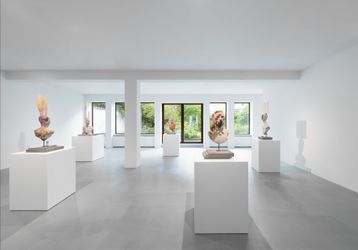
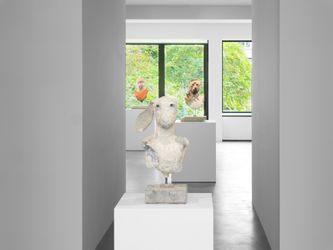
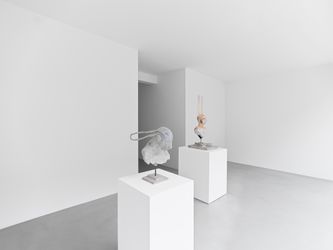
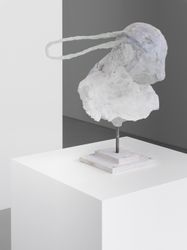
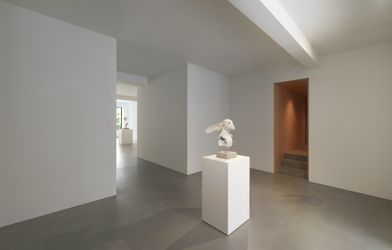
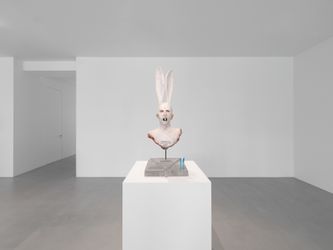
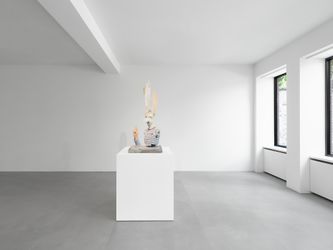
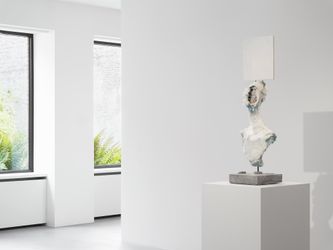
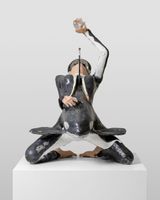
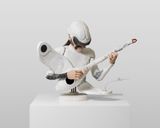
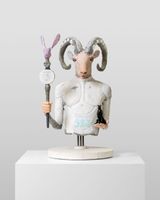
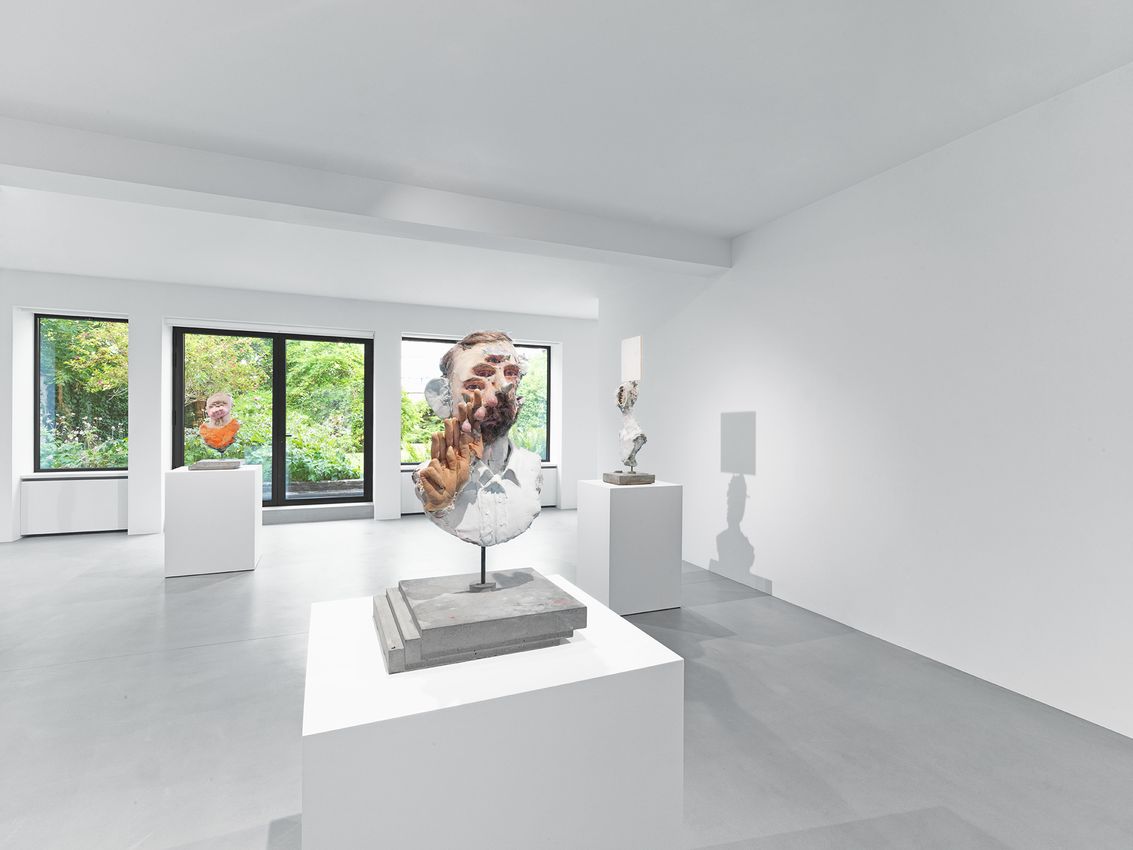
In this exhibition, David Altmejd presents a series of hybrid sculptures in which humans and rabbits are fused into strange and enigmatic forms. The works exemplify some of the most enduring themes in his oeuvre—transformation, metamorphosis and regeneration—while also revealing fresh creative impulses and subtle but significant shifts in his sculptural practice. Executed in a characteristically rich array of materials, including crystals, resin and fur, the anthropomorphic works are a disconcerting presence in the space: beguiling in their visual complexity yet unnerving in their other-worldliness.

While Altmejd has always been fascinated by rabbits, they have only had a discreet and subliminal presence in his oeuvre to date. In these new works, however, they manifest themselves as protagonists in their own right. Altmejd’s amalgamated forms—neither fully human nor completely animal—seem to be arrested in a state of transition that defies the laws of nature. As a result, they appear to allude to the workings of altogether more mysterious and unknowable life forces. The artist expresses the energy generated by transformation and metamorphosis, as well as by the symbiotic process of decay and regeneration, through the addition and subtraction of matter: building while deconstructing, moulding while excavating, replicating while reducing. The textural richness of Altmejd’s Rabbits, coupled with their indeterminate nature, lends them a distinctly liminal quality, as though standing on the threshold between two distinct states of being.

The works also allude to existential dichotomies such as life and death and the boundaries between, for example, science/mysticism or materiality/spirituality. As the artist explains, the works also reference different pathways towards enlightenment: Eastern Hinduism and Western Christianity. These parallel systems are represented by a number of time-honoured symbols. For example, multiple cast hands, which have previously functioned in Altmejd’s work as active tools of creation, are here raised in benediction. The circles in pale and limpid hues allude to the ancient Hindu concept of the chakras (the seven centres of spiritual power in the human body), each one of which is linked to a specific colour and vibrational tone (hence the piano keys). Multiple eyes evoke the esoteric notion of the invisible ‘third eye’ that provides perception beyond ordinary sight, while a taxonomic table references science, order and classification i.e. rationality.

The figure of the rabbit is particularly meaningful within this context as the animal has long been a symbol of fertility, desire and procreation, as well as new life, abundance, comfort and vulnerability. They are mystical creatures (associated with the resurrection in Christianity) yet integral to science (and are often used in laboratories). Adept at navigating unmarked burrows in pitch darkness, rabbits are acutely sensitive to vibrations and energies that are beyond human comprehension. For this reason, they are also linked to intuition: these creatures have no need of an outside source to illuminate the way. One only has to think of Alice in Wonderland and the journey of self-discovery that begins when the eponymous heroine tumbles down a rabbit hole...

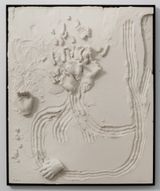
Many of these ideas are articulated in Altmejd’s new sculptures, most notably fertility and birth. In one, the rabbit’s ears interlock in a way that is suggestive of procreation. In another, we see a drawing of a tumbling figure (an allusion to The Fall of Man?) alongside a column of luminous circles; below is a sketch of a woman giving birth. Combining sculpture and autonomous drawings is a new departure for the artist. While he has often pencilled on works before, the rabbit sculptures have now become a tabula rasa for figurative scenes relating to the human condition. If these works are about ‘being’ in terms of energy and materiality, then the drawings can perhaps be seen as corresponding to an existential awareness. Such is the significance of these vignettes that Altmejd even includes the tools of his trade in his work: pencils. Bright, vivid and upright, as though poised for use.

David Altmejd was born in Montreal in 1974 and lives and works in Los Angeles. He studied at the University of Quebec in Montreal and graduated with an MFA from Columbia University, New York in 2001. His numerous international exhibitions include The Flux and the Puddle, MNBAQ, Quebec (2016), Géants, Royal Museums of Fine Arts, Brussels (2016) and a major survey exhibition, Flux, which travelled from Musée d’Art Moderne de la Ville de Paris to the MUDAM in Luxembourg and the Musée d’Art Contemporain de Montréal, Canada (2014–2015). In 2007, he represented Canada at the 52nd Venice Biennale with his installation The Index, and he was included in the Istanbul and Whitney Biennials in 2003 and 2004 respectively.

Read More

Installation Views

About the Artist

David Altmejd creates highly detailed sculptures that often blur the distinction between interior and exterior, surface and structure, representation and abstraction. For Altmejd, the process of making is paramount – he is interested in how the act of constructing an object generates meaning. Altmejd often defies traditional material conventions. In his recent series of large-scale semi-figurative sculptures he used seemingly random objects (such as hessian, polystyrene, chains, fur, crystals and resin casts of his hands and of exotic fruits) to create resonant connections and juxtapositions between diverse material elements. In his complex installations involving Perspex structures and vitrines, Altmejd often pairs symbolic objects, such as crystals and taxidermy birds and animals, with virtuosic applications of materials such as plaster, glitter, minerals and mirrors. Motivated by the invisible worlds that often exist just beneath the surface of things, the artist reveals the hidden structures in his own works through negative spaces: gaps, holes, fissures and crystal filled orifices are a recurring motif. In contrast, the reflective surfaces of his mirrored sculptures are impenetrable and both define and destabilise, as well as multiply, the spaces around them.

View Artist Profile

Also Exhibiting at Xavier Hufkens

About the Gallery
Xavier Hufkens is one of Europe’s leading galleries for contemporary art. Located in Brussels, the gallery maintains a diverse exhibition programme with solo exhibitions of the gallery artists as well as group exhibitions and special projects. The gallery deals in a distinctive combination of painting, drawing, sculpture, photography, video and installation-based work.

The origins of the gallery date back to 1987, when Xavier Hufkens opened a gallery space in an un-refurbished warehouse in the neighbourhood of the South Station (Midi) in Brussels. During the early years, the focus of the gallery was upon mid-career and emerging artists and the gallery is known for having introduced some of the most influential contemporary artists to Brussels at a time when they were still relatively unknown. British sculptor Antony Gormley, who is still affiliated with the gallery, Felix Gonzalez-Torres and Rosemarie Trockel all showed in Belgium for the first time with Xavier Hufkens (Gormley in 1987; Gonzalez-Torres in 1991 and Trockel in 1993).

In 1992, the gallery moved to a 19th-century townhouse at 6 rue Saint-Georges, close to the Avenue Louise. Completely renovated by Belgian architects Paul Robbrecht, Hilde Daem and Marie-José Van Hee, the house quickly gained a reputation for being not just one of the most beautiful contemporary art spaces in the Belgian capital, but also one of the most interesting. The expanded exhibition programme coincided with the additional representation of a number of established artists from Belgium and abroad, including Richard Artschwager, Thierry De Cordier and Jan Vercruysse. In 1997, Hufkens expanded the gallery further by annexing the adjacent building and a number of new artists joined the gallery, including Louise Bourgeois, Roni Horn and Thomas Houseago.

A second space in the same street, at 107 rue Saint-Georges, opened in spring 2013. Located in the Galerie Rivoli, a mixed-use commercial development from the 1970s, the new gallery space was designed by Swiss architect Harry Gugger, who was previously in partnership with Herzog and De Meuron. Slegten & Toegemann, Brussels, managed the project.

An eclectic but very clear vision underpins all of the gallery’s activities: ‘The definition of the gallery was established from the start. The common thread, then and now, is quality over and above everything else, which I find more intellectually challenging than a forced definition. From the early days I juxtaposed established artists such as Michelangelo Pistoletto with someone like Felix Gonzalez-Torres when he was totally unknown. Today I still mix my work: I have no problem showing Malcolm Morley … alongside Robert Ryman, or Willem de Kooning.’ [Xavier Hufkens in The Art Newspaper, Issue 220, January 2011, published online: 20 January 2011]

Xavier Hufkens represents some thirty artists from different generations. He was part of the six-member selection committee for Art Basel during seven years and also participates in up to five international Arts Fairs annually. The gallery has partnerships with the estates of Louise Bourgeois, Willem de Kooning, Robert Mapplethorpe and Alice Neel.
View Gallery Profile
Address
44 rue Van Eyck
Van Eyckstraat
Brussels
Belgium
Opening Hours
Tuesday – Saturday
11am – 6pm
(1)
Brussels 44 rue Van Eyck, Van Eyckstraat
Xavier Hufkens
44 rue Van Eyck, Van Eyckstraat, Brussels, Belgium

Opening hours
Tuesday – Saturday
11am – 6pm
The art world in focus