



Press Release

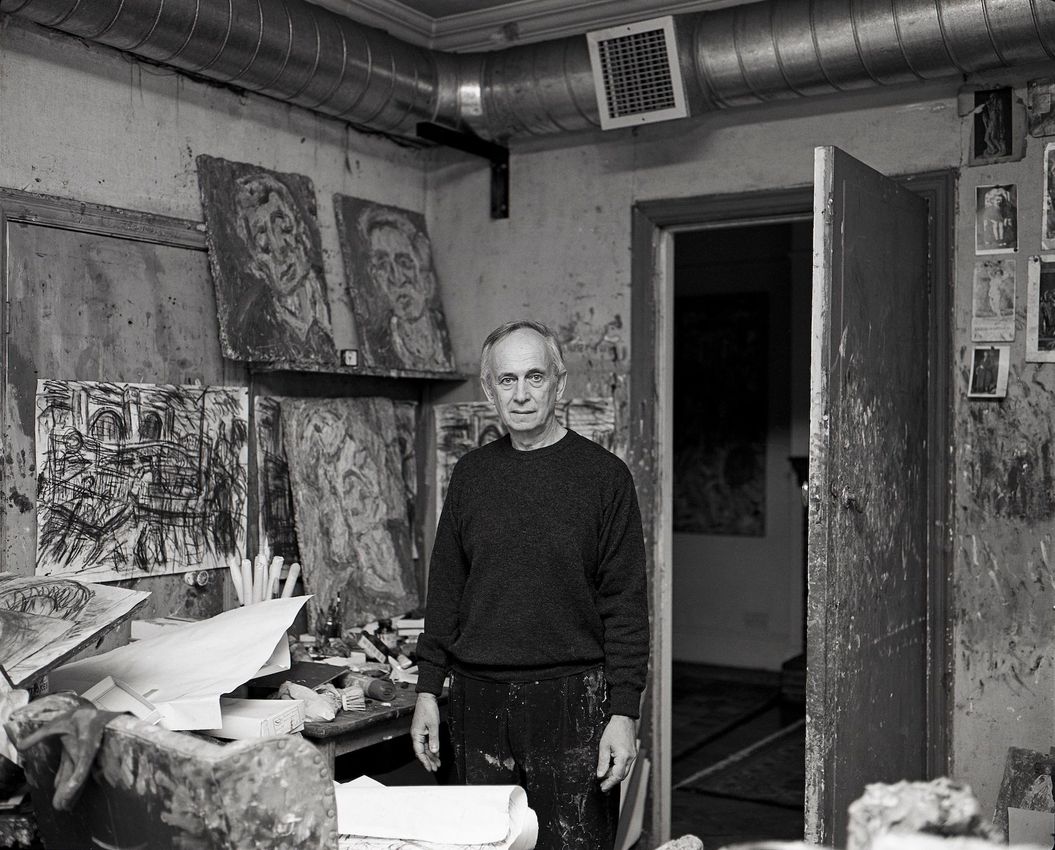
Xavier Hufkens is pleased to announce the gallery’s first exhibition dedicated to the work of the British painter Leon Kossoff (1926-2019). Featuring paintings and drawings made over a five-decade period — almost his entire working life — the presentation takes the form of a condensed retrospective. Two significant bodies of work showcase major themes in Kossoff’s oeuvre, namely London cityscapes and his ‘translations’ of works by Old and Modern Masters. Supplemented by portraits and an early nude from 1963, the exhibition presents a comprehensive overview of Kossoff’s practice as well as its stylistic evolution.

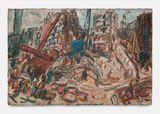
Leon Kossoff was a leading member of the London School, a loose association of artists that also included Francis Bacon, Lucian Freud, Frank Auerbach, and David Hockney. Although stylistically diverse, they all focused on figuration and expressive realism at a time when abstraction and minimalism were the dominant forces in contemporary art. Kossoff painted London almost obsessively. The works in the exhibition include scenes from the north of the city, where he lived and worked, and the East End, where he was raised. Painted between 1971 and 1992, they chronicle Kossoff’s fascination with the city’s post-war renewal. He was especially drawn to places of transformation and transit, such building sites and stations, as evidencedby Demolition of YMCA Building No. 2, Spring (1971), Booking Hall, Kilburn Underground Station No. 4 (1978) and Outside Kilburn Underground Station, November (1984). Separated by a period of six years, the Kilburn paintings not only bear witness to the artist’s unwavering interest in his everyday surroundings but also the way in which even the most familiar subjects are in a state of permanent flux.

The artist additionally depicted buildings and places that evoked specific memories for him, such as Red Brick School Building, Winter (1982). This was a type of school building familiar to many English children growing up in the post-war period, and which reminded him of the primary school he himself attended in Spitalfields. The nearby church, one of London’s grandest baroque edifices, designed by Nicholas Hawksmoor, was the subject of another of his paintings, Christ Church, Spitalfields, early summer (1992). For Kossoff, these subjects were not just physical landmarks but ones in which there is a constant interplay between past and present, underscored by the charged and ever-moving brushwork. Kossoff painted London all year round and always from life. Light and the weather determine the atmosphere of his works, together with his gestural technique and characteristic use of impasto. In an oeuvre that chronicles the ebb and flow of life in one of the world’s largest metropolises over the best part of a century, time and memory are important touchstones. While many of the locations that Kossoff painted have long since vanished, the places immortalised in the paintings on exhibition — the Red Brick School Building, (Willesden), Christ Church, Spitalfields, and Kilburn Underground station — can all be seen today.

Leon Kossoff is also renowned for his ‘translations’ of paintings by Old and Modern Masters. While he visited and drew in the National Gallery in London on a weekly basis, and had done from a young age, the drawings in this exhibition were mainly made from works shown in Royal Academy exhibitions: Francisco Goya’s paintings and Courbet’s The German Huntsman were included in the retrospectives dedicated to these artists in 1978 and 1994 respectively, while Titian’s The Flaying of Marsyas (c. 1570-1576) was exhibited in Venetian Painting in 1983. Here too, Kossoff worked from life: he made his drawings in the galleries before the actual paintings. Yet these are anything but academic copies. Kossoff’s rapid, dynamic technique and repetitive strokes are unmistakably his own and the sketches, whilst faithful to the originals, are never identical to them. Hence the term ‘translation’. Captivated by certain Old Masters, or canvases by pioneers such as Cézanne and Courbet, Kossoff strove to analyse the psychological and emotional impact of the paintings by recreating it in his own work. It was both an intellectual engagement and an educational exercise. He wrote in 1987: “In my work done in the National Gallery, and elsewhere from the works of others, I have always been a student. From the earliest days...my attitude to these works has always been to teach myself to draw from them, and, by repeated visits, to try to understand why certain pictures have a transforming effect on the mind.” Kossoff was particularly drawn to dramatic and intense works, or those depicting a struggle, as can be seen in the exhibition.

Portraits of family and friends are the third major pillar of Leon Kossoff’s oeuvre. They are represented here by an early, almost abstract nude (1963), a life-size portrait of his father and a self-portrait (both 1978). Kossoff’s father, Wolf, was a baker who had fled Kyiv, then part of the Russian Empire, prior to the First World War. Arriving in London, he eventually opened a bakery in Fournier Street, which is the road on the left in his son’s painting of Christ Church. While the three figurative works are executed in the sombre, earthy tones that characterised Kossoff’s early years, his late work, Cherry Tree (2015), sits at the opposite end of the spectrum. It not only demonstrates the evolution of his palette towards lighter and brighter shades but also the emergence of a gentler and sparser painting technique. The subject is a tree in Kossoff’s London garden, which he saw every day.

Leon Kossoff began his artistic training at St. Martin’s School of Art in 1943 but left in 1945 to complete three years of military service. He returned to St. Martin’s in 1949 and followed David Bomberg’s classes at Borough Polytechnic from 1950 to 1952. He then completed his training at the Royal College of Art between 1953 and 1956. Kossoff represented Britain at the Venice Biennale in 1995 and was the subject of a retrospective at the Tate Gallery in 1996. His work is held in major public and private collections around the world, including the Art Institute of Chicago, the J. Paul Getty Museum, Los Angeles, Metropolitan Museum of Modern Art, New York, and the Tate Gallery, London.

Read More
About the Artist

British artist Leon Kossoff (1926–2019) is one of the most acclaimed figurative painters of the twentieth century. A born and bred Londoner, Kossoff found inspiration in his close environment; from within his studio walls to the city’s streets. Often building layer on layer of paint over long periods of time, Kossoff created expressive, tactile surfaces. Through a use of heavy impasto, his canvases took on a three-dimensional, almost sculptural quality.

View Artist Profile

Also Exhibiting at Xavier Hufkens

About the Gallery
Xavier Hufkens is one of Europe’s leading galleries for contemporary art. Located in Brussels, the gallery maintains a diverse exhibition programme with solo exhibitions of the gallery artists as well as group exhibitions and special projects. The gallery deals in a distinctive combination of painting, drawing, sculpture, photography, video and installation-based work.

The origins of the gallery date back to 1987, when Xavier Hufkens opened a gallery space in an un-refurbished warehouse in the neighbourhood of the South Station (Midi) in Brussels. During the early years, the focus of the gallery was upon mid-career and emerging artists and the gallery is known for having introduced some of the most influential contemporary artists to Brussels at a time when they were still relatively unknown. British sculptor Antony Gormley, who is still affiliated with the gallery, Felix Gonzalez-Torres and Rosemarie Trockel all showed in Belgium for the first time with Xavier Hufkens (Gormley in 1987; Gonzalez-Torres in 1991 and Trockel in 1993).

In 1992, the gallery moved to a 19th-century townhouse at 6 rue Saint-Georges, close to the Avenue Louise. Completely renovated by Belgian architects Paul Robbrecht, Hilde Daem and Marie-José Van Hee, the house quickly gained a reputation for being not just one of the most beautiful contemporary art spaces in the Belgian capital, but also one of the most interesting. The expanded exhibition programme coincided with the additional representation of a number of established artists from Belgium and abroad, including Richard Artschwager, Thierry De Cordier and Jan Vercruysse. In 1997, Hufkens expanded the gallery further by annexing the adjacent building and a number of new artists joined the gallery, including Louise Bourgeois, Roni Horn and Thomas Houseago.

A second space in the same street, at 107 rue Saint-Georges, opened in spring 2013. Located in the Galerie Rivoli, a mixed-use commercial development from the 1970s, the new gallery space was designed by Swiss architect Harry Gugger, who was previously in partnership with Herzog and De Meuron. Slegten & Toegemann, Brussels, managed the project.

An eclectic but very clear vision underpins all of the gallery’s activities: ‘The definition of the gallery was established from the start. The common thread, then and now, is quality over and above everything else, which I find more intellectually challenging than a forced definition. From the early days I juxtaposed established artists such as Michelangelo Pistoletto with someone like Felix Gonzalez-Torres when he was totally unknown. Today I still mix my work: I have no problem showing Malcolm Morley … alongside Robert Ryman, or Willem de Kooning.’ [Xavier Hufkens in The Art Newspaper, Issue 220, January 2011, published online: 20 January 2011]

Xavier Hufkens represents some thirty artists from different generations. He was part of the six-member selection committee for Art Basel during seven years and also participates in up to five international Arts Fairs annually. The gallery has partnerships with the estates of Louise Bourgeois, Willem de Kooning, Robert Mapplethorpe and Alice Neel.
View Gallery Profile
Address
107 rue St-Georges
St-Jorisstraat
Brussels
Belgium
Opening Hours
Tuesday – Saturday
11am – 6pm
(1)
Brussels 107 rue St-Georges
Xavier Hufkens
107 rue St-Georges, St-Jorisstraat, Brussels, Belgium

Opening hours
Tuesday – Saturday
11am – 6pm
The art world in focus