Press Release

Xavier Hufkens is pleased to present its inaugural exhibition with the influential American artist Sherrie Levine. As one of the artists who are most often cited in relation to appropriation art, it has to be recognized this category is too narrow to contain all that Levine’s work achieves. The more it is looked at, the more depth and complexity her practice yields.

Sherrie Levine is adept at making bodies of work that are both precise and confounding. Her reiterations of artefacts obtain their own aura — through a poised selection, of source artefacts, material, execution, and a stilled dramaturgy of sequence and presentation. These aspects still do not explain the mystique Levine’s work propagates: the magic seems to lie in the way the works relate, to each other, their earlier selves in whose image they were remade, Levine’s practice, and as physical markers to the vast networks of objects and meanings that comprise our collective cultural experience.

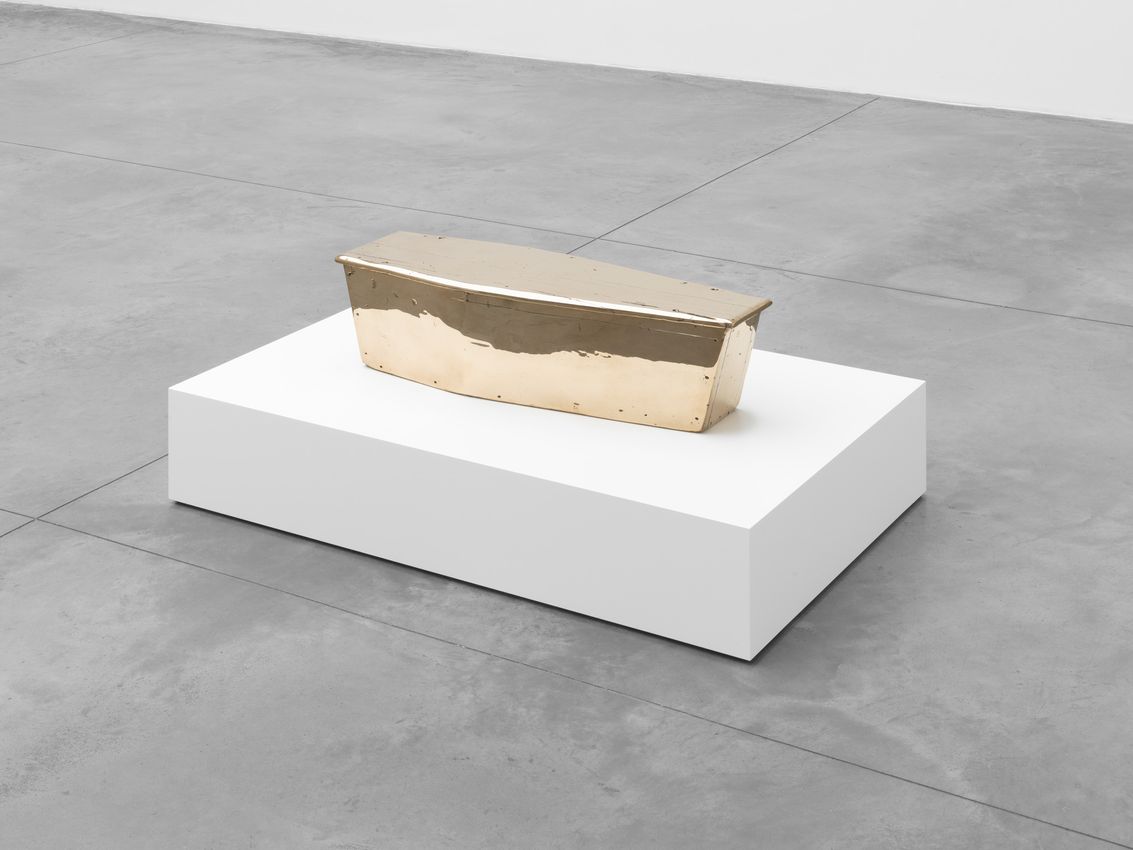
In the first room, Levine presents Monochromes After Emil Nolde: 1–12. The colours are distilled from the pixilation of a photograph of a painting of poppies by the German expressionist Emil Nolde (1867–1956). Levine’s choice of source is hardly innocent: in the nineteen forties Nolde was persecuted by the Nazi’s and forbidden to paint. He called the watercolours of flowers he made in secret during this period Unpaintings, a title which, by extension, also questions the status of these new paintings. We see a small bronze coffin, cast from a wooden original, polished to perfection, the carpentry details clearly visible. Tight Coffin brings to mind Dali’s obsession with Millet’s painting The Angelus, 1857–1859. The surrealist sensed there was a child’s coffin at the feet of the workers in the field who had paused to pray, even if none was visible. In 1932-5 Salvador Dali wrote about his visions at length in his book The Tragic Myth of Millet’s Angelus: Paranoiac-Critical Interpretation. An x-ray confirmed his intuition in 1963. Sherrie Levine’s Tight Coffin is similar in shape and scale to the one unveiled in Millet’s painting. The object is like a Pandora’s box, suggesting a life unlived, and a locked-in charge capable of unleashing countless associations.

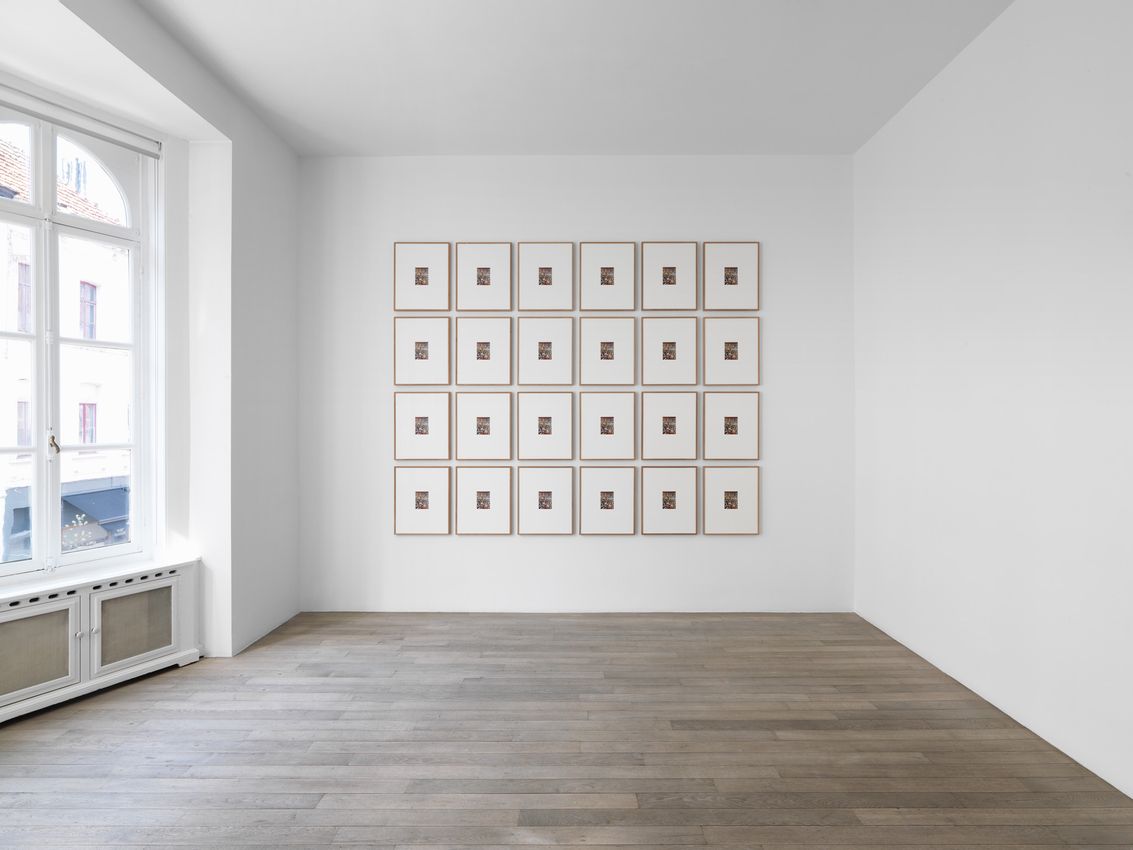
Two postcard collages of each 24 identical, framed postcards, manifest in and of themselves notions of repetition and seriality. And as we walk past them, we see every postcard differently, as the others crowd into our peripheral vision. The postcard of the first After Ensor: The Intrigue (detail) shows many people wearing masks, a recurrent motif of disguise in Levine’s work. They feature again in the second postcard collage that presents a detail of James Ensor’s painting Christ’s Entry into Brussels, 1889. In this painting, the Anglo-Belgian artist depicted himself as Christ at the centre of a carnivalesque multitude.

The viewer may imagine a further link to Brussels in the bronze Christ Child, a figure not unlike Manneken Pis, the fountain of a small boy that splashes forth in the centre of Brussels. This in turn harks back to Levine’s Fountain (Buddha), with which she reiterated Marcel Duchamp’s 1917 urinal/readymade Fountain that he signed R. Mutt. Taking a slightly different model by the same company in the same year, Levine’s Fountain (Buddha) bore no signature. It was executed in polished bronze — this quality recalled the sculptures of two other male, modernist artists, Brancusi and Arp — and has been Levine’s material of choice for casting ever since. Her sources are often rich in cultural references, but the way she reiterates and displays them are just as central to her project.

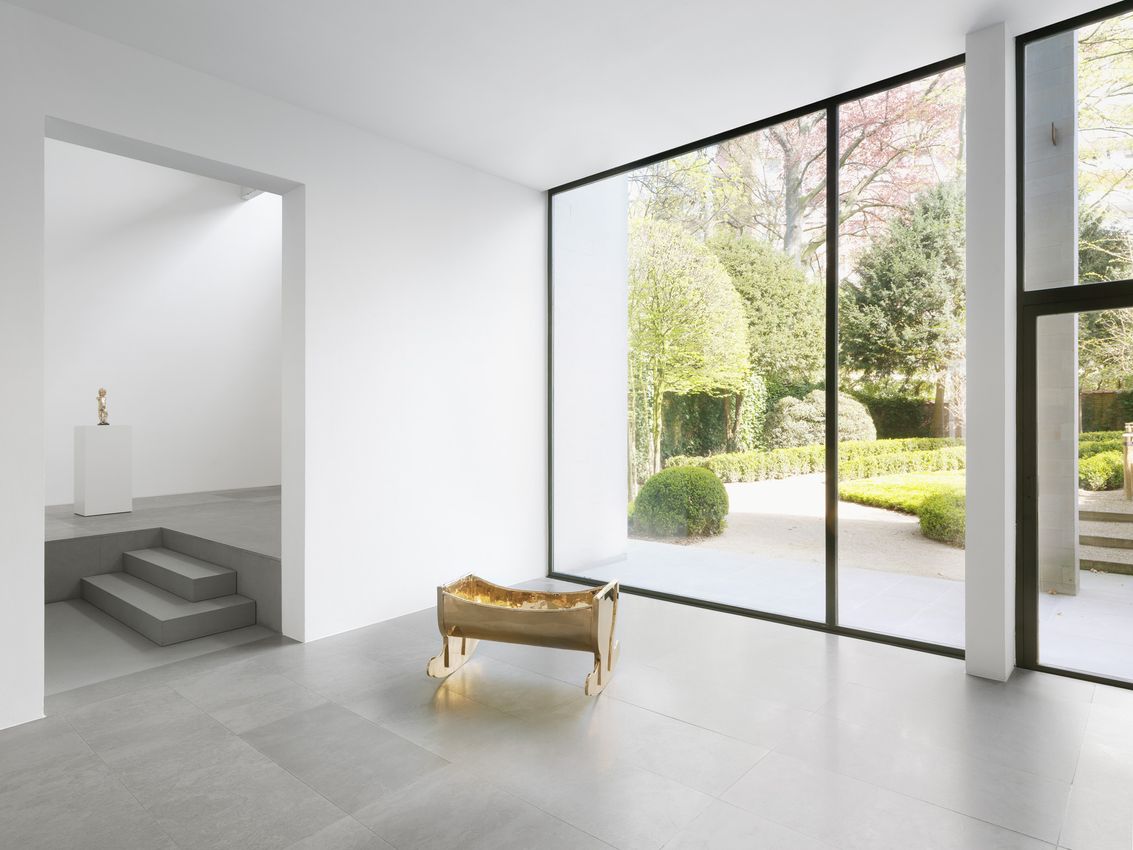
Levine’s Very Large Cradle relates to a painting by Van Gogh that Levine reproduced in an earlier work: a woman is pictured holding the strings that rock a cradle, which is left outside of the image. Van Gogh was influenced by Millet: the cradle and coffin touch on how ideas and forms reappear in the arts through time. Seeing them together further amplifies their associative potential.White Moonlight After Man Ray: 1–15, is one of a series of ‘knot paintings’ or ‘not-paintings’ Sherrie Levine began making in 1985. Taking plywood panels, the artist highlights the knots in the grain of the wood by painting them. The series is subtly varied, in terms of ground colour, and number and colour of the spots. The title of this particular work acknowledges a collage Man Ray made in which the grain of a blackened piece of wood suggested the clouds of a moonlit sky.

Medicine Ball harks back to Levine’s own Beach Ball, after Roy Lichtenstein’s Girl with Ball, an image he had found in a hotel advertisement. The sculpture was a contradiction-in-form, representing an object of lightness in bronze. This opposition is reversed again in Medicine Ball  — the original item is already heavy. Lightness abounds once more in Rabbit, cast from a found folkloric item. It recalls Levine’s postcard collage After Dürer: 1–18, only here the motif is leaping.

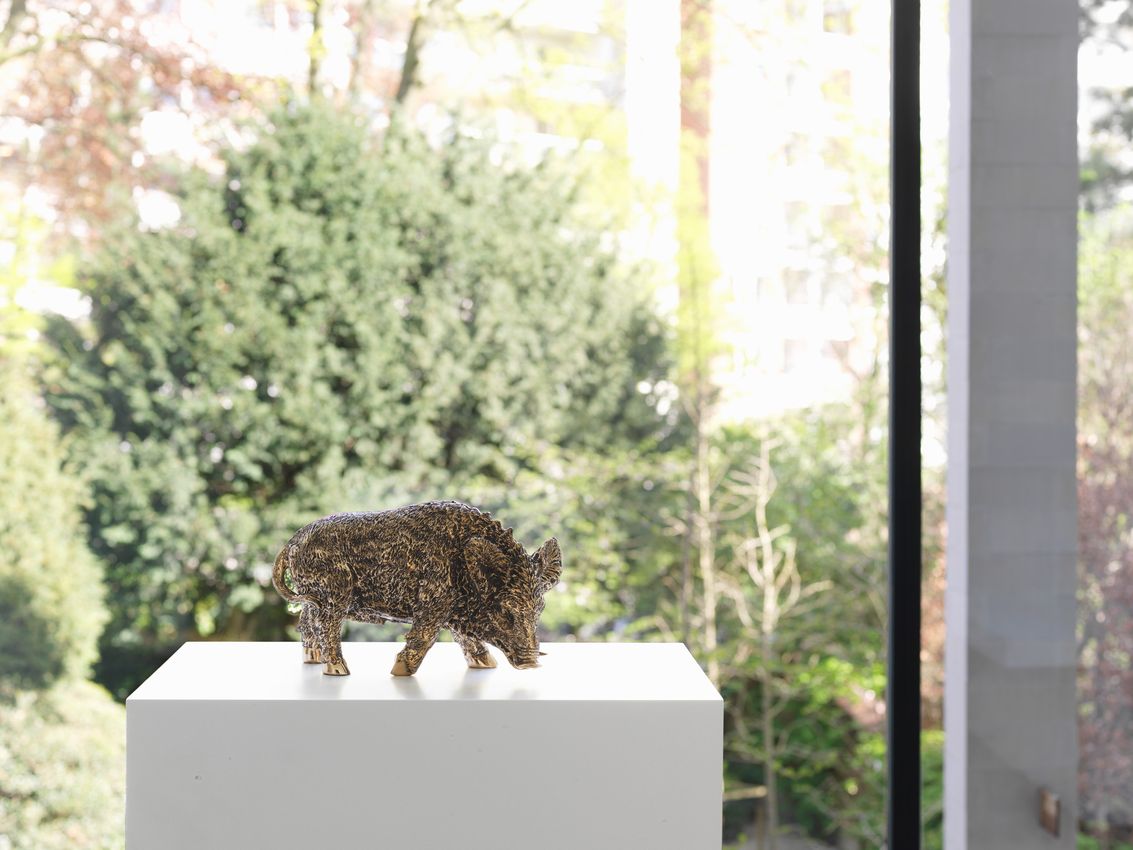
The bronze Chemin Wild Boar emphasizes this stream of cultural associations Sherrie Levine’s works — together — seem to unleash. A wild boar may be small in size, but it can be strong and fierce, and capable of wreaking havoc and devastation. In Greek mythology, the animal is related to notions of fecundity and reproduction. In light of Sherrie Levine’s practice, which forever questions ideas of originality and copies of images and objects, the boar can be seen as a potent emblem of cultural fertility on overdrive.

Sherrie Levine (b. 1947) lives and works in New York. Her earliest work was included in the seminal exhibition Pictures, 1977, at Artists Space in New York. In 1981 Levine debuted her controversial series Untitled, After Walker Evans which, together with other similar series, made her a leading member of the ‘Pictures Generation’, a group of artists using appropriation techniques to challenge the notions of authenticity and originality in the media-saturated 1980s. Levine’s work has been the subject of solo exhibitions at prominent institutions worldwide and can be found in major international museum collections.

Read More

Installation Views

About the Artist

Active since the late 1970s, American artist Sherrie Levine is recognised for her radical and uncompromising analysis of the critical issues surrounding art-historical interpretation. Initially establishing her reputation in the field of photography and appropriation, most notably of works from the modernist canon, her practice has broadened over the years into a wide-ranging discourse on the historical and contemporary meaning of originality and authorship. Central to her approach is the decontextualisation and recontextualisation of material culture with an emphasis on form and aesthetics. The relationship of Levine’s work to its ‘source’ - be it an existing artwork, found object or theoretical concept - typically creates a paradigm shift that prompts a re-evaluation of the trajectories that objects and ideas travel across time and media. In this, Levine not only challenges the institutional structures, hierarchies and systems that define and categorise art, but also the mechanisms responsible for the creation of history and significance. In works that are as formally rigorous as they are intellectually prescient, Levine explores the seductive nature of objects and images and reveals how their power and authority can be mediated, eroded, subverted or augmented.

View Artist Profile

Also Exhibiting at Xavier Hufkens

About the Gallery
Xavier Hufkens is one of Europe’s leading galleries for contemporary art. Located in Brussels, the gallery maintains a diverse exhibition programme with solo exhibitions of the gallery artists as well as group exhibitions and special projects. The gallery deals in a distinctive combination of painting, drawing, sculpture, photography, video and installation-based work.

The origins of the gallery date back to 1987, when Xavier Hufkens opened a gallery space in an un-refurbished warehouse in the neighbourhood of the South Station (Midi) in Brussels. During the early years, the focus of the gallery was upon mid-career and emerging artists and the gallery is known for having introduced some of the most influential contemporary artists to Brussels at a time when they were still relatively unknown. British sculptor Antony Gormley, who is still affiliated with the gallery, Felix Gonzalez-Torres and Rosemarie Trockel all showed in Belgium for the first time with Xavier Hufkens (Gormley in 1987; Gonzalez-Torres in 1991 and Trockel in 1993).

In 1992, the gallery moved to a 19th-century townhouse at 6 rue Saint-Georges, close to the Avenue Louise. Completely renovated by Belgian architects Paul Robbrecht, Hilde Daem and Marie-José Van Hee, the house quickly gained a reputation for being not just one of the most beautiful contemporary art spaces in the Belgian capital, but also one of the most interesting. The expanded exhibition programme coincided with the additional representation of a number of established artists from Belgium and abroad, including Richard Artschwager, Thierry De Cordier and Jan Vercruysse. In 1997, Hufkens expanded the gallery further by annexing the adjacent building and a number of new artists joined the gallery, including Louise Bourgeois, Roni Horn and Thomas Houseago.

A second space in the same street, at 107 rue Saint-Georges, opened in spring 2013. Located in the Galerie Rivoli, a mixed-use commercial development from the 1970s, the new gallery space was designed by Swiss architect Harry Gugger, who was previously in partnership with Herzog and De Meuron. Slegten & Toegemann, Brussels, managed the project. A third space opened in spring 2020, located at 44 Rue Van Eyck, designed by architect Bernard Dubois.

An eclectic but very clear vision underpins all of the gallery’s activities: ‘The definition of the gallery was established from the start. The common thread, then and now, is quality over and above everything else, which I find more intellectually challenging than a forced definition. From the early days I juxtaposed established artists such as Michelangelo Pistoletto with someone like Felix Gonzalez-Torres when he was totally unknown. Today I still mix my work: I have no problem showing Malcolm Morley … alongside Robert Ryman, or Willem de Kooning.’ [Xavier Hufkens in The Art Newspaper, Issue 220, January 2011, published online: 20 January 2011]

Xavier Hufkens represents some thirty artists from different generations. He was part of the six-member selection committee for Art Basel during seven years and also participates in up to five international Arts Fairs annually. The gallery has partnerships with the estates of Louise Bourgeois, Willem de Kooning, Robert Mapplethorpe and Alice Neel.
View Gallery Profile
Address
6 rue St-Georges
St-Jorisstraat
Brussels
Belgium
Opening Hours
Tuesday – Saturday
11am – 6pm
(1)
Brussels 6 rue St-Georges
Xavier Hufkens
6 rue St-Georges, St-Jorisstraat, Brussels, Belgium

Opening hours
Tuesday – Saturday
11am – 6pm
The art world in focus
