Yavuz Gallery Sydney is delighted to present Emerging Topographies, a group exhibition featuring four young Australian artists - Orson Heidrich, Nabilah Nordin, Stanislava Pinchuk and Kien Situ.
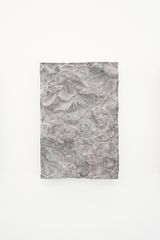
Emerging Topographies acts as a broad mapping of the emerging arts sector within Australia. By taking the practices of four artists as key data points, the exhibition offers an introduction to a new generation of artists that are pushing the boundaries of their medium and experimenting with new territories. Emerging Topographies focuses specifically on artists whose practice references topography - either through an exploration of form and surface or through a direct investigation of mapping of territory, land and data.
Orson Heidrich (b. 1996, Australia) is a mixed media artist whose practice spans across photography, video, sculptureand installation. Trained as a photographer, Heidrich uses theimage, photographic and videographic, as a starting point.The imagery is then reinterpreted via the application ofindustrial printing techniques onto diverse industrialmaterials such as steel, aluminium, copper, glass and mirror.The changing mediums alter the final reception andimpression of the same source imagery material. Sitting at thejuncture between sculpture and print, Heidrich’s works arehybrid objects.
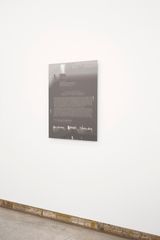
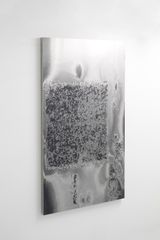
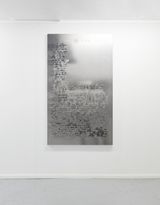
For Emerging Topographies, Heidrich presents the Multispec series - a body of work that is both tangible and immaterial asit comprises UV pigment prints on aluminium plates, UVpigment prints onto mirrors and augmented reality 3Dmodels. In the Multispec series, the source imagery Heidrichuses is derived from monochromatic information fieldsgenerated from 2–15kb sized thumbnails of misinterpreted,interpolated PDFs found through Google Images. Oncedetected by Google, these digital anomalies are periodicallyremoved and wiped from the internet where they were oncegenerated. Playing with pure data, the Multispec series is anaesthetic interpretation of an accidental internet by-product.Through the collection of the abstract data-debris andanomalies, the Multispec series can be read as a topography of an online space that is unseen by most.
Nabilah Nordin (b. 1991, Singapore) is a sculptor known for her amorphous, globby creations. Prolific in her production, her visual language bleeds into every aspect of her life. Nordin’s anarchic sculpturesand installations incorporate found objects and materials, giving her works a strangely uncanny senseof the familiar - forms that are simultaneously alien and human.In the exhibition, Nordin’s installation consists of a series of wonky constructions: haphazard combinations of discarded (and reused) wood, pulp, wire, cement, sand, wax and alginate dust, amongother things. This cacophony of natural and artificial materials are stuck, glued or brutishly screwedtogether. The sculptures, each with their own distinct personality, are composed from multiple layersslathered on top of each other, building form, texture and colour. Imitating the more traditionalsculptural form of ceramic or pottery, the assemblages are finally coated in layers of gloss or matte resin.This conservation process prevents decomposition and mirrors other preservation methods - such asmummification. In their embalmed forms, these sculptures seem wrenched from the earth’s crust,clumps of land or volcanic rock frozen in time and space by Nordin’s treatment.The six works sit perched atop a jaunty splattering of cardboard pieces. The cardboard has been soaked, torn up, mushed and reprocessed into organic forms before being sprayed with yellow linemarking spray paint. This paint is often used during construction work to demarcate space and defineboundaries - here, Nordin asserts her own territory within the context of this group exhibition.
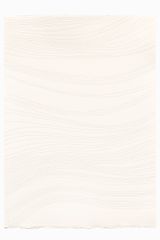
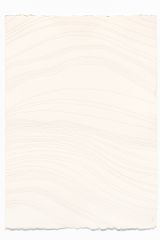
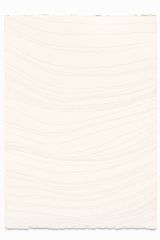
Stanislava Pinchuk is multidisciplinary artist exploring the boundaries of drawing, installation, tattooing, film and sculpture. Pinchuk surveys the ways in which landscape holds memory and testament of political events and violations of human rights. Using source materials of data, documentation, and detritus surveyed through field-work, Pinchuk’s critical practice reconsiders perceptions of geopolitical borders, migration, climate catastrophe and nuclear crises.Pinchuk presents a five-panel work consisting of pinhole drawings titled Data Study (Annual Mean Temperature Anomaly: Australia). This paper-based polyptych is a study of one of Pinchuk’s yet to beannounced projects; a public art commission taking the form of a climate data mural and a nightlyanimation that would be directly connected to the Bureau Of Meteorology data and change dailyaccordingly. In this delicate five-panel work, Pinchuk has translated, pinhole by pinhole, thousands ofdata points describing the changing patterns of Australian temperature. A meticulous, physicallydemanding and time-consuming creative process that highly resembles her home-made tattooingpractice. Data Study (Annual Mean Temperature Anomaly: Australia) is a poetic transcription of scientificfigures into an ocean of undulating waves.
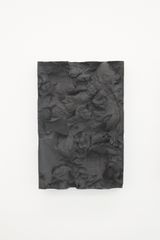
Kien Situ 司徒建 (b. 1990, Australia) works across sculpture and installation to explore the ideas of memory, cultural amnesia and identity in relation to constructed objects and built environments.Drawing upon both his diasporic Chinese-Vietnamese upbringing and his Eurocentric architecturaleducation, Situ creates objects which reinterpret his formative hybrid aesthetics. The incorporation ofink is foundational to Situ’s practice as part of his broader investigation into the interrelationshipsbetween geography and identity. The material associations of region-specific ink and colour providedeeply embedded connotations to time and place.For Emerging Topographies, Situ has created a suite of new sculptures whose auspicious dimensions are directly informed by the tradition of Chinese numerology. The dark forms take their colour from thealchemical mixing of industrial gypsum cement with Chinese Mò ink. Through a manual and labour-intensive casting process, Situ physically manipulates the cement mixture as it solidifies to createmovement and form. The stormy gradients, now frozen in time, become evocative of layers of geologicalstratum, or a distant birds eye view of landscape. These new works take visual cues from the naturalworld; the Shansui (Strata) series imitates a cross-section view of the earth’s crust, whereas the organictextures of the Shansui (Surface) series could easily be mistaken for volcanic rock. Situ’s abstractedforms are loaded with a psychological and formal resonance that links to the topographies of land,place and geography.


Ames Yavuz embraces its diverse cultural background through a strong international focus and perspective. The gallery’s vision is underpinned by robust curatorial practices that form the core of our program and foster intercultural discourse on a global scale.

A respected voice in contemporary art discourse.
Focusing on ambitious storytelling and insightful art-world commentary. Ocula Magazine publishes in-depth interviews, critical essays and timely analysis on the artists, exhibitions and ideas driving the global art world.
Learn more about Ocula Magazine
Showcasing the best of the art world.
Ocula partners with galleries from around the world to highlight their artists, artworks and exhibitions. Gallery membership is by application and invitation, with each member vetted by an independent panel.
Learn more about Ocula Membership

Specialises in the sale of major artworks.
Led by a team with deep ties to the world’s leading auction houses, galleries and collectors. Ocula’s advisory team offers bespoke services to high-net-worth clients from around the world who are looking to acquire the best of contemporary and modern art.
Learn more about our team and services