Press Release

Zilberman | Berlin is delighted to announce the solo exhibition Done with evil-doing of İz Öztat.

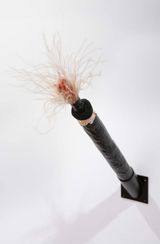
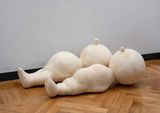
İz Öztat’s title cites the sentence with which Wilhelm Busch ends his graphic story Max and Moritz, a German classic from 1865. The exhibition includes an identically titled sculpture, which shows the two naughty boys lying next to each other, covered in felt shrouds—citing the penultimate scene from the book, where they are wrapped in bread dough and put in the oven, a precursor to their bitter end after one more prank. Finally, order is restored, punishment is meted out: Max and Moritz are ground in the mill and fed to the ducks: ‘Now we’re done with evil-doing.’ And ‘when all saw the fate they’d met, the villagers felt no regret.’ Max and Moritz was originally meant not as a tale for children, but rather as satirical parody, revealing the cold, harsh ethics of an authoritarian society, as well as the moral double standards applying to disobedience and punishment. İz Öztat pursues Busch’s line of harsh social criticism.

In her exhibition, Öztat picks up on the ambivalence laid out by Busch and adds to it other German-language narrative topoi drawn from the Kasperle puppet theatre and the Faust legend, with its theme of a pact with the devil. Here, too, the ostensible lesson is not unambiguous; it depends on who is perceived as evil-doer and who as victim, and whom the reader identifies with. Rather than morally neutralising the violence inherent in these stories, Öztat uses the traditional narrative material and themes to investigate how they are anchored in collective memory, co-opted by national ideologies, and continue to shape norms and modes of conduct in the present day. In so doing, she raises questions about artistic agency and complicity, obedience and disobedience, as well as demonisation and punishment.

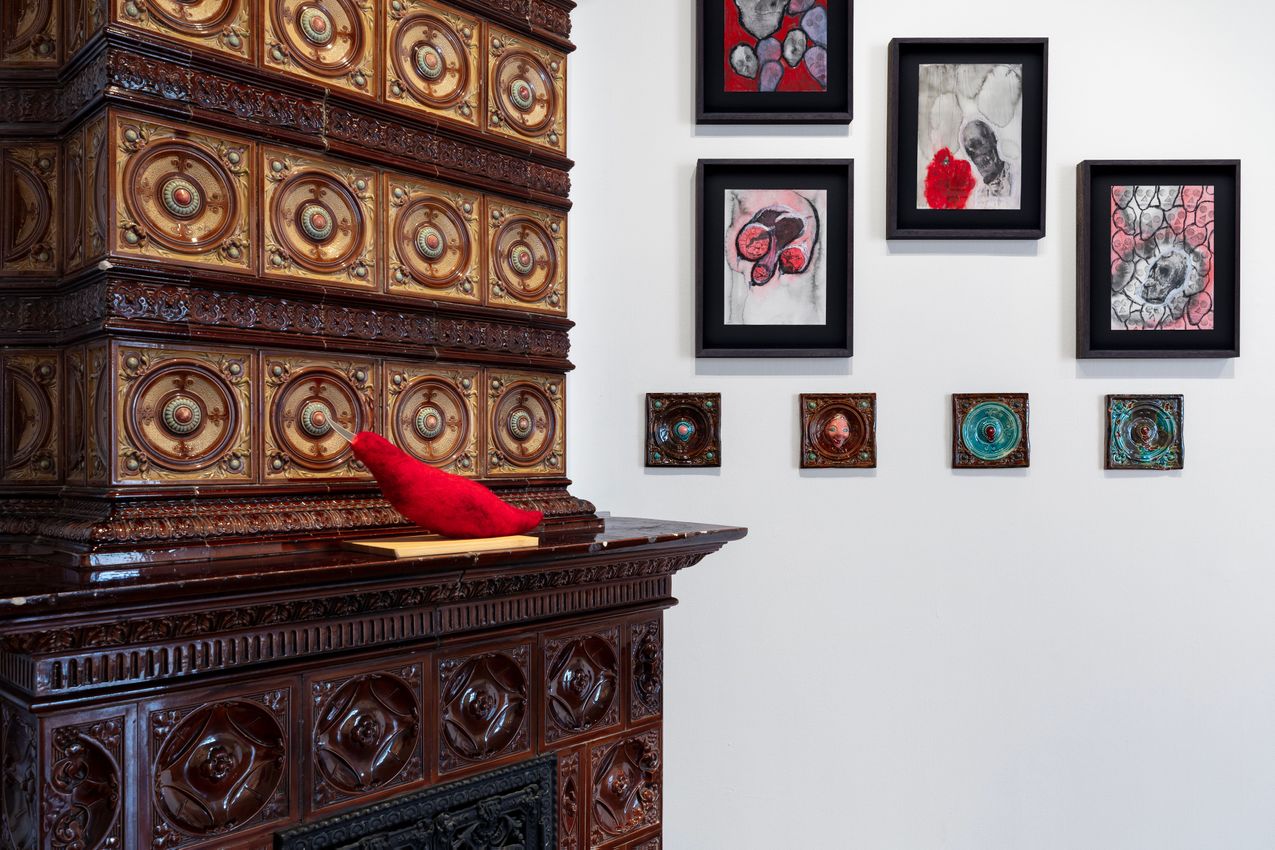
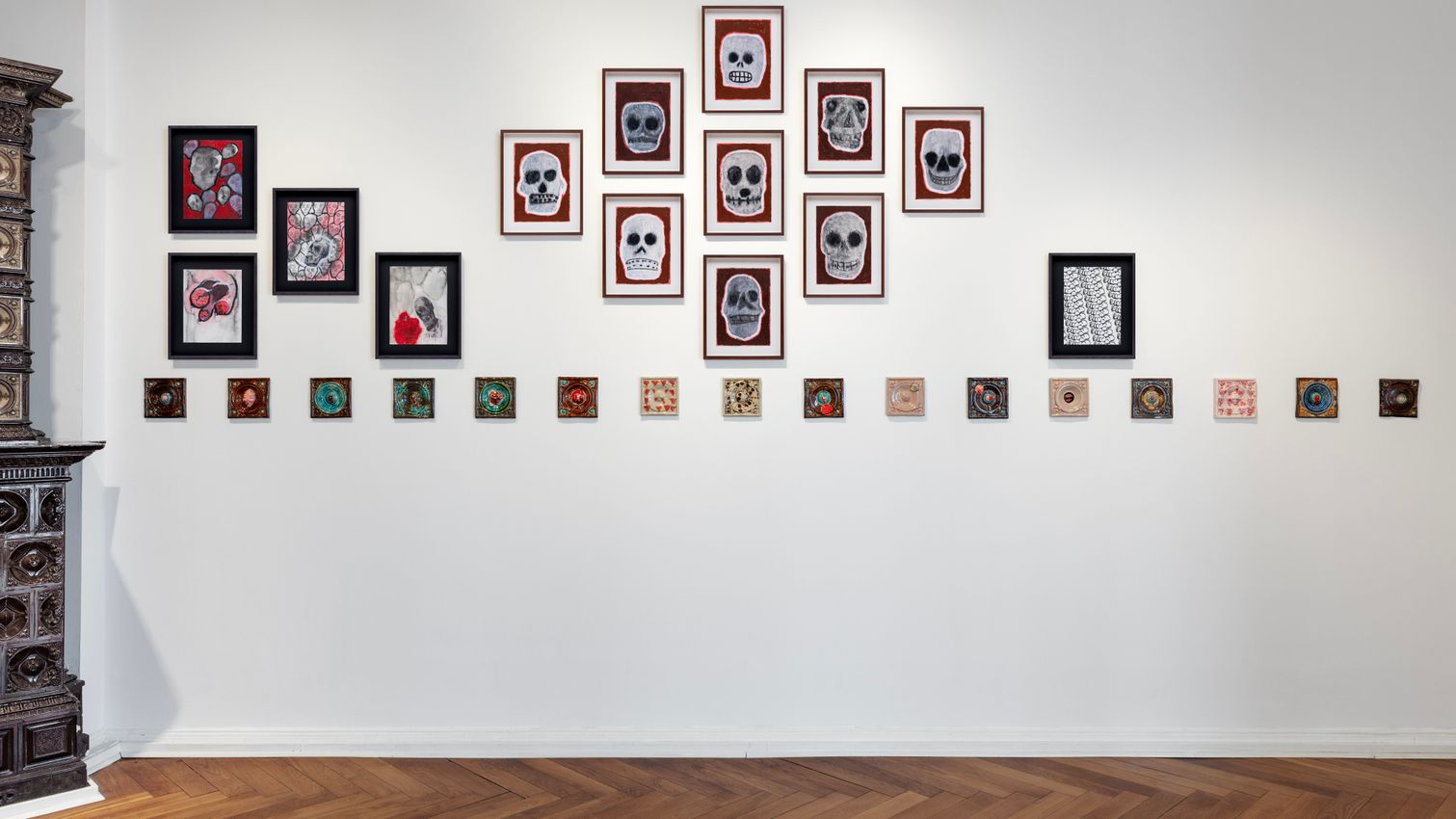
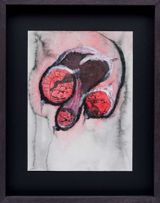
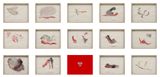
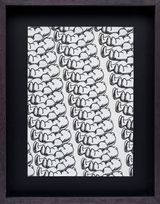
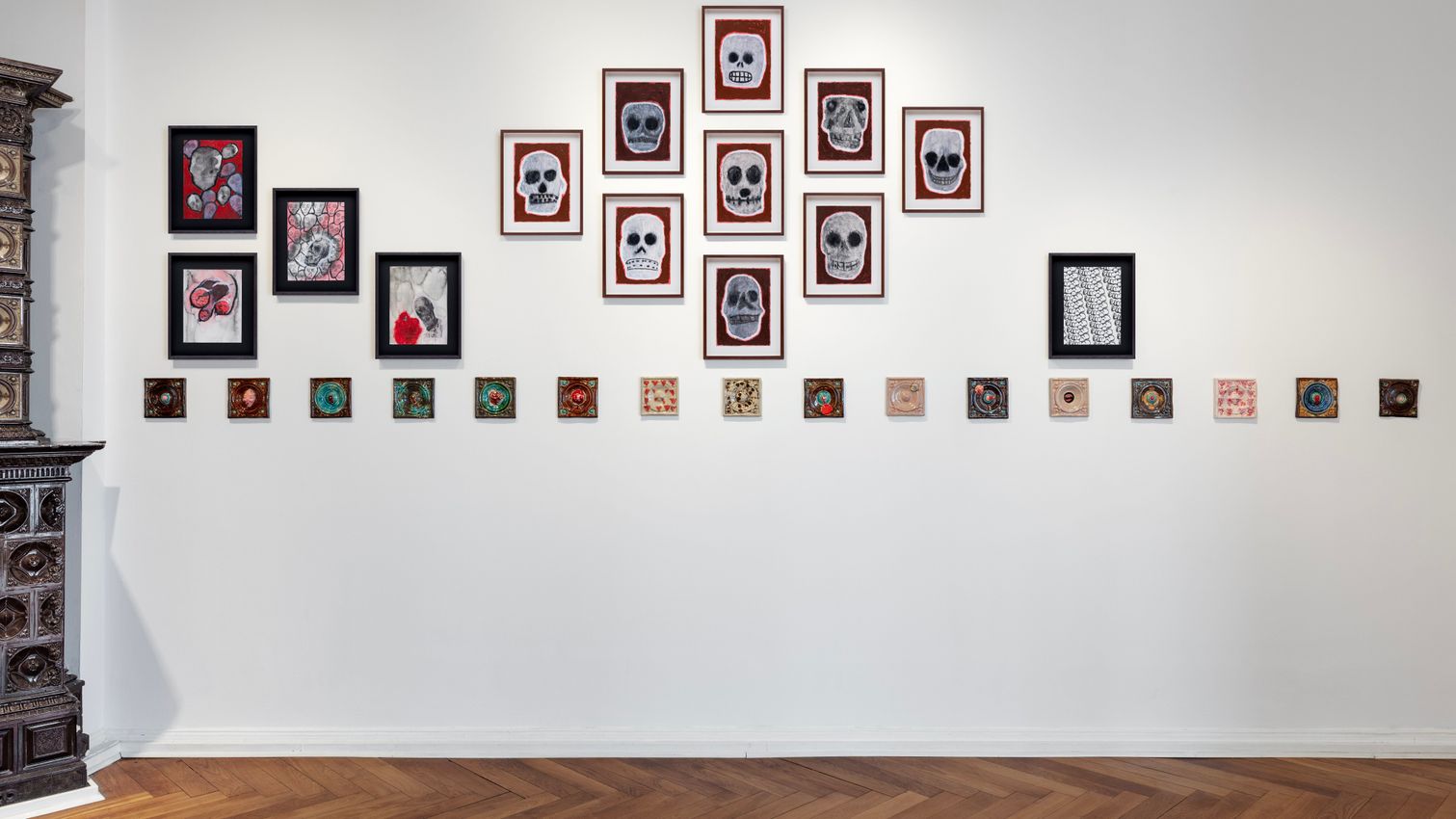
Öztat uses the bourgeois setting of the gallery—the parquet floors, stucco wall ornamentation, and brown tile stove of an old-Berlin building—as starting point. The tile stove is both a functional object and bearer of a decorative surface. In a site-specific body of work, İz Öztat engages with this decorative surface by recasting one of the tiles and exhaustively reinterpreting it. In some tiles, Öztat leaves the casting seams, usually sanded off by the artisan, visible, and thus infringes on the standard of a smooth, flawless façade. The devil is in the detail: in minute cracks, visible casting seams, a pair of devil’s horns jutting out. In other tiles, peep-holes appear, which—like the series of watercolours titled Surrender exhibited next to them—reveal fragmentary views of bodies in bondage and broken skin and thus encourage a playful interaction between desire, pain and control, as counter-image to the bourgeois rigidity of a voyeuristic gaze constrained within a strictly regulated moral regime.
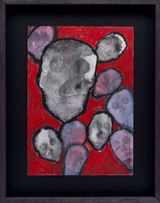
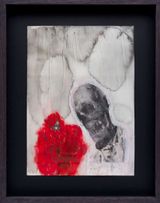
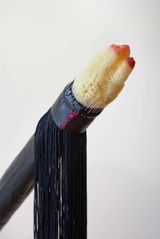
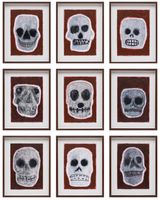
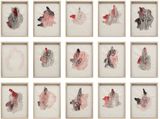
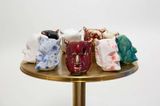
The Kasperle theatre is historically shaped by political instrumentalisation and as a pedagogical and ideological medium. Öztat is preocupied with two stock characters of the genre: Devil and Death. While both figures were subject to regulation by the German Reich Institut für Puppenspiel, founded in 1937, it was the Death puppet that disappeared from the ensemble and did not return. Öztat understands the enduring absence of Death as symptom of the repression that appears precisely in historical situations, in which state-sponsored violence is hushed up and mourning is prohibited. She conjures up the missing figure in a series of paintings titled Return of the Death Puppet. In various works in the exhibition, including the sculpture The Demons and The Demonized and a series of watercolours titled Studies on Evil, Öztat takes issue with racialised representations of the Devil in the hand puppets she collected.

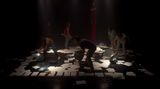
Öztat pursues the issue of repression and return in her video installation Rest (2024). Red tape marks, in the video as in space, borders, zones, and transitions. It makes reference to the staking out of territories, to inclusion and exclusion, to the regulation of movement and the room for maneouvre. With terse but weighty artistic means, the work rehearses an allegory of nation building and the exercise of power: the drawing of artificial lines, the top-down enforcement of authority, and submission—but also resistance, mobilisation, and the demand for justice. In collaboration with the performers Selim Cizdan, Yeşim Coşkun, Gökçe ‘CheChe’ Gürçay, Leyla Postalcıoğlu, Ra, Mihran Tomasyan and Aslıhan Tuna, Öztat works in a consciously defined Black Box—a protected internal space, to which she moves her work when the public space is increasingly restricted or oppressively regulated.

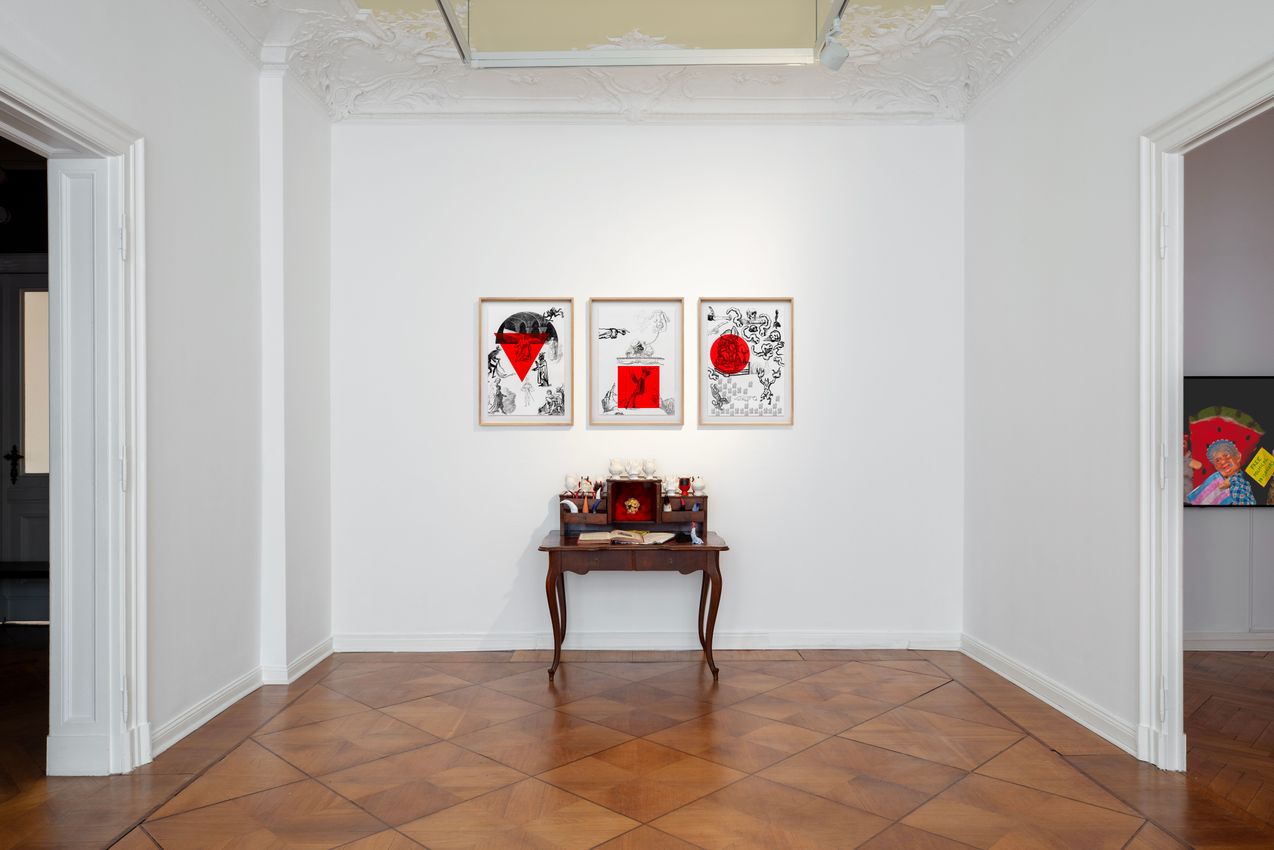
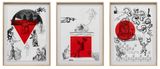
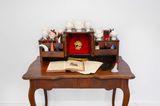
The bourgeois setting of the exhibition leads into a study. An old writing-desk evokes a space of knowledge production and seduction, in which power, desire, and cognition are interlocked. The triptych Studies for Faustian Bargain (2026) draws upon historical engravings and wood-cuts on the Faust legend, in particular illustrations to Goethe’s Faust. The various panels show the scholar in his study, as well as Mephisto, devils, and other allegorical motifs. Various hands intervene in the scenes—pointing, seducing, directing—as in a theatre of marionettes, thus representing Faust’s actions as directed from above and without agency. Faust moves between a thirst for knowledge, a vulnerability to influence, and abettal. Characteristic of a particular iconography that İz Öztat has developed over the years, red geometric forms appear. They establish viewing axes, allow for political associations, and frame Faust as a figure with limited leeway for discretion.

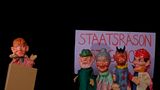
The red triangle re-appears in the video Here and Now, and After? (2025), in a humorous way, as the red, inverted triangle nose of a disobedient puppet. As a puppet play for the camera, this work deals with national narratives—what they leave out and repress—and ties conventions from the Kasperle theatre in to elements of Karagöz shadow plays. The show’s action develops from the playing out of three contractual relationships: the Faustian pact with the devil, the artist’s pact with the state, and the negotiation of erotic power-play. In these exchanges, consent, refusal, and negotiation—and thus questions relative to artists’ power to act, the institutional conditions of their work, and their accountability—become visible. Erotic power dynamics appear in Öztat’s work as forming a relational, consensual space of experience, in which desire and control become explicitly negotiable. While certain figures enter into agreements, others refuse to comply and demand justice on their own terms.

In Done with evil-doing, İz Öztat weaves her reflections on historical subject-matter and finely honed elements of her artistic practice together in a dense scenography. As in earlier works, such as her long-term collaboration with Zişan (1894–1970), who appears in Öztat’s work as a ghost and alter ego, she here draws upon archives and speculative narratives, in order to reveal those fractures in the historical material which continue to shape political and societal tensions to this day. In using satire as an artistic device, İz Öztat creates a space in which practices of resistance are made visible and questions of accountability and justice are re-negotiated.

Press release courtesy Zilberman. Text: Lotte Laub. Translation: Darrell Wilkins.

Read More

Installation Views

Selected Works

Loading...
About the Artist

In her collective and individual artistic practice spanning diverse media defined by her reseach, İz Öztat explores the persistence of violent histories through forms, materials, space and language. She responds to absences in official historiography through spectral, intergenerational and speculative fictions. İz Öztat fabricates the (auto)biography of Zişan (1894-1970), who appears to her as a historical figure, a ghost, and an alter ego. She takes on Zişan’s archives and interprets them through her practice to construct a complex temporality of action that enables the suppressed past to intervene in the increasingly authoritarian present. The values and methodologies driving her practice have been articulated in relation to struggles against the taming of running waters for profit and progress, queer desire and consensual negotiation of power.

View Artist Profile

Also Exhibiting at Zilberman

About the Gallery

Zilberman Gallery, founded in Istanbul in 2008, stages 10–12 exhibitions every year at its main gallery spaces in Istanbul and Berlin and at the project space. The gallery occupies two separate floors of Mısır Apartment, one of the most famous examples of art nouveau architecture in Istanbul.

View Gallery Profile
Address
Goethestr. 82
Berlin

Germany
Opening Hours
Tuesday – Saturday
11am – 6pm
(1)
Berlin Goethestr. 82
Zilberman
Goethestr. 82, Berlin, Germany
+49 (0) 30 31809900
http://www.zilbermangallery.com

Opening hours
Tuesday – Saturday
11am – 6pm
The art world in focus