





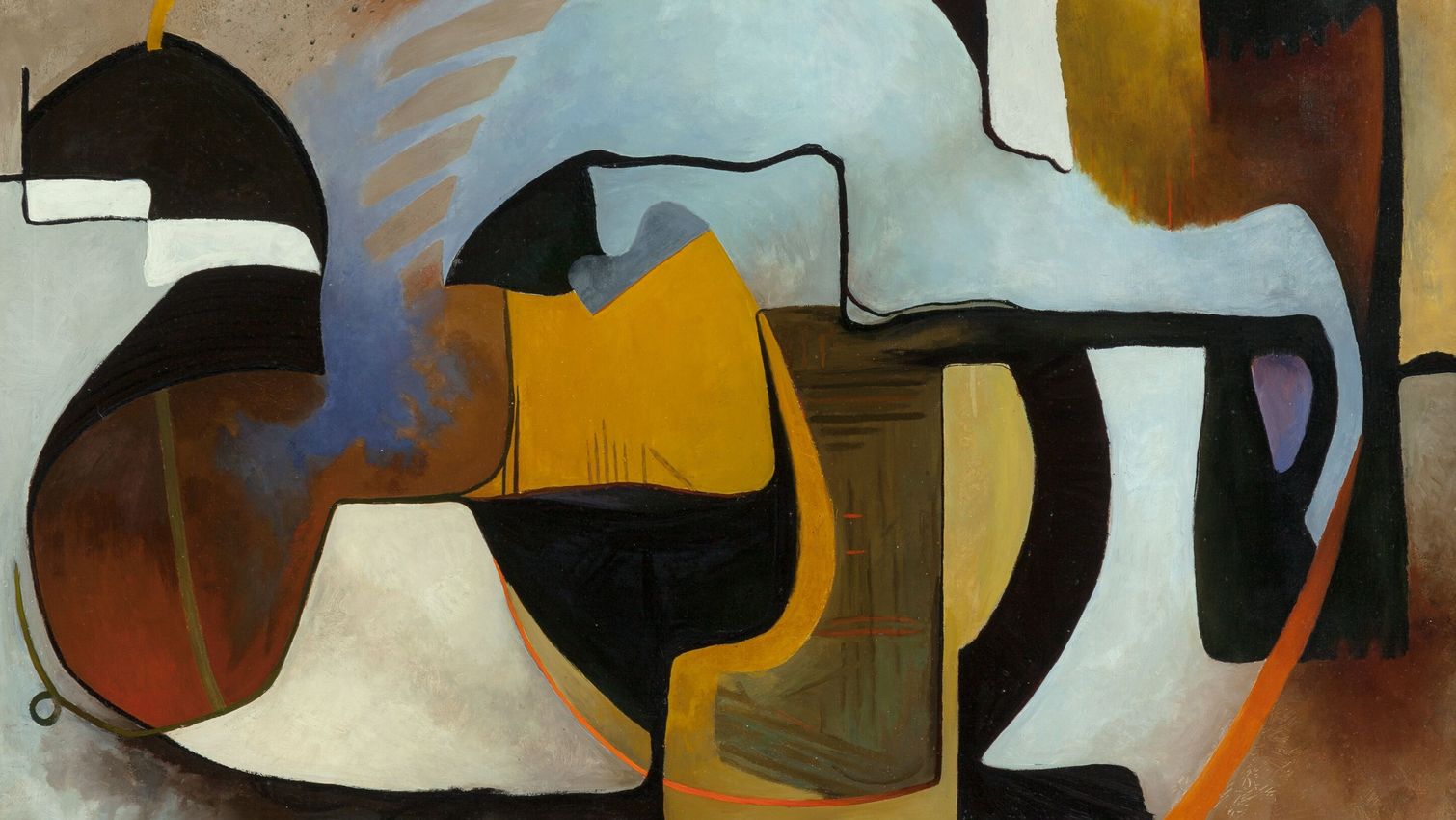
ALICE TRUMBULL MASON
1904-1971, United StatesAlice Trumbull Mason was a pioneering American abstract artist whose architectonic, geometric paintings and prints helped define the trajectory of 20th-century contemporary art. A founding member of the American Abstract Artists group, Mason’s commitment to non-objective art and her leadership in the promotion of abstraction established her as a central figure in American art history. Her work has been celebrated in major retrospectives, including at the Whitney Museum of American Art, and is now represented by Galerie Lelong & Co., New York, in collaboration with the Emily Mason and Alice Trumbull Mason Foundation.
Early Years
Born in Litchfield, Connecticut, in 1904, Alice Trumbull Mason was a direct descendant of the 18th-century painter John Trumbull. She spent part of her youth in Italy, studying at the British Academy in Rome in 1921–1922. On her return to the United States, Mason continued her studies at the National Academy of Design with Charles Hawthorne, and later at the Grand Central School of Art in New York, where she was influenced by Arshile Gorky. Travels in Italy and Greece in the late 1920s exposed her to archaic Greek sculpture and Byzantine mosaics, which would become enduring influences in her art.
Mason married Captain Warwood Mason in 1930 and had two children, Emily Mason—who also became a noted painter—and Jonathan Mason. After a period focused on poetry and literary correspondence, including with Gertrude Stein, Mason returned to painting and became a leader in the American Abstract Artists group, serving as treasurer, secretary, and president.
Alice Trumbull Mason Artworks
Alice Trumbull Mason’s artworks are defined by their evolution from biomorphic abstraction to geometric, architectonic compositions. Her approach to art was grounded in a belief in the expressive potential of materials and the construction of form, rather than representation.
Early Abstraction and Biomorphic Forms (1920s–1930s)
In the late 1920s and early 1930s, Mason’s work featured biomorphic forms and expressive lines, influenced by European modernism and Surrealism. She was the only artist to exhibit abstract work at the 1935 Washington Square Art Show in New York, marking her early commitment to abstraction.
Geometric and Architectural Abstraction (1940s–1960s)
By the 1940s, Mason shifted to geometric abstraction, influenced by Piet Mondrian and Constructivism. Paintings such as Latitude of Identical Shapes (1947) and her later works display her signature “architectural abstraction,” characterised by interlocking forms, rhythmic patterning, and a restrained palette. Her work diverged from the gestural style of Abstract Expressionism, focusing instead on structure and harmony.
Printmaking and Woodcuts
In 1945, Mason began working at Atelier 17 in New York, the experimental printmaking studio founded by Stanley William Hayter. There, she explored intaglio techniques, extending her abstract vocabulary into graphic media. In 1952, she began making woodcuts, distilling her compositions into sharp, interlocking forms and dynamic rhythms. The woodcut medium allowed her to emphasise contrast, symmetry, and spatial tension, resulting in works that are both architectural and expressive.
Select Awards and Accolades
- Charles M. Lea Prize, The Print Club, Philadelphia (1946)
- Treasurer’s Prize, The Society of American Graphic Artists (1948)
- The Longview Foundation, painting purchased for the Walker Art Center, Minneapolis (1963).
Exhibitions
Alice Trumbull Mason has been the subject of both solo exhibitions and group exhibitions at important institutions. Below is a selection.
Solo Exhibitions
- Alice Trumbull Mason: Retrospective, Whitney Museum of American Art, New York (travelled), 1973–1974
- Solo Exhibition, Museum of Living Art, New York, 1942
Group Exhibitions
- Labyrinth of Forms: Women and Abstraction, 1930–1950, Whitney Museum of American Art, New York, 2021–2022
- Signs & Symbols, Whitney Museum of American Art, New York, 2012
- Transitions at Mid-Century, Works on Paper 1945–1955, Whitney Museum of American Art, New York, 2002
- 1955 Annual Exhibition of Contemporary American Painting, Whitney Museum of American Art, New York, 1955–1956
- 1953 Annual Exhibition of Contemporary American Painting, Whitney Museum of American Art, New York, 1953 __
- 1951 Annual Exhibition of Contemporary American Painting, Whitney Museum of American Art, New York, 1951–1952
- 1938 Annual Exhibition of Contemporary American Painting, Whitney Museum of American Art, New York, 1938
Website
Alice Trumbull Mason’s legacy is managed by the Emily Mason & Alice Trumbull Mason Foundation (ematm.org).
Alice Trumbull Mason FAQs
Where can I see Alice Trumbull Mason’s work?
Her artworks are held in major public collections, including the Whitney Museum of American Art, the Museum of Modern Art, the Metropolitan Museum of Art, the Philadelphia Museum of Art, the Hirshhorn Museum and Sculpture Garden, and the Solomon R. Guggenheim Museum. Her work is also shown at Galerie Lelong & Co., New York.
What artistic movement is Alice Trumbull Mason associated with?
She is a foundational figure in American geometric abstraction and a leading member of the American Abstract Artists group, known for her architectonic, non-objective paintings.
What is distinctive about Alice Trumbull Mason’s style?
Her style evolved from biomorphic abstraction to geometric, architectonic compositions, marked by a focus on structure, line, and the expressive potential of materials.
How did Mason influence the art world?
Mason was a leader in the American Abstract Artists group, advocating for abstraction and mentoring younger artists. Her organisational work and commitment to non-objective art were instrumental in gaining recognition for abstraction in the United States.
What are some interesting facts about Alice Trumbull Mason?
She was the only artist to show abstract work at the 1935 Washington Square Art Show. Her daughter, Emily Mason, also became a prominent painter. Mason corresponded with literary figures such as Gertrude Stein and William Carlos Williams, and her poetry was an important part of her creative life.
How do you pronounce her name?
Her name is pronounced: ‘AL-iss TRUM-bull MAY-sun’.
Ocula | 2025

Explore and Follow Artists Shaping Contemporary Art
A respected voice in contemporary art discourse.
Focusing on ambitious storytelling and insightful art-world commentary. Ocula Magazine publishes in-depth interviews, critical essays and timely analysis on the artists, exhibitions and ideas driving the global art world.
Learn more about Ocula Magazine
Showcasing the best of the art world.
Ocula partners with galleries from around the world to highlight their artists, artworks and exhibitions. Gallery membership is by application and invitation, with each member vetted by an independent panel.
Learn more about Ocula Membership
Specialises in the sale of major artworks.
Led by a team with deep ties to the world’s leading auction houses, galleries and collectors. Ocula’s advisory team offers bespoke services to high-net-worth clients from around the world who are looking to acquire the best of contemporary and modern art.
Learn more about our team and services