





A Sunday Afternoon with Andrew Cranston at the Musée D’Orsay
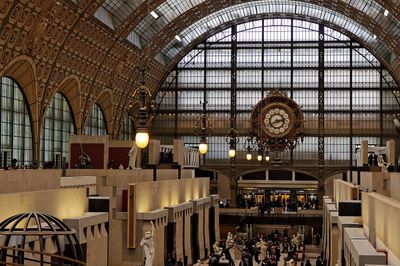
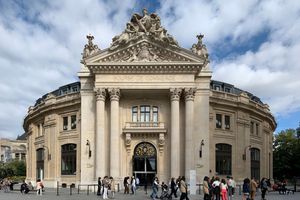
Musée D'Orsay lobby. CC-BY-SA 3.0. Photo: Thesupermat.


‘I haven’t been here in 20 years,’ Andrew Cranston laughs. ‘It’s the queues.’
The Glasgow-based painter is standing beneath the clock in the main hall of the Musée d’Orsay. Some 100 years ago, it kept time for the legions of travellers chuffing in and out of the Beaux-Arts railway station on trains heading to and from southwestern France. Today, the clock face has the privilege of keeping an eye on the rotating collection of largely Impressionist and Post-Impressionist masterpieces that inhabit the Paris museum, and all those that come to bask in them.
On a Sunday afternoon in October, Cranston is visiting with his wife, fellow painter Lorna Robertson. They are in town for Cranston’s solo exhibition at Modern Art, so we joined forces and headed into the Musée d’Orsay to get his perspective on some of France’s art-historical greats.

Pierre Bonnard, Femme assoupie sur un lit (The Indolent Women) (1899)
Every time he has a bath, Cranston thinks about Pierre Bonnard. He’s definitely not the only one. The French Post-Impressionist painter is a pin-up for many artists working today: for the way he conveys movement in every stroke, captures the lushness of differing lights, and evokes a dreamlike wonderland.
It’s one of Bonnard’s early works, however—a 1889 oil on canvas titled Femme assoupie sur un lit (The Indolent Women)—that catches Cranston’s eye.
‘His early paintings are perhaps not as loved as the later ones.’ Cranston notes. ‘The colours are duller, and they’re darker tonally as opposed to his later style, which is more in line with Impressionism.’
One of the first nudes Bonnard ever painted, the work depicts a woman reclining on an unmade bed, her left foot hooked up on her right thigh, legs splayed. One arm is tucked behind her mop of hair while the other clutches at her chest.
‘This painting makes me think of my 20s,’ Cranston explains. ‘Working in freezing studios in the wee small hours, living in cheap bedsits, existing on toast and marmite, accepting a certain laxness—indolence, some would say—having not much money, but lots of time. That’s what I see in this painting: time.’
In January 2025, Ingleby Gallery will stage a group show centred on Bonnard, featuring paintings by the historic artist, alongside contemporary artists including Cranston, Lorna Robertson, and Chantal Joffe, among others.
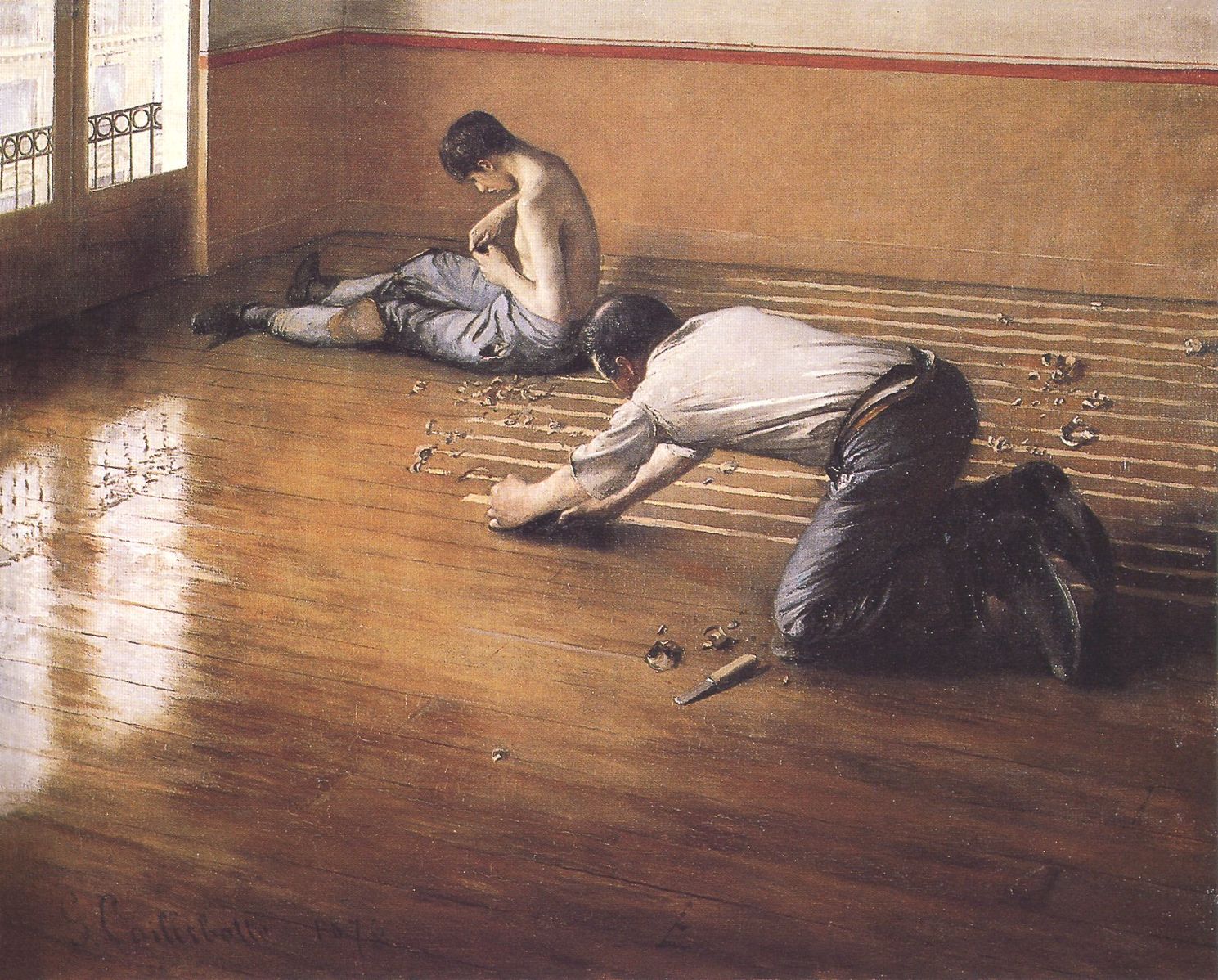
Gustave Caillebotte, Les raboteurs de parquet (The Floor Scrapers) (1876)
It’s for the Caillebotte show that the queues really do need to be braved—albeit for good reason. Titled Caillebotte: Painting Men (8 October 2024–19 January 2025), the exhibition showcases around 70 works—paintings, pastels, sketches, and photographs—centred on masterpieces such as Young Man at His Window (1876) and Paris Street; Rainy Day (1877).
As we head in, Cranston’s gaze immediately falls on Les raboteurs de parquet (The Floor Scrapers) (1876), but perhaps not the version you’re familiar with. Instead, we’re standing in front of a later canvas that Caillebotte painted in retort to the former being rejected by France’s most prestigious art exhibition, the Paris Salon, in 1875.
‘I saw this painting when I first visited Paris aged 18 and it really spoke to me,’ Cranston explains. ‘I was working as an apprentice to a joiner at the time, and being taught by older men, some near to retirement,’ he adds. ‘These men measured in inches and counted in twelves, and they complained about their shoulders, hips, and especially their knees after a lifetime of kneeling down on wooden floors.’
The wooden floor in Caillebotte’s painting belongs to a bourgeois Parisian apartment, and the men—one middle-aged, the other young—could be read as master and apprentice, or perhaps as father and son. One of the first representations of the French urban proletariat by an Academician, the original painting had shocked the Salon’s jurors, who deemed the depiction of working-class labourers performing their trade a ‘vulgar subject matter’.
‘The subject of the painting could be space itself, our eye is moved from the front to the back,’ Cranston notes. ‘There’s a minimalism and an economy to it. There are also big areas of the painting where you could say nothing much is happening, but, of course, it very much is.’
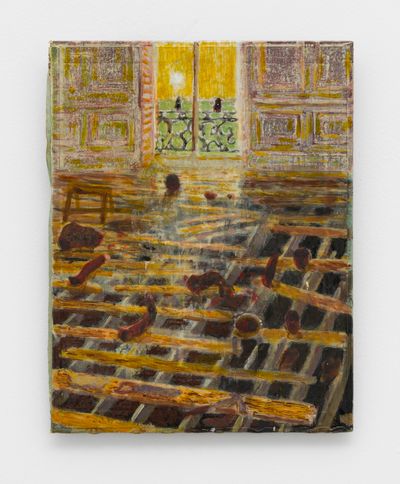
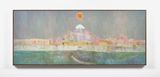
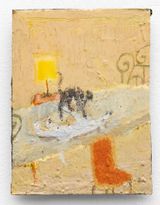
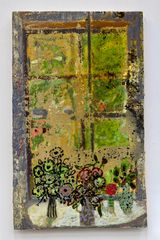
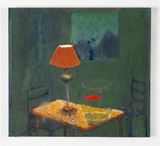
A trip across Paris to Cranston’s solo show at Modern Art later that afternoon makes clear Caillebotte’s influence. The exhibition, titled Thoughts from under the floorboards (13 October–16 November 2024), lines the walls of the Hausmann-style building with a series of paintings on hardback book covers. One, The Apartment (Tell-tale heart) (2024)—an abstract painting of a light-filled apartment with upended floorboards—provides a portal to these two masterpieces painted nearly 150 years ago.
Henri de Toulouse-Lautrec, La danse mauresque (Moorish Dance) (1895)
‘What a spectacular painting this is! Or is it what R.B. Kitaj called a “drawing-painting”? Perhaps it’s somewhere in between. Kitaj highlighted [Edgar] Degas as the supreme example of this,’ says Cranston. ‘But, for me, it’s [Henri de] Toulouse-Lautrec.’
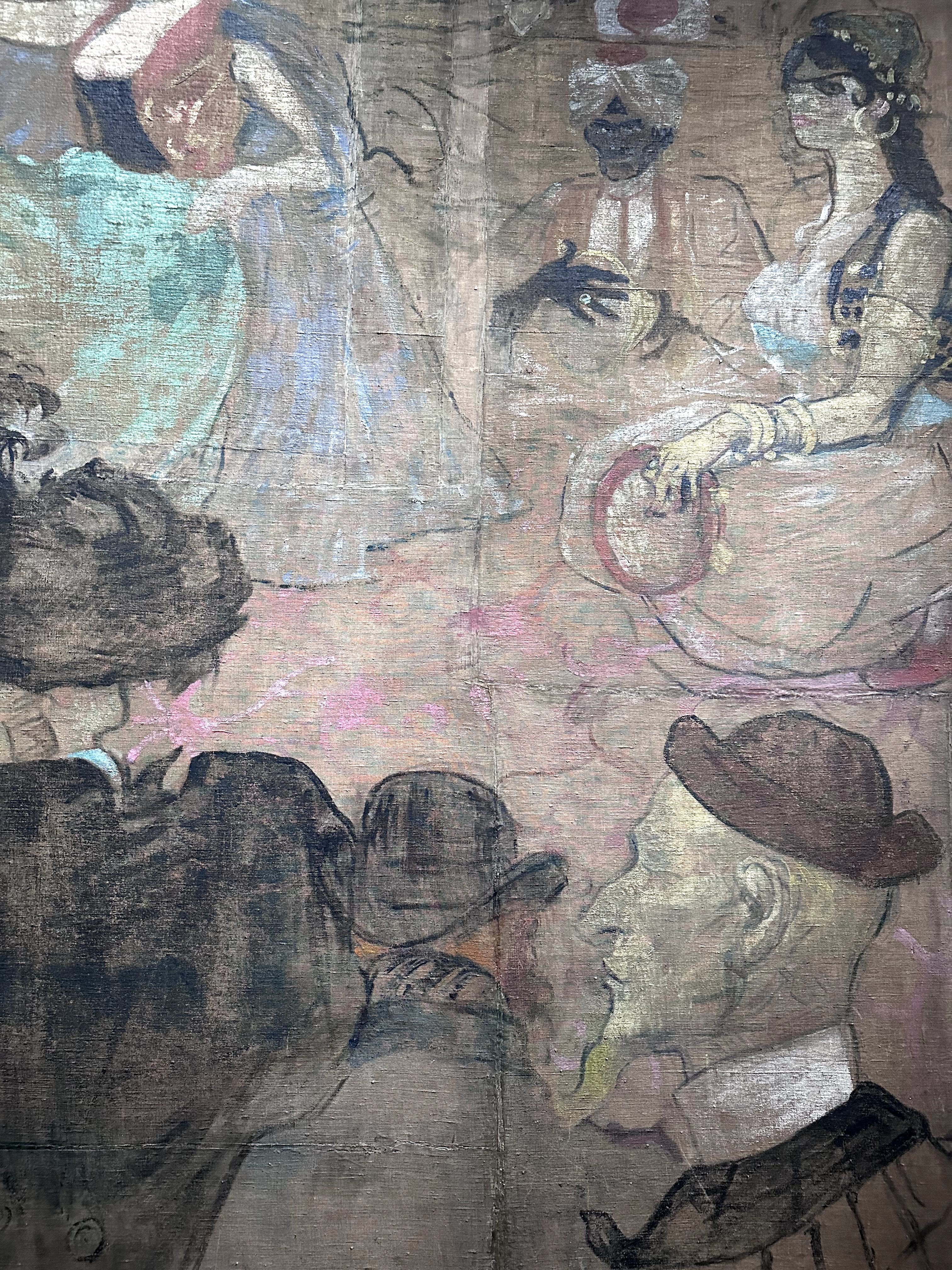
At three by three metres, it is definitely spectacular, made all the more so when you discern the cast of characters at eye level: Oscar Wilde, Toulouse-Lautrec himself, and La Goulue, the stage name of Louise Weber, the French can-can dancer who was the star of the Moulin Rouge.
But it’s the way Toulouse-Lautrec pastes sections of the canvas together—rupturing the reading of the image—which draws Cranston in. It’s a strategy that he employs in his own work.
Cranston paints on torn-off book covers, enabling viewers to see the grain beneath the painted image or, rather, the inner page curling under the moisture of his brush. But, like Toulouse-Lautrec, his paintings’ idiosyncrasies—the cracks, the wear, the tone of the canvas beneath—play into the irradiance and character of the overall composition.
‘The tension between image and surface is simultaneously subtle yet brutally raw, almost shocking,’ Cranston notes. ‘You can only imagine how this must have looked to a viewer 100 years ago.’ —[O]
Selected Artworks by Andrew Cranston
Main image: Musée D'Orsay lobby. CC-BY-SA 3.0. Photo: Thesupermat.









A respected voice in contemporary art discourse.
Focusing on ambitious storytelling and insightful art-world commentary. Ocula Magazine publishes in-depth interviews, critical essays and timely analysis on the artists, exhibitions and ideas driving the global art world.
Learn more about Ocula Magazine
Showcasing the best of the art world.
Ocula partners with galleries from around the world to highlight their artists, artworks and exhibitions. Gallery membership is by application and invitation, with each member vetted by an independent panel.
Learn more about Ocula Membership
Specialises in the sale of major artworks.
Led by a team with deep ties to the world’s leading auction houses, galleries and collectors. Ocula’s advisory team offers bespoke services to high-net-worth clients from around the world who are looking to acquire the best of contemporary and modern art.
Learn more about our team and services