






BILL HAMMOND
b. 1947, New ZealandBill Hammond was a painter and printmaker known for his Surrealist and post-colonial paintings—inspired by drugs, rock music, and Pacific history—that ambiguously commented on decadent suburban lifestyles and environmental calamity.
Early Life
Raised in Christchurch, Hammond attended Ilam School of Fine Arts at the University of Canterbury over the period of 1966 to 1969. After working a few years as a sign maker, toymaker, musician, and jewellery designer, and participating in the occasional group show, he had his first solo exhibition in 1982 in Christchurch with the Brooke Gifford Gallery. He then had his first Auckland exposure at DKD Café in 1985, and his first Peter McLeavey exhibition in Wellington in 1987.
Bill Hammond Artworks
Earlier Paintings
After initially absorbing a wide range of influences as far apart as Jim Nutt, Francisco Goya, Giorgio de Chirico, and Tony Fomison, Hammond’s early paintings emerged depicting violently distorted block-headed figures in surreal suburban settings, celebrating the sounds and stimulants of rock culture and bemusedly observing the ‘straight’ ethos. See, for instance, The Worry Index (1984), The Young Designers (1985), and Headset 1 & 2 (1989).
These earlier paintings are deliberately rough and raw in their paint application, and because of their extreme angles of perspective, have an abstracted gestural ambience—though often mixed with chanted lyrics from rock music. As Hammond made more works, the images became more intricate and finely detailed, embracing groups of silhouettes, staccato patterns, and extreme spatial distancing.
Hammond also incorporated small paintings, charts, and diagrams within bigger paintings, much in the manner of comics like Beano or MAD. Examples include Endangered Species (1991) and Piano Forte (1992). They become compositionally more complex. They also began small but became large, often being painted on flexible supports like big canvas blinds.
Later Paintings
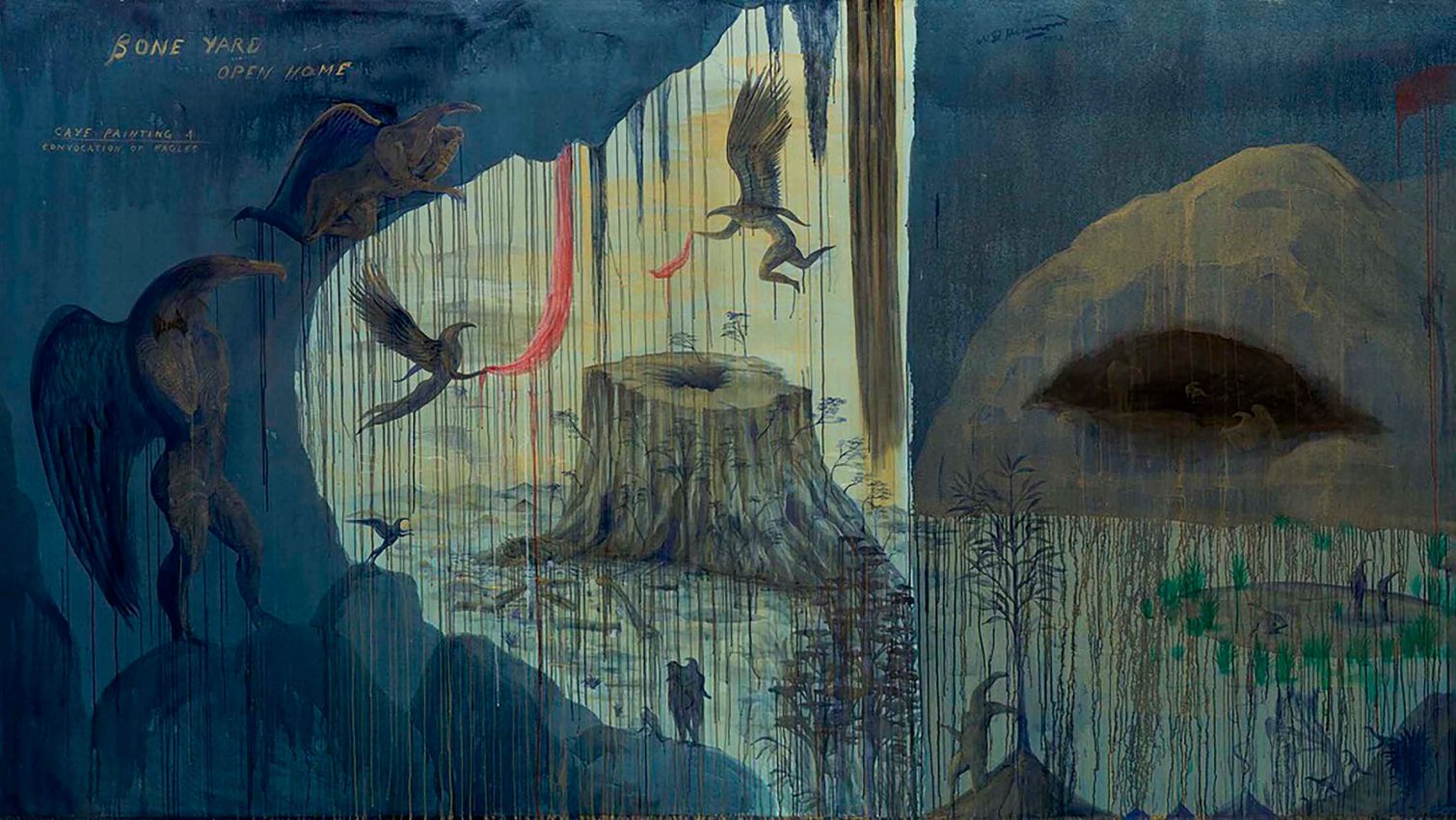
In 1989 Hammond visited the remote Auckland Islands in a trip organised for artists, and was profoundly affected by the primal landscape and winged wildlife. It changed his work, impacting gradually over several years. The settings for his paintings moved outdoors, away from the claustrophobic neurotic mood of rubbery sitting rooms and angular bedrooms.
Strutting or marching figures and buildings were replaced by avian wildlife nesting on cliffs or in dense bush, vertical creatures half-bird, half-human, that as sentinels standing amid dripping bush/paint alluded to ghosts or ancestral spirits. Examples of this work include Walter Buller Blind (1994), Placemakers I (1996), and Zoomorphic Lounge III (1999).
Hammond’s colours became less acidic, less vibrant or complementary, shifting instead to darker and more ominous tones, while his rendering of creaturely forms and vegetation became virtuosic, elegant, and lyrical. His subject matter, once stoner, anarchic, and frenetic, now shifted to a contemplative fascination with Pacific history, ecological issues, and post-colonial planetary alarm. While there is a musicality common to both periods, now the mood became elegiac and melancholic: much more serious and academic. See Living Large 6 (1995), Headboard (1996), and Blood Bin, Sin Bin (1998).
Exhibitions
Bill Hammond has featured in both solo and group exhibitions. Significant solo exhibitions include Playing the Drums, Christchurch Art Gallery Te Puna o Waiwhetū (2019); Selected Works from a Private Collection, Gus Fisher Gallery, Auckland (2016); Bill Hammond: Jingle Jangle Morning, Christchurch Art Gallery Te Puna o Waiwhetū (2007); Bill Hammond: 23 Big Pictures, Dunedin Public Art Gallery (1999); W.D. Hammond, Gregory Flint Gallery, Auckland (1994).
Significant group shows include Hangover: 1995—1996, Dunedin Public Art Gallery (1995); Headlands: Thinking Through New Zealand Art, Museum of Contemporary Art Australia, Sydney (1992); and Distance Looks Our Way: Ten Artists from New Zealand, Sarjeant Galley, Whanganui (1991).
Hammond’s work is held by major collections throughout New Zealand, including Te Papa Tongarewa Museum of New Zealand, Wellington; Auckland Art Gallery Toi o Tāmaki; Christchurch Art Gallery Te Puna o Waiwhetū; Dunedin Public Art Gallery; Chartwell Collection of Contemporary Art, Auckland; and Jenny Gibbs Collection, Auckland.
John Hurrell | Ocula | 2021


Explore and Follow Artists Shaping Contemporary Art
A respected voice in contemporary art discourse.
Focusing on ambitious storytelling and insightful art-world commentary. Ocula Magazine publishes in-depth interviews, critical essays and timely analysis on the artists, exhibitions and ideas driving the global art world.
Learn more about Ocula Magazine
Showcasing the best of the art world.
Ocula partners with galleries from around the world to highlight their artists, artworks and exhibitions. Gallery membership is by application and invitation, with each member vetted by an independent panel.
Learn more about Ocula Membership
Specialises in the sale of major artworks.
Led by a team with deep ties to the world’s leading auction houses, galleries and collectors. Ocula’s advisory team offers bespoke services to high-net-worth clients from around the world who are looking to acquire the best of contemporary and modern art.
Learn more about our team and services