





BRICE MARDEN
1938-2023, United States‘Ultimately I’m using the painting as a sounding board for the spirit. . . . You can be painting and go into a place where thought stops—where you can just be and it just comes out. . . . I present it as an open situation rather than a closed situation.’—Brice Marden
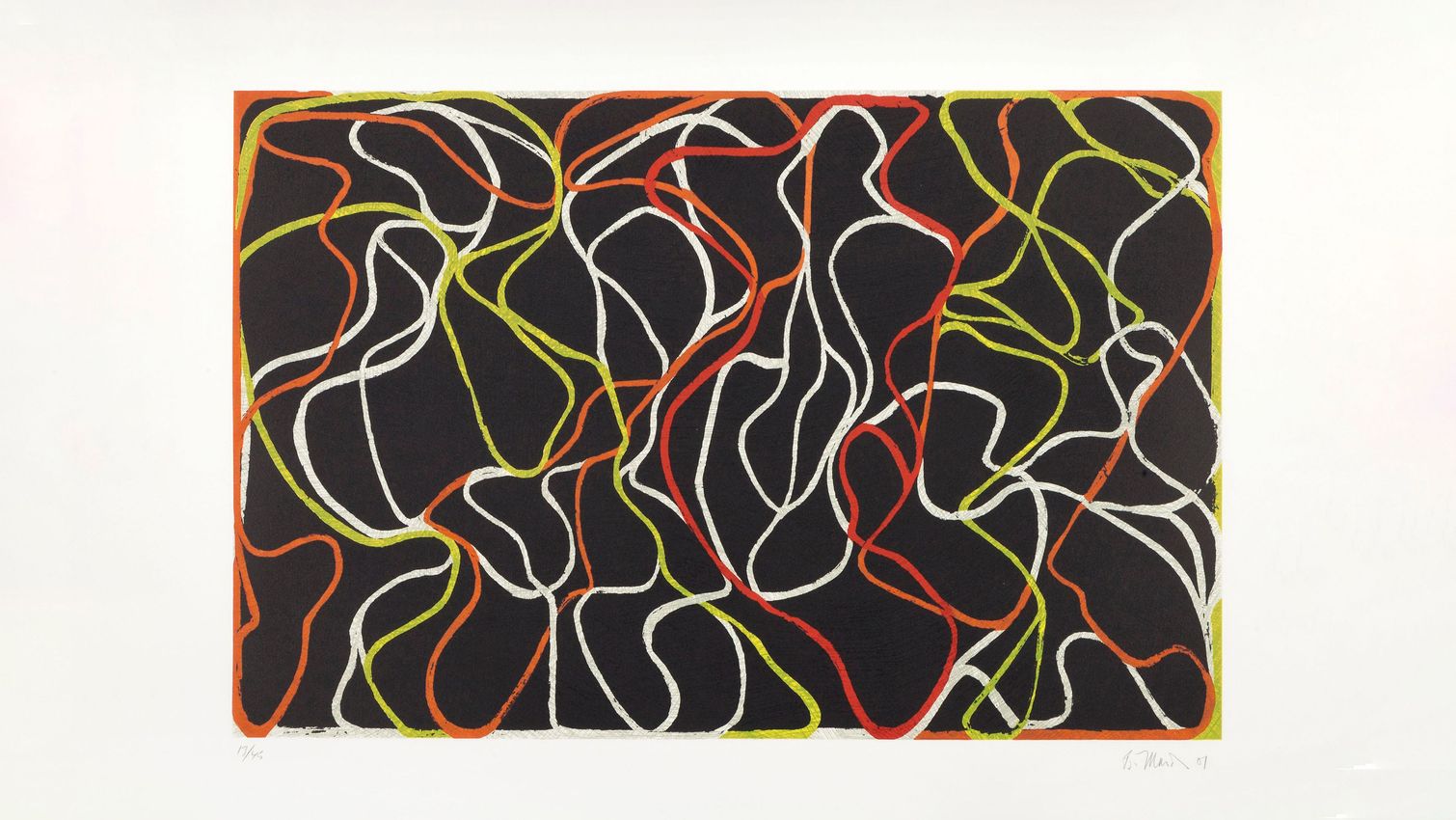
Brice Marden continuously refines and extends the traditions of lyrical abstraction. Experimenting with self-imposed rules, limits, and processes, and drawing inspiration from his extensive travels, Marden brings together the diagrammatic formulations of Minimalism, the immediacy of Abstract Expressionism, and the intuitive gesture of calligraphy in his exploration of gesture, line, and colour.
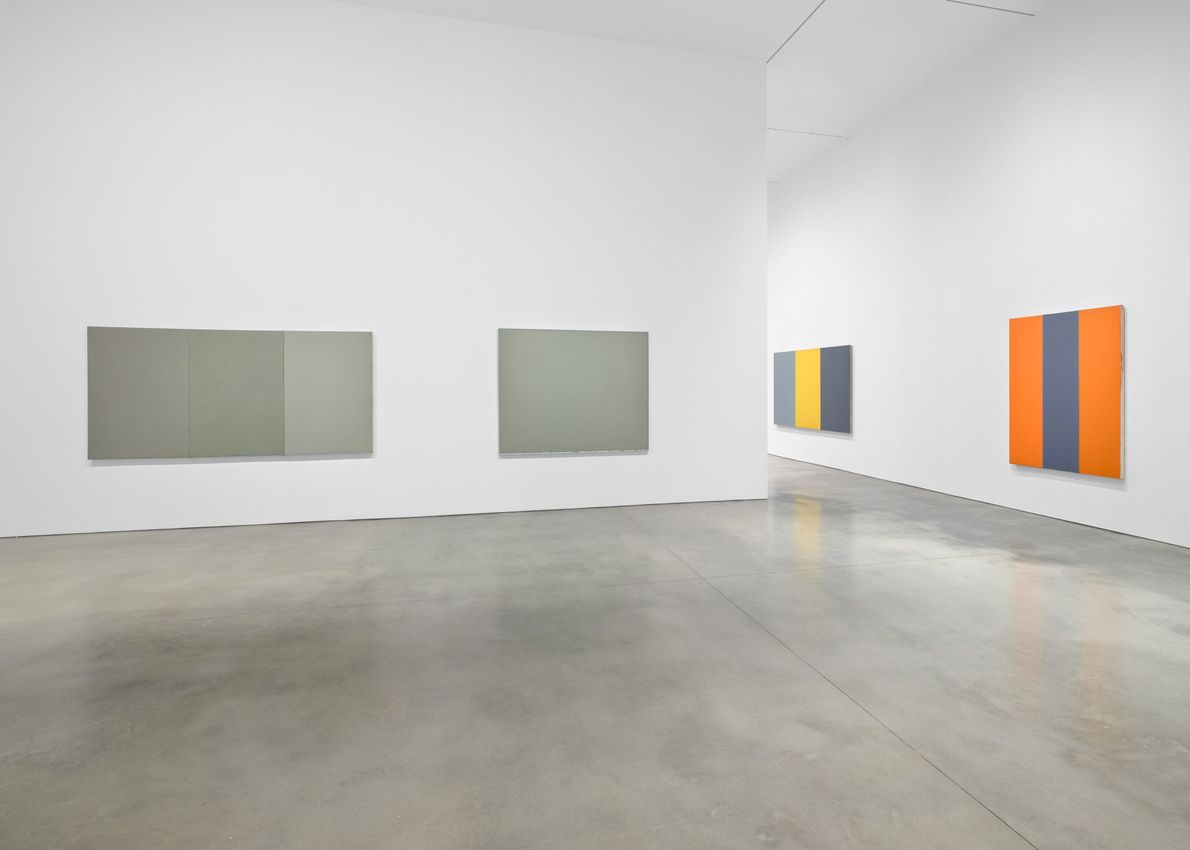
In 1963 Marden received an MFA from Yale University’s School of Art and Architecture, where his teachers included the painters Alex Katz and Jon Schueler. After graduation he worked as a guard at the Jewish Museum in New York. There, during a 1964 Jasper Johns retrospective, Marden studied Johns’s early works extensively and considered them in relation to the Baroque masters he has long admired, such as Francisco de Zurbarán, Francisco Goya, and Diego Velázquez. Marden’s works from the 1960s include subtle, shimmering monochromes in grey tones, sometimes assembled canvases into multipanel works, in a manner similar to the black paintings and White Paintings of Robert Rauschenberg, who hired Marden as a studio assistant in 1966.
A trip to Greece in the early 1970s led Marden to create the Hydra paintings (1972), which capture the turquoise hues of the Mediterranean, and Thira (1979–1980), a painting composed of eighteen interconnected panels inspired by the shadows and geometry of ancient temples. To heighten the effect of each colour, plane, and brushstroke, Marden developed the unique process of adding beeswax and turpentine to oil paint and applying the mixture in many thin layers. Marden employed this technique for the Grove Group paintings (1972–1976)—exhibited at Gagosian’s Madison Avenue gallery in New York in 1991, along with related works—and the Red Yellow Blue paintings (1973–1974)—five permutations of the primary trio—which were united for the first time since their making at Gagosian, 980 Madison Avenue, New York in 2013.
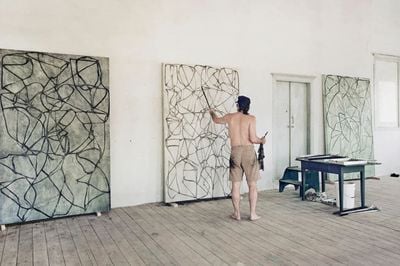
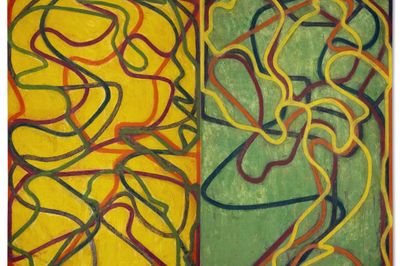
In the 1980s Marden began to incorporate organic, intersecting lines, creating rhythmic patterns over fields of colour. He has been exploring these winding lines ever since, experimenting with blank space, erasure, and references to the natural world. He seeks to create a mystical experience through the creation of elusive abstract spaces. As his many themes and techniques have overlapped, Marden has sought to bring them together in cohesive, often multipart works, which he has described as his ‘summation paintings.’ Among them is The Propitious Garden of Plane Image, Third Version (2000–2006), held in the collection of the Museum of Modern Art in New York, where he had his first comprehensive retrospective in 2006.
In recent years Marden has continued his exploration of the qualities of monochrome. This engagement with muted colours has informed new calligraphic drawings and works on canvas, such as the Nevis Stele paintings (2007–2015), inspired by Chinese stone carvings from the late eighth century. In 2017 he turned his gaze to the expansive possibilities of terre verte (green earth), an iron silicate clay pigment, which he first used in the Grove Group. His new paintings incorporate many different brands of terre verte, each a variation on the indefinable hue. Marden thins his slow-drying paint and applies it gradually to the canvas in many successive layers, leaving a visible residue of the painting process at the lower edge of each canvas.
Courtesy Gagosian

Exhibiting Elsewhere










Explore and Follow Artists Shaping Contemporary Art
A respected voice in contemporary art discourse.
Focusing on ambitious storytelling and insightful art-world commentary. Ocula Magazine publishes in-depth interviews, critical essays and timely analysis on the artists, exhibitions and ideas driving the global art world.
Learn more about Ocula Magazine
Showcasing the best of the art world.
Ocula partners with galleries from around the world to highlight their artists, artworks and exhibitions. Gallery membership is by application and invitation, with each member vetted by an independent panel.
Learn more about Ocula Membership
Specialises in the sale of major artworks.
Led by a team with deep ties to the world’s leading auction houses, galleries and collectors. Ocula’s advisory team offers bespoke services to high-net-worth clients from around the world who are looking to acquire the best of contemporary and modern art.
Learn more about our team and services