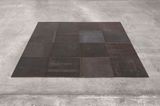
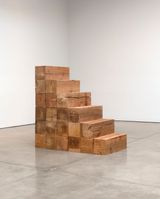
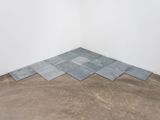
Interested in geometric grids, Carl Andre’s sculpture is characterised by ordering structures like modular systems.
Talking with artist Frank Stella persuaded Andre that sculpture could be linear and abandon height. He realised he could make a type of Brancusi’s Endless Column (1918) horizontal and flat, and extend it using matrixes of machine-cut zinc squares or lines of firebricks, with the work using weight, no adhesive, and featuring only one kind of object. Sometimes they can be walked on. See, for example, 144 Titanium Square (2011), 144 Magnesium Square (1969), Steel Zinc Plain (1969), Equivalent VIII (1966), and Lever (1966).
Characteristics of Art
Andre greatly relates to the ‘working man’ ethos of blue-collar workers, because he spent four years working on the Pennsylvania Railroad as a brakeman and freight conductor. In fact he does not like being called a conceptual artist but sees himself as a sculptor very much concerned with the materiality of what he works with: its mass, substance, shape, and extension.
Andre has stated, ‘I am certainly no kind of conceptual artist because the physical existence of my work cannot be separated from the physical existence of it ... I have a great anger against so called conceptual art because the great beauty of art ... is the simple fact [it] is close to nature, and ... conceptual art is ... not.’
Andre believes in the notion of ‘sculpture as place’: that the environment around a work is an essential part of it. A dramatic example is Stone Field Sculpture (1977), an installation of 36 large ice-age rocks on a lawn in Hartford, Connecticut.
Poetry
Andre’s poetry is concrete in that the word length is carefully controlled, so that stacked groups collectively form shapes on the page: sometimes rectangles, squares, or zigzagging geometric Brancusi-type formations. The content is in the Imagist tradition. Some of his books utilise pages of graph paper.