





CHAO CHUNG-HSIANG
1910-1991, ChinaIn the second catalogue the gallery produced, Alice King introduced Chao Chung-Hsiang, writing: “to Chao, painting was not merely a pictorial representation, but a continuous thought process related to one’s spiritual well-being and outlook on life. He worked tirelessly to ensure that contemporary Chinese painting would become part of the mainstream and not a mere tributary of Western art.”
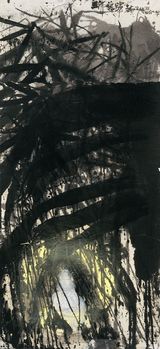
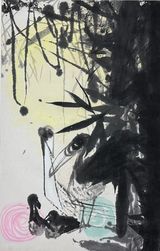
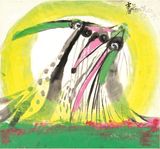
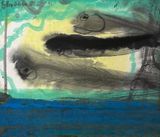
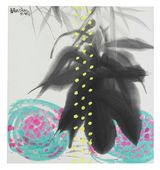
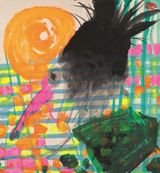
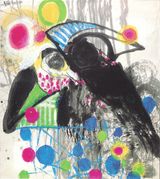
Like Zao Wou-Ki, Chu Teh-chun, and Wu Guanzhong, Chao studied under the renowned artist Lin Fengmian at the National Institute of Art, Hangzhou (currently the China Academy of Art) before graduating in 1939. In 1948, he immigrated to Taiwan, and in 1956 won a fellowship to study in Spain. He toured Paris and Europe before settling in New York in 1958, where he remained for most his life. There, he discovered American Abstract Expressionist art, which inspired him to work conscientiously to achieve a synthesis of East and West. The main subjects of Chao’s work are flowers, fish, birds, the cosmos, and abstraction. In the 1970s, Yin-Yang symbols and hexagrams derived from the ancient Chinese divination text I-Ching began appearing in his paintings, referencing Buddhism, Taoism, and Confucianism. In his paintings, blocks of dazzling fluorescent color sporadically float upon expressive images rendered in rich ink washes. After more than thirty years in New York City, Chao moved to Hong Kong in 1989, then to Chengdu, and finally to Taiwan. He passed away in 1991 at the age of eighty-one.
In 1972, Chao won the New York Creative Artists Public Service Program Award. From 1997-99, his works were exhibited in the important traveling group exhibition, Asian Traditions/Modern Expressions, organized by the Jane Voorhees Zimmerli Art Museum, Rutgers University. His work was also included in China: 5,000 Years, an exhibition held at the Guggenheim Museum in 1998.
Alisan Fine Arts began representing Chao in 1985, and since 1992, the gallery has organized four major solo exhibitions for him, including two traveling shows, one in 1999 at the Zhejiang West Lake Art Museum; Hong Kong Arts Centre; Alisan Fine Arts; Club 21 Gallery in Singapore, and one in 2004 at National Museum of History, Taipei; National Art Museum of China, Beijing; Shanghai Art Museum; Galerie Adler, Paris; Hong Kong Arts Centre. Chao’s works have been frequently exhibited at internationally renowned museums, including the Guggenheim Museum, Zhu Qizhan Art Museum, and Hong Kong Museum of Art. In 2014, Sotheby’s Hong Kong Gallery organized a solo exhibition for the artist. Alisan Fine Arts manages his estate.
Chao’s works have been collected by the Metropolitan Museum of Art, New York; Columbia University, New York; The Art Institute of Chicago, Chicago; National Art Museum of China, Beijing; Shanghai Art Museum, Shanghai; Zhejiang Westlake Art Museum, Hangzhou; Taipei Fine Arts Museum, Taiwan; Hong Kong Museum of Art, Hong Kong; and M+, Hong Kong.
Text courtesy Alisan Fine Arts.


View Chao Chung-Hsiang's Artworks











Explore and Follow Artists Shaping Contemporary Art
A respected voice in contemporary art discourse.
Focusing on ambitious storytelling and insightful art-world commentary. Ocula Magazine publishes in-depth interviews, critical essays and timely analysis on the artists, exhibitions and ideas driving the global art world.
Learn more about Ocula Magazine
Showcasing the best of the art world.
Ocula partners with galleries from around the world to highlight their artists, artworks and exhibitions. Gallery membership is by application and invitation, with each member vetted by an independent panel.
Learn more about Ocula Membership
Specialises in the sale of major artworks.
Led by a team with deep ties to the world’s leading auction houses, galleries and collectors. Ocula’s advisory team offers bespoke services to high-net-worth clients from around the world who are looking to acquire the best of contemporary and modern art.
Learn more about our team and services