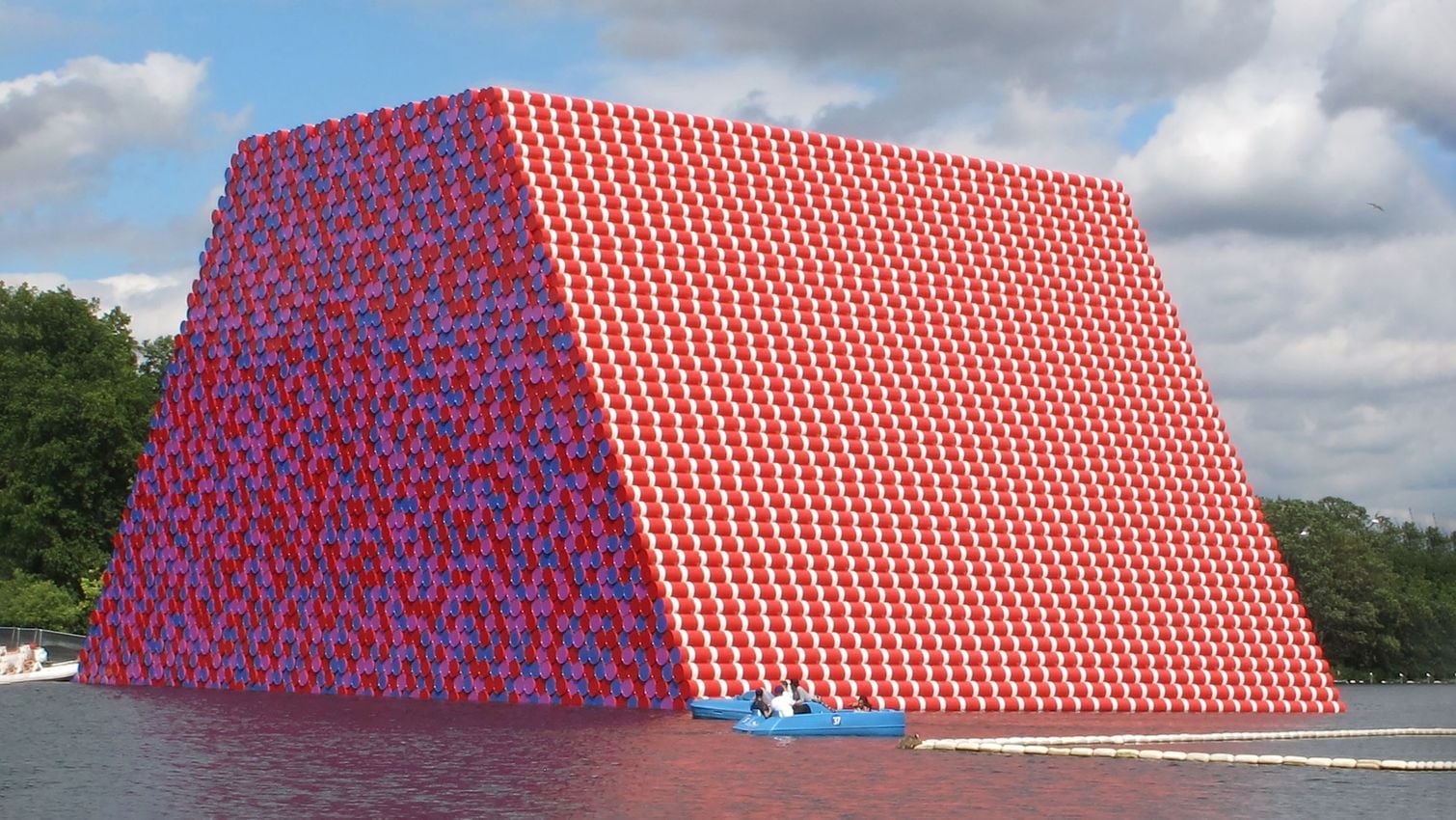
Christo and Jeanne-Claude became recognised in the 1960s, as they experimented with wrapped items and oil barrels made into large-scale installations. For their early collaboration Wall of Oil Barrels — The Iron Curtain (1962), 89 oil barrels were stacked to block access to a street in reference to the Berlin Wall.
The duo conceived of the projects together—Christo drew the sketches, which were sold to fund the installation. Despite the collaboration, Jeanne-Claude insisted the artworks were branded under Christo’s name to simplify business transactions and divert existing prejudice against female artists. She was known as Christo’s publicist and manager, until much later. Today, the massive outdoor installations are credited to both names.
Nouveau Réalisme - Wrapped Objects, New Landscapes
Prompted by the progressive art scene in Paris, Christo started experimenting with common materials and recycled objects, such as bicycles, beer cans, and plastic bottles. He was interested in the objects as physical things—the shape, the texture—more so than their meaning. The scale of the artworks increased with time, while Christo’s obsession with wrapping remained constant.
Christo’s early, small-scale works that experimented with wrapping were inspired by the Nouveau Réalisme movement, which made use of everyday objects and materials adapted into installations. These were influenced by artists like Jean Tinguely and Yves Klein, whose sculptural and kinetic works blur the line between artwork and environment.
Wrapped Coast, One Million Square Feet (1969)
Christo and Jeanne-Claude’s large-scale installations modified existing landscapes and public spaces, integrating the environment. Wrapped Coast, One Million Square Feet (1969) covered the coast of Little Bay in Sydney with a million square feet of erosion-control fabric. The materials and landscape were recycled and returned to their original condition afterwards.
Over the years, the duo successfully wrapped The Pont Neuf, the Reichstag, an air balloon, and living trees. The Gates (2005), an installation of 7503 bright orange gateways along 23 miles of Central Park in New York, took 26 years and $21 million to complete. Its installation took into consideration the root system of adjacent trees and the way pedestrians navigate the city.
Arc de Triomphe
When they first arrived in New York, Christo and Jeanne-Claude contemplated the idea of wrapping two skyscrapers together. The idea originated in Paris in 1961, when Christo made a photo collage depicting a wrapped building in a Parisian square.
A photomontage showing the Arc de Triomphe wrapped was drafted a year later, as the couple rented a room near the monument. The project was soon set aside, as the artists assumed it would be impossible to obtain permission from local authorities.
As Jeanne-Claude once said, ‘Artists don’t retire. They die. ... When they stop being able to create art, they die.’ Jeanne-Claude passed away from a brain aneurysm in New York in 2009. Following Christo’s passing in 2020, L’Arc de Triomphe Wrapped(2021) was unveiled in Paris as an homage to the artists.
Exhibitions and Awards
Christo’s works are held in major collections across the world. The artist received the Praemium Imperiale in 1995, the International Sculpture Center’s Lifetime Achievement in Contemporary Sculpture Award in 2004, and the Vilcek Prize in 2006.
Completed projects include Stacked Oil Barrels and Dockside Packages (1961), Air Package (1966), Wrapped Museum of Contemporary Art (1969), Wrapped Monuments (1970), Valley Curtain (1972), The Pont Neuf Wrapped (1985), Wrapped Reichstag (1995), and The London Mastaba (2018).
Select exhibitions include Christo et Jeanne-Claude: Paris!, Centre Pompidou, Paris (2020); Christo and Jeanne-Claude: Barrels and The Mastaba 1958–2018, Serpentine Galleries, London (2018); and Christo and Jeanne-Claude: The Tom Golden Collection, Biggs Museum of American Art, Dover, Delaware (2017). Further exhibitions have been organised by the Metropolitan Museum of Art in New York (2004), Martin-Gropius-Bau in Berlin (2001), Museum Ludwig in Cologne (1981), and the Institute of Contemporary Art in Boston (1979).
Website and Instagram
Christo and Jeanne-Claude’s website can be found here, and their Instagram can be found here.