






Chun Kwang Young
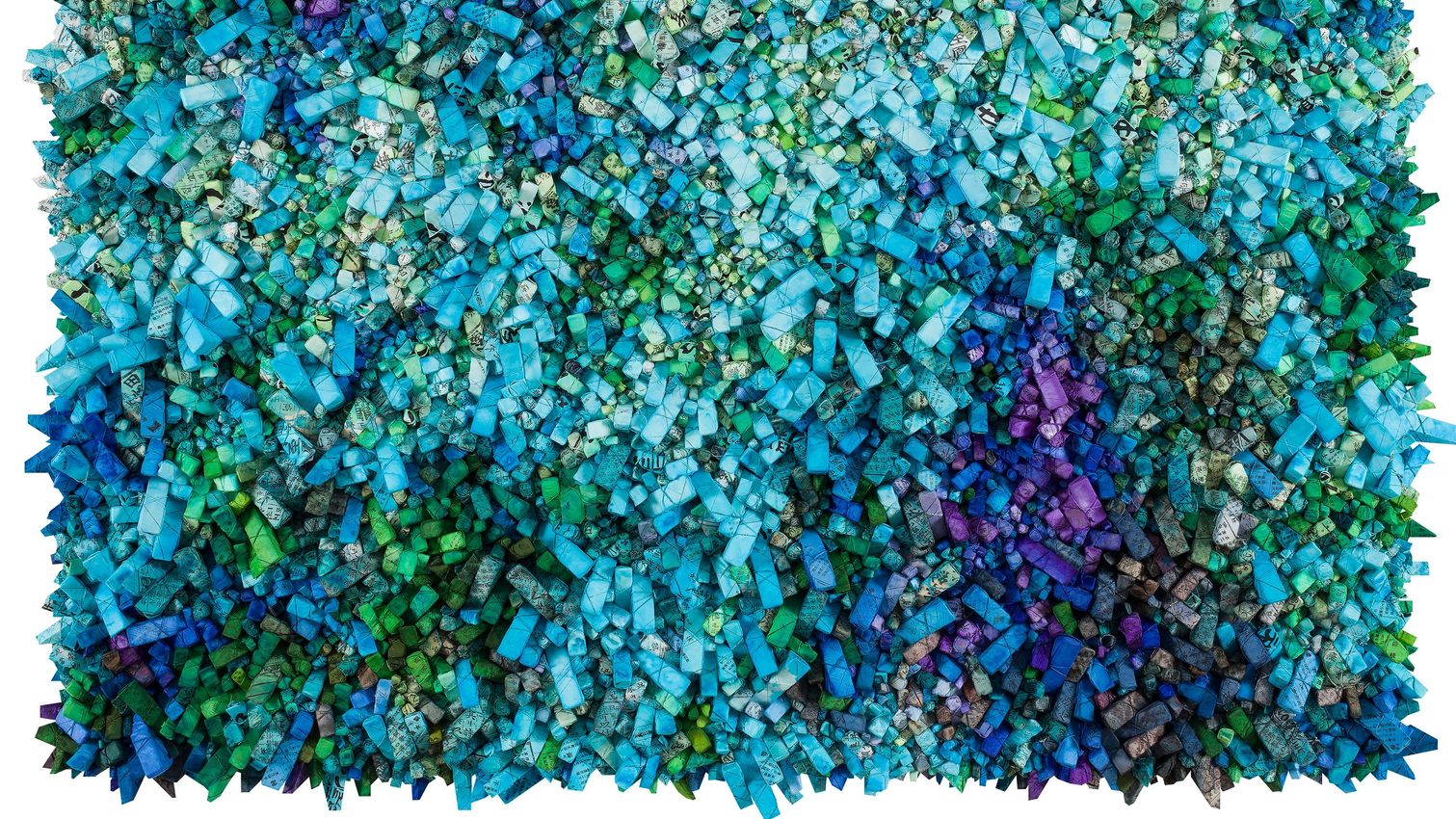
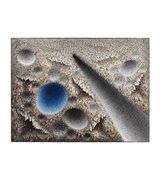
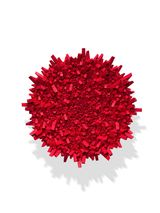
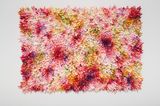
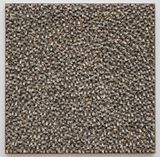
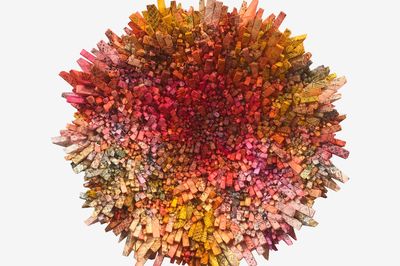
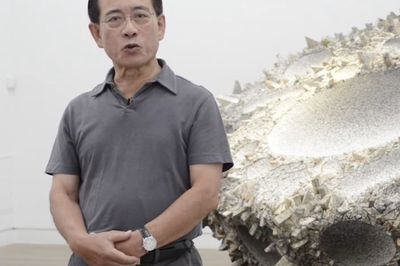
b. 1944, South KoreaChun Kwang Young is a contemporary South Korean artist recognised for his ‘Aggregations’ (1995–ongoing) series of tactile sculptural compositions that are made of multiple minute triangular forms wrapped in mulberry paper. The richly textured surfaces of these ‘Aggregations’ are reminiscent of the stalactites of caves or the moon with its crater-like hollows.
Education and influences
Chun graduated from Seoul‘s Hongik University in 1968, but in 1971 he moved to the United States to undertake a master’s course at the Philadelphia College of Art. There, he was drawn to Abstract Expressionism, which, in his own words, ‘seemed to be the best way to freely express my surprise and sadness at witnessing the huge gap between idea and reality’. Liberated from the rigid rules of traditional art, Chun began to interrogate the medium of painting in works such as ONT-010-73-43 (1973), in which long, expressionist brush strokes of many hues frame the rectangular opening of vivid red in the centre.
Early career
Increasingly dissatisfied with his work Chun returned to Korea in the second half of the 1970s. He continued to make abstract paintings, experimenting with clashing coloured stripes in works such as ONT-085 (1978) or short, stumpy strokes in ONT-093 (1986). However, Chun grew discontented with Abstract Expressionism and sought to find his own unique voice while acknowledging his Korean upbringing.
Use of hanji
A solution came in 1995 in the form of hanji, a Korean traditional paper made from mulberry. The artist developed a process of cutting small modular forms in polystyrene and wrapping them in this paper, which he would then dye with tea or other colouring agents. These he would attach to a support to create assemblages that are now known as part of his signature ‘Aggregations’ series. His use of hanji was inspired by a recollection of childhood memories, when he would visit a traditional apothecary and see little hanji packages—each containing different medicinal herbs—hanging from the ceiling. For Chun, hanji signifies the Korean ethos he wished to convey.
‘Aggregations’
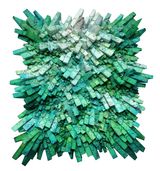
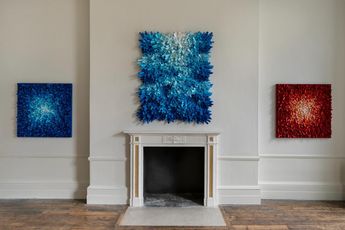
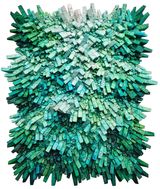
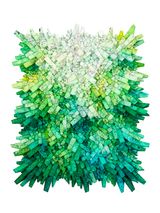
The ‘Aggregation’ works vary in colour, from the monochromatic light brown in Aggregation 95-06 (1995) to shades of cool blue and green in Aggregation 18-AP027 (2018). Chun has also expanded their forms over the decades; in his solo exhibition Collisions: Information, Harmony and Conflict at Sundaram Tagore Gallery, Singapore, in 2019, for example, he presented wall hangings (such as Aggregation 19-JU45, 2019), but he has also presented free-standing sculptures as part of the series in the past. In ‘Aggregations’, each hanji-wrapped piece signifies the basic unit of information, while the Chinese and Korean characters printed on them allude to generations of knowledge.
Exhibitions
In 2009, Chun received the Presidential Prize in the 41st Korean Culture and Art Prize from the Korean Ministry of Culture, Sports and Tourism. Notable solo exhibitions of Chun Kwang Young’s work include:
- Wooyang Museum of Contemporary Art, Gyeongju (2016)
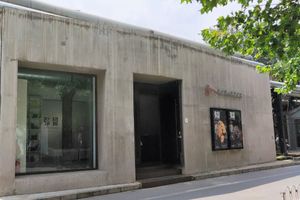
- PKM Gallery, Seoul (2018)
- Brooklyn Museum, New York (2018)
- Chun Kwang Yung: Times Reimagined, Palazzo Contarini Polignac, during the Venice Biennale (2022)
- Time Blossom, Perrotin, Seoul (2025)
Chun Kwang Young FAQs
Where can I view Chun Kwang Young’s artworks in person?
Chun Kwang Young’s works are held in major public and private collections worldwide. Notable institutions include M+ in Hong Kong, the National Museum of Modern and Contemporary Art in Seoul, and the Victoria and Albert Museum in London. His works have been exhibited at prominent galleries such as Sundaram Tagore Gallery, Tristan Hoare Gallery, and Perrotin.
What are Chun Kwang Young’s most notable artworks?
Chun is renowned for his acclaimed ‘Aggregation’ series: freestanding and wall-hung amalgamations of small, triangular forms wrapped in antique mulberry paper, often tinted with teas or pigment. These works explore themes of harmony and conflict.
What themes does Chun Kwang Young explore in his art?
Chun’s work delves into the dynamics of harmony, conflict, and the interconnectedness of living beings. His Aggregation series reflects on the anxieties and uncertainties at the core of human existence.
What materials and techniques does Chun Kwang Young use?
Chun employs a variety of materials and techniques, including wrapping tiny geometric packages in antique mulberry paper and combining them into massive wall-mounted and freestanding assemblages. These compositions are composed of thousands of individual mulberry paper parcels, carefully toned with tea and pigment.
Ocula | 2025
Works at Tristan Hoare Gallery




Recently Exhibited

Exhibiting Elsewhere

Works Elsewhere


















Explore and Follow Artists Shaping Contemporary Art
A respected voice in contemporary art discourse.
Focusing on ambitious storytelling and insightful art-world commentary. Ocula Magazine publishes in-depth interviews, critical essays and timely analysis on the artists, exhibitions and ideas driving the global art world.
Learn more about Ocula Magazine
Showcasing the best of the art world.
Ocula partners with galleries from around the world to highlight their artists, artworks and exhibitions. Gallery membership is by application and invitation, with each member vetted by an independent panel.
Learn more about Ocula Membership
Specialises in the sale of major artworks.
Led by a team with deep ties to the world’s leading auction houses, galleries and collectors. Ocula’s advisory team offers bespoke services to high-net-worth clients from around the world who are looking to acquire the best of contemporary and modern art.
Learn more about our team and services