






DAVID LAMELAS
b. 1946, ArgentinaDavid Lamelas (*1946) is a key figure in the history of conceptual art and experimental film. His nomadic practice comprising film and video, performance, photography, sculpture, installation and drawing is as pioneering as it is complex, eluding tidy categorisation. Works by the Argentina-born artist, who lives between Los Angeles, Buenos Aires and Paris, focus on the viewer’s own perception and critically assess mechanisms of cultural production. Central to Lamelas’s oeuvre is the notion of time and what people make of it.
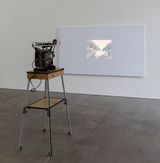
The artist first trained as a sculptor in Buenos Aires, and the earliest phase of his work is characterised by an attempt to leave the material objecthood of the sculptural behind. Having started with extensive, painted sculptures that invaded the traditional viewing space, Lamelas cultivated a practice of non-material sculpture and media-based intervention. Subsequent works including Situacion de Tiempo (Situation of Time, 1967) and Signaling of Three Objects (1968) use a minimalist formal vocabulary to turn the viewer’s spatial and temporal experience into an object in its own right. Engaged in a specific kind of institutional critique, he began to analyse what might be considered exhibition space and developed an exhibition politics based on a radical empowerment of the viewer.
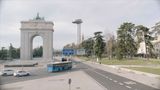
The artist’s unusually peripatetic life between cities including Brussels, Los Angeles, New York, Berlin and Paris began with his move to London in the late 1960s. What followed was a sweeping expansion of his practice and the creation of a now-iconic array of works that explored concrete phenomena of time and zeitgeist: the Time as Activity series (1969–present), for example, an arbitrary capturing of everyday urban life in different cities, is a fusion of film, installation and social sculpture. Another example is Time (1970), a performance involving a line of participants standing in a row, telling the person next to them the time at 60-second intervals. Or the 1974 photo series Rock Star (Character Appropriation), for which Lamelas had himself photographed in a variety of clichéd rock singer poses, exposing the idea of the “star” as at least partially the product of photographic imaging strategies.
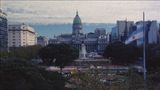
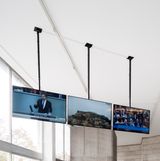
The 1970s marked the beginning of an intensified probing of the modes of film, a medium Lamelas would ultimately prefer for “capturing time.” His 1974 film The Desert People was an experimental portrait of Los Angeles. Other works including The Dictator (1977), Scheherazade (1980) and The Dictator Returns (1984)—made in collaboration with video artist Hildegarde Duane—consisted in improvised, current events-sensitive parodies of soap operas and television journalism. Later films such as The Invention of Dr. Morel (2000) and In Our Time (2018) take up strategies common to period films and documentaries. Lamelas’s cinematic works emulate the attention-grabbing strategies of commercial Hollywood film and criticise them at the same time. His deconstructive approach shatters traditional narrative logics, diverting focus to the gap between “film time” and “real time,” or the time inhabited by viewers watching the film. They absorb the zeitgeist and put the present itself centre stage.
Lamelas’s art bears witness to a radical life experiment. One reason for the difficulty of pinpointing his practice is that it always enters into a critical dialogue with the aesthetic, chronological and geographic conditions of the art system he found at the particular location and time of the work’s creation. His oeuvre has consequently become part of a series of art-historical narratives. Situated in neither centres nor peripheries, and at home in multiple, synchronous spaces, his inimitable work captures an elusive quality of time.
Courtesy Sprüth Magers










Recently Exhibited




Exhibiting Elsewhere



Explore and Follow Artists Shaping Contemporary Art
A respected voice in contemporary art discourse.
Focusing on ambitious storytelling and insightful art-world commentary. Ocula Magazine publishes in-depth interviews, critical essays and timely analysis on the artists, exhibitions and ideas driving the global art world.
Learn more about Ocula Magazine
Showcasing the best of the art world.
Ocula partners with galleries from around the world to highlight their artists, artworks and exhibitions. Gallery membership is by application and invitation, with each member vetted by an independent panel.
Learn more about Ocula Membership
Specialises in the sale of major artworks.
Led by a team with deep ties to the world’s leading auction houses, galleries and collectors. Ocula’s advisory team offers bespoke services to high-net-worth clients from around the world who are looking to acquire the best of contemporary and modern art.
Learn more about our team and services