






DAVID LAMELAS
b. 1946, ArgentinaDavid Lamelas is an Argentine conceptual artist whose five-decade practice spans sculpture, installation, film, video, performance, and photography, grounded in rigorous explorations of time, space, and information. Emerging from the Buenos Aires avant-garde and later based between London, Los Angeles, and Europe, he helped redefine sculpture as a situational, time-based experience and used film to question how media and narrative construct reality.
Lamelas work work sits in leading collections, while current and upcoming exhibitions such as David Lamelas: The Machine at Dia Chelsea (2026–2027) attest to his continuing relevance in contemporary art discourse.
Early Life and Career
Born in Buenos Aires in 1946, Lamelas studied sculpture at the Academia Nacional de Bellas Artes, completing his B.A. in 1966. He was among the youngest artists active in the city’s avant-garde scene centered on the Instituto Torcuato Di Tella, where he helped push Argentine art toward conceptual and experimental practices. Early on, he used formally reduced sculptural and architectural installations to probe the exhibition space itself, treating volume, light, and spatial limits as subjects.
In 1968, after receiving a British Arts Council Fellowship, Lamelas moved to London, where he completed an M.A. in sculpture at St. Martin’s School of Art (1969) and deepened his engagement with European conceptualism. That same year he represented Argentina at the 34th Venice Biennale, introducing works that examined information, media, and institutional contexts to an international audience. By the early 1970s he had relocated for periods to Los Angeles, where exposure to Hollywood cinema and television decisively shaped his move from traditional sculpture toward film, video, and narrative-based installations.
Works, Series, and Methods
Spatial Installations and Early Sculptural Practice
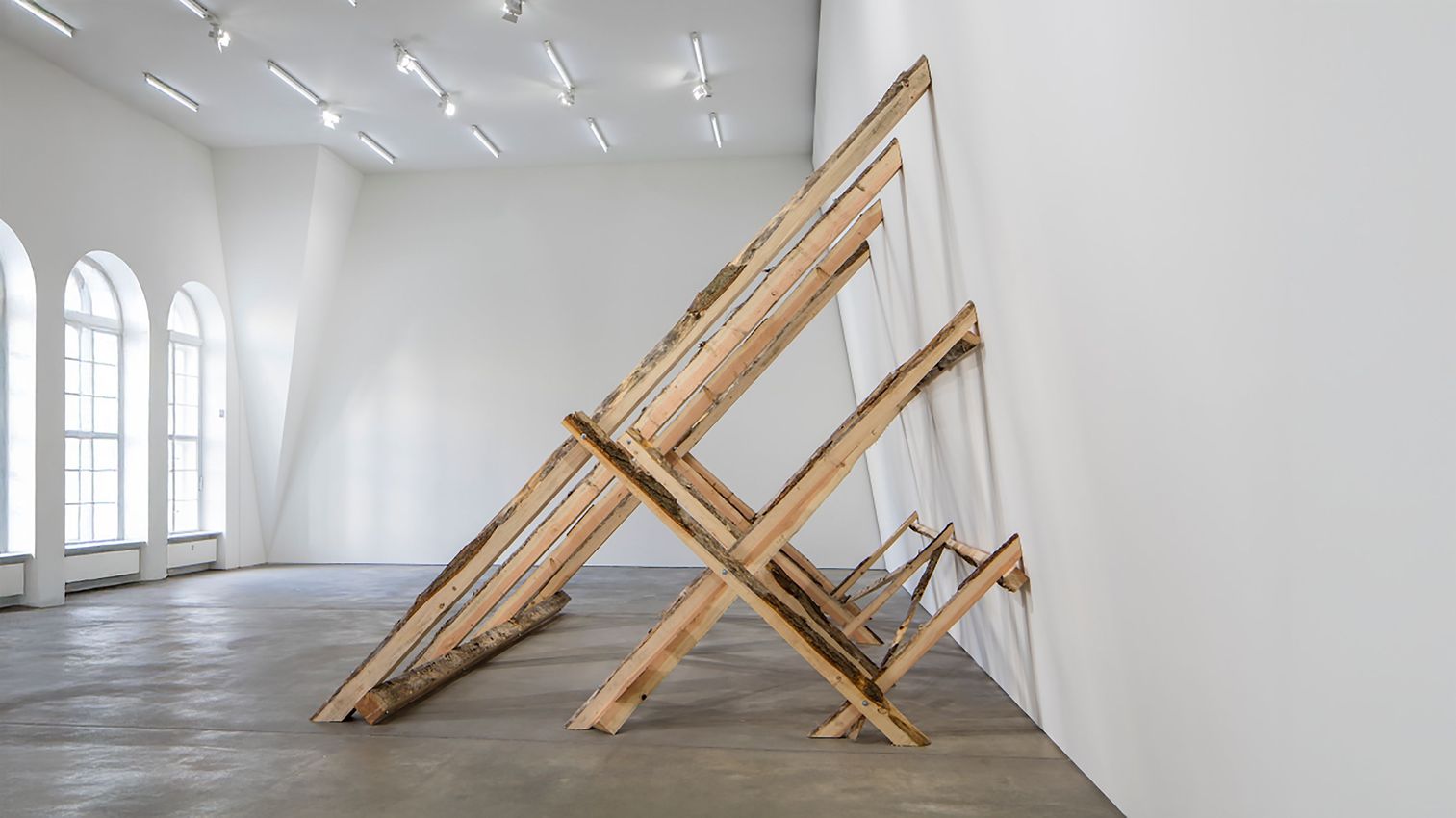
In the mid-1960s, Lamelas developed a body of site-responsive installations that are now seen as touchstones of conceptual sculpture. Works like Situación de cuatro placas de aluminio (Four Changeable Plaques) (1966)—a movable configuration of aluminum sheets—and Limit of a Projection (1967)—a spotlight in a darkened room—focus on the physical conditions of the exhibition space rather than on autonomous objects. These pieces invite viewers to become aware of light, volume, and perception as active components of the work, prefiguring his lifelong interest in time and space as materials.
Subsequent installations, such as Límite de una proyección II (Limit of a Projection II) (1967) and 28 placas ubicadas en dos formas no convencionales (28 Plaques Placed in Two Unconventional Forms) (196667/2013), extend this logic by turning architectural boundaries and geometric arrangements into instruments for measuring and destabilising viewers’ sense of space. These works, now held by Dia Art Foundation, underline Lamelas’s critical role in rethinking sculpture as a situation in time rather than a static form.
Film, Narrative, and “Fake Documentary”
From the late 1960s onward, Lamelas increasingly used film and video to explore how stories, genres, and media conventions structure reality. The multi-channel installation Film Script (Manipulation of Meaning) (1972), first shown at Nigel Greenwood’s gallery in London, combines one film and three slide sequences to dissect how image, sound, and sequencing produce meaning. Shot within the gallery and featuring its staff, the work loops between documentary and fiction, foregrounding the constructed nature of narrative and the institutional frame in which art is shown.
A crucial work in his Los Angeles period, The Desert People (1974) is described by Lamelas as a “fake documentary” following five people travelling to and from a Native American reservation in Arizona. The film intercuts road-movie scenes with talking-head interviews, where four researchers offer divergent accounts of their experience of the Papago (Tohono O’odham) community and a fifth participant, who is Papago, moves between English, Spanish, and his Native language. While the interviews appear convincing, the film’s stylised editing and dramatic ending reveal the influence of television talk shows and Hollywood cinema, ultimately calling into question the reliability of the documentary form itself.
Photography, Performance, and the Image of the Artist
Photography and performance also play central roles in Lamelas’s practice, often blurring lines between personal portraiture, fashion imagery, and media stereotype. The photo series London Friends (1973), produced with a professional fashion photographer, depicts the artist’s acquaintances assuming glamorous poses as if for magazine spreads. These images function simultaneously as intimate portraits and staged fashion photographs, mapping the 1970s London scene while interrogating how identity and celebrity are constructed through images.
His long-running engagement with time as activity is evident in works and exhibitions such as Time as Experimental Activity (1969), which premiered at Kunsthalle Düsseldorf, and the later retrospective A New Refutation of Time, organised as a travelling exhibition in the late 1990s. Across film, video, and performance, Lamelas repeatedly uses duration, delay, and repetition to expose how viewers participate in constructing both the artwork and its narrative frame.
Themes and Context
Throughout more than five decades, time, space, information, and perception have remained Lamelas’s core themes. Early works from the Di Tella years address spatial measurement and architectural limits, while later film and video pieces treat news, cinema, and television as systems that shape public understanding. His projects can be read as ongoing experiments in how information is produced, disseminated, and consumed, whether through a gallery spotlight, a film script, or a staged interview.
Lamelas is often described as a pioneer of Conceptual art whose practice intersects with Minimalism and Pop-inflected strategies but resists strict categorisation. Working nomadically between Buenos Aires, London, Los Angeles, and Europe, he brings questions of displacement, language, and cultural translation into his examination of media and narrative. His work also participates in broader histories of institutional critique, rethinking the role of museums, galleries, and biennials in the production of meaning.
Exhibitions, Collections, and Recognition
Over his career, David Lamelas has been the subject of numerous solo exhibitions and surveys, as well as key group shows that have helped consolidate his reputation as a central figure in post-war conceptual and media art. The major retrospective, David Lamelas. I Have to Think About It (2023—2024), was presented at Fondazione Antonio Dalle Nogare, Bolzano. Earlier solo projects include Life as Activity: David Lamelas (2021) at Hunter College Art Galleries, New York, which focused on his film practice and its relation to sculpture, and exhibitions at institutions such as the University Art Museum, California State University Long Beach, and MALBA, Buenos Aires.
Lamelas has long been recognised by leading museums: MoMA, New York holds, among others, his site-specific installation Corner Piece (1966), currently on view within the museum’s Collection 1940s–1970s displays for an extended period. His works are also represented in collections at Tate, Dia Art Foundation, and other international institutions. Early in his career he received key distinctions such as the British Arts Council Fellowship (1968) and a Guggenheim Fellowship (1993), as well as a DAAD stipend (1998), reflecting sustained recognition across Europe and the Americas.
He has participated in major international exhibitions including the Venice Biennale (notably the 34th edition, where he represented Argentina), and continues to appear in thematic surveys that reassess conceptual and minimal practices on a global scale.
As of 2025–2026, Lamelas’s work is the focus of significant institutional attention, with both solo survey and group exhibitions underscoring his ongoing relevance. David Lamelas: The Machine (6 March 2026–16 January 2027) is being presented at Dia Chelsea, New York by Dia Art Foundation. The show is a a comprehensive survey exhibition and the artist’s first major solo show in New York. It unfold over three parts: a performance series, a presentation of installations and sculptures, and an extensive film programme emphasising key moments from 1965 to the present, including an especially commissioned large-scale installation, Situación de tiempo II (2025), and recently acquired works Límite de una proyección II (1967) and 28 placas ubicadas en dos formas no convencionales (1966–67/2013). As a prelude, Lamelas’s performance 1416 m³ (2014/2026), composed by Gavin Gamboa, was activated in the galleries on 10 February 2026, using sound and voice to map volumetric and metaphysical space. In parallel with the installation presentation, Dia is screening a selection of Lamelas’s films from the mid-1970s to the 2020s in its program space, from 6 March to 30 September 2026, highlighting the scope of his moving-image practice.
David Lamelas FAQs
What is David Lamelas best known for?
David Lamelas is best known for his conceptual installations and films that treat time, space, and information as sculptural material. Key works such as Situación de cuatro placas de aluminio (1966), Limit of a Projection (1967), Film Script (Manipulation of Meaning) (1972), and The Desert People (1974) exemplify his interest in how viewers, media, and exhibition spaces co-produce meaning.
What themes does David Lamelas explore in his work?
David Lamelas consistently explores the experience of time, the architecture of exhibition spaces, and the circulation of information through film, television, and news media. His projects often question how narratives, genres, and institutional frames shape what we perceive as reality, encouraging viewers to reflect on their own role as active interpreters.
Where can I see David Lamelas’s work now?
Currently, David Lamelas’s work can be seen in the survey David Lamelas: The Machine at Dia Chelsea, New York (6 March 2026—16 January 2027), which includes installations, performances, and a film programme, while permanent-collection pieces are on view at institutions such as MoMA and Tate.
How does David Lamelas work ‘The Desert People’ challenge the documentary genre?
The Desert People (1974) adopts the structure of a road documentary and anthropological film but subtly undermines both. By mixing convincing interview segments with stylised road-movie scenes and a deliberately destabilising ending, the film exposes the constructed nature of documentary truth, highlighting how editing and genre expectations shape viewers’ belief in what they see.
Why is David Lamelas important to Conceptual art?
David Lamelas is considered a pioneer of Conceptual art because he shifted the focus of art from objects to contexts, information, and viewer experience, starting in the mid-1960s. His early installations and later media works anticipated key concerns of institutional critique, media theory, and global conceptualism, making him a crucial reference for understanding how conceptual practices evolved between Latin America, Europe, and the United States.
Ocula | 2026














Explore and Follow Artists Shaping Contemporary Art
A respected voice in contemporary art discourse.
Focusing on ambitious storytelling and insightful art-world commentary. Ocula Magazine publishes in-depth interviews, critical essays and timely analysis on the artists, exhibitions and ideas driving the global art world.
Learn more about Ocula Magazine
Showcasing the best of the art world.
Ocula partners with galleries from around the world to highlight their artists, artworks and exhibitions. Gallery membership is by application and invitation, with each member vetted by an independent panel.
Learn more about Ocula Membership
Specialises in the sale of major artworks.
Led by a team with deep ties to the world’s leading auction houses, galleries and collectors. Ocula’s advisory team offers bespoke services to high-net-worth clients from around the world who are looking to acquire the best of contemporary and modern art.
Learn more about our team and services