

FABIENNE VERDIER
b. 1962, FranceFabienne Verdier brings together Western and Chinese art traditions through her abstract paintings and unusual techniques. She creates her own giant brushes and painting tools, hanging them over the canvas, and has also experimented with en plein air and sound compositions.
Early Years
Fabienne Verdier was born in Paris in 1962. She studied at the École des Beaux-Arts in Toulouse but was disenchanted with the programme and moved to China to study calligraphy and traditional painting techniques—a totally different approach to the way she had worked in France. “The masters gave me a piece of white paper and a brush and told me to paint my spiritual view of tree branches,” she has said, talking about the experience. “When I wanted to go out and paint what I saw, they laughed at me. They explained that there’s no good looking at a tree, or a landscape. You must, by force of contemplation, be at one with the thing you are painting. It took me a long time to realise that if I wanted to bring something new to painting, I would have to learn this thousand-year culture.” After 10 years, she returned to France in 1993 (with an illness that meant she only weighed 30kg at the time), moving to a hamlet in the Val d’Oise.
Fabienne Verdier: Artworks
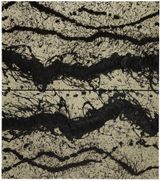
Fabienne Verdier’s art combines principles of Eastern art (spontaneity, unity) with a Western aesthetic of line and abstraction. Returning to France following a decade in China, she used Chinese brush techniques with Western acrylic paints, developing giant horsetail brushes that she hung from her studio ceiling. She later refined this further, adding the “brush” to bicycle handlebars that she could move around to guide it, and developing paint “wells” that could be filled and moved like piping nozzles.
- The Sound Trace series of 2014 came about because of an invitation from the Juilliard School for Fabienne Verdier to work with musicians, allowing the sound to dictate her brushstrokes and creating a dialogue between painting and music that spanned visual art and performance. Verdier used the project as an opportunity to refresh her creative thinking. “The ‘encounter’ with the world of sound was very disruptive, “ she said. “Suddenly, I found myself disagreeing profoundly with my practice as a painter up to now.”
- The Rainbow Paintings series of 78 large-format works came from a project in which Verdier began a dialogue with the Isenheim Altarpiece, painted by Matthias Grünewald around 1516. Verdier was interested in Grünewald’s use of light, and her works portrayed auras of light as seen during the death of stars, likening the end of human life and representations of death as a way of transmitting energy to the living.
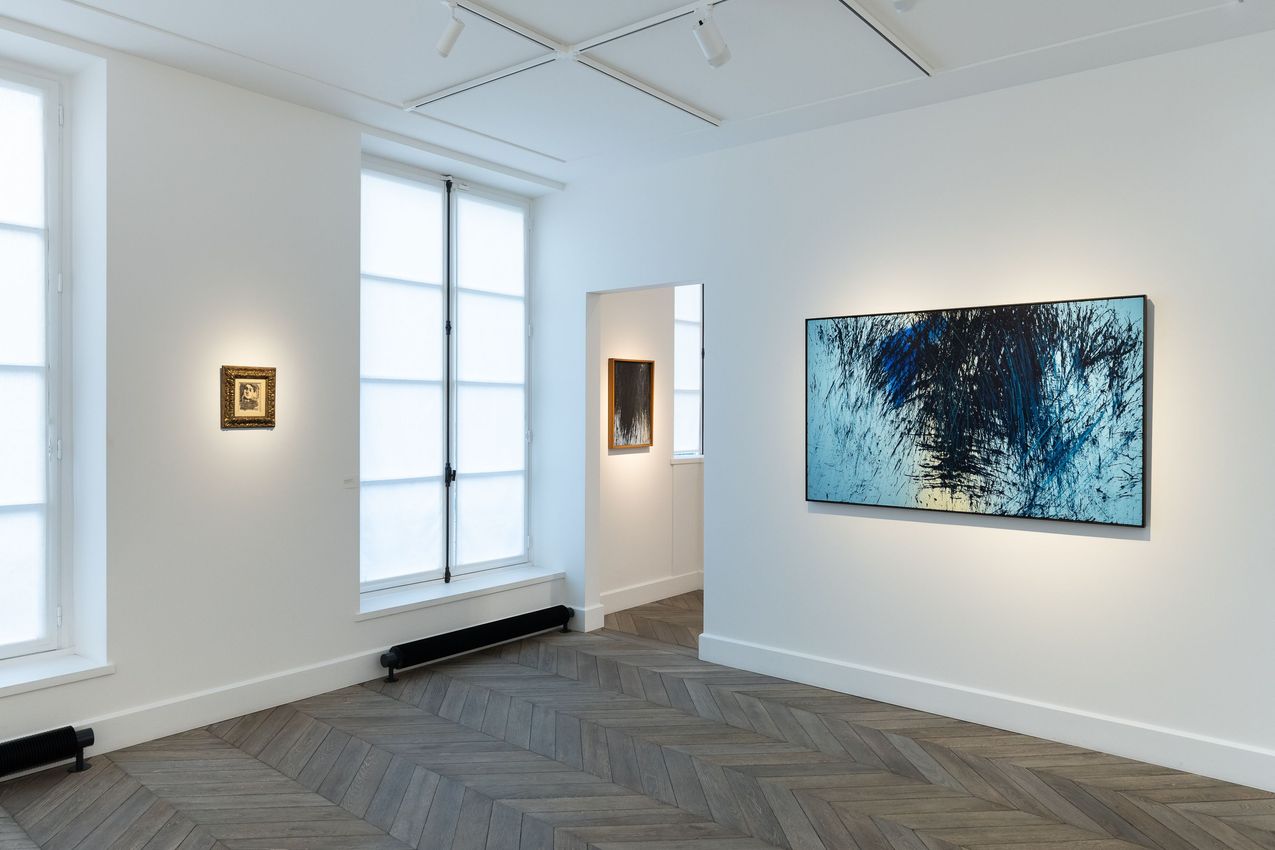
- Verdier’s Walking Paintings, such as 2023’s yellow-and-black Était-ce le printemps ? Était-ce l’été ? and Le rideau des horizons are achieved using a technique where the artist swapped her brush for a piping funnel, through which paint flows as she passed along the canvas, controlling the paint to achieve a long, continuous gesture.
Fabienne Verdier: Select Exhibitions
Select Solo Exhibitions
- Aria, Waddington Custot, London (2026)
- Poétique de la ligne, Domaine de Chaumont-Sur-Loire (2025)
- France Mute, Cité de l’architecture et du Patrimoine, Paris (2025)
- Retables, Waddington Custot, London (2024) (and touring)
- Rainbow Paintings, Valode and Pistre, Paris (2024)
- Energy Lines, Christie’s, Custot Gallery Dubai (2023)
- Fabienne Verdier, Patrick Derom Gallery, Brussels (2022)
- The Song of Stars, Musée Unterlinden, Colmar (2022)
- Sur les terres de Cézanne, Musée Granet and Musée du Pavillon de Vendôme, Aix-en-Provence (2019)
- Vide—Vibration, Galerie Alice Pauli, Lausanne (2017)
- Rhythms and Reflections, Waddington Custot, London (2016) *Energy Fields, Galerie Jaeger Bucher, Paris (2013)
- Abbaye de Silvacane (2004)
- Pacific Cultural Foundation, Taipei (1997)
- Contemporary Art Centre, Hong Kong (1993)
- French Cultural Centre, Beijing (1991)
Select Group Exhibitions
- Hommage à Pierre Dax, Waddington Custot, Paris (2026)
- The Shape of Colour, Waddington Custot, London (2025)
- Sammlung Looser, Kunsthaus Zürich (2024)
- La Mouvance de la Matière, M&M Saradar Collection, Château Lynch-Bages, Pauillac (2023)
- Picasso, Gorky, Warhol: Sculptures and Works on Paper, Hubert Looser Collection, Kunsthalle Zurich (2019)
- Un Autre Œil, d’Apollinaire à Aujourd’hui, Musée de l’Hospice Saint-Roch, Issoudun (2018) (and touring)
- The World Meets Here, Custot Gallery Dubai (2016)
- Flux, Art Plural Gallery, Singapore (2014)
- Not for Sale, Art Centre Passage de Retz, Paris (2011)
- elles@centrepompidou, Paris (2009)
- Expansion Résonance, Galerie Jaeger Bucher, Paris (2008)
- Peintures, Dessins, Sculptures et Estampes, Galerie Alice Pauli, Lausanne (2007)
- Accrochages, Galerie Alice Pauli, Lausanne (2006)
- Oeuvres sur Papier, Galerie Alice Pauli, Lausanne (2005)
- Contemporary Brushstrokes, National Art Museum of China, Beijing (1990)
Further Reading
- Fabienne Verdier’s website
- 2023/2019 interview and studio visit from Christie’s
- Profile in Wallpaper to coincide with Verdier’s exhibitions in Aix-en-Provence
- Conversation in Ocula from 2014
Fabienne Verdier FAQs
Why did Fabienne Verdier go to China?
Speaking to Ocula in 2014, Verdier explained that she had always had an interest in Chinese calligraphy, but that she was “quite disappointed” with the education about Chinese art she received in France. She envisaged that she’d stay in China for a month but ended up living there for a decade. This is because when she enrolled at the Sichuan Fine Arts Institute in Chongqing in 1984, she couldn’t find anyone to teach her calligraphy and traditional ink painting. She met Huang Yuan, but he didn’t want to teach, because he had effectively been sidelined by the Cultural Revolution... until Verdier began to drop off drawings she had made outside his door every day. He eventually agreed to teach her if she stayed for 10 years.
What rituals and practices does Fabienne Verdier use to create her art?
Meditation is a key part of Verdier’s artistic practice: because she moves such large brushes/brush substitutes across the canvas, her every vibration and movement is recorded. She also paints for four or five hours at first light, following up by working on her notebooks, albums packed with drawings and photographs alongside other inspiration from poetry to maths.
How was Fabienne Verdier influenced by Cézanne?
Paul Cézanne painted the landscape around Aix-en-Provence, working en plein air (caught in a storm in 1906, he contracted the pneumonia from which he would die only days later). Sur les terres de Cézanne, Fabienne Verdier’s 2019 exhibition (part of three shows about her work in the area that year), saw her bringing her highly physical painting techniques into the hills of Provence. She created a portable version of her studio apparatus, carried by donkeys, to create “Walking Paintings”. The weather was not kind, and fierce wind and rain made their own mark on the wet paint as it dried. She eventually destroyed those works, but recreating the conditions in the studio with a fan led to the same valleys created in the paint.
Ocula

Explore Fabienne Verdier's Exhibitions On Now

View Fabienne Verdier's Artworks










Explore and Follow Artists Shaping Contemporary Art
A respected voice in contemporary art discourse.
Focusing on ambitious storytelling and insightful art-world commentary. Ocula Magazine publishes in-depth interviews, critical essays and timely analysis on the artists, exhibitions and ideas driving the global art world.
Learn more about Ocula Magazine
Showcasing the best of the art world.
Ocula partners with galleries from around the world to highlight their artists, artworks and exhibitions. Gallery membership is by application and invitation, with each member vetted by an independent panel.
Learn more about Ocula Membership
Specialises in the sale of major artworks.
Led by a team with deep ties to the world’s leading auction houses, galleries and collectors. Ocula’s advisory team offers bespoke services to high-net-worth clients from around the world who are looking to acquire the best of contemporary and modern art.
Learn more about our team and services